Understanding Islamic Religious Ideological Terrorism & consequences post-Easter Sunday attacks – lessons for Sri Lanka & the region
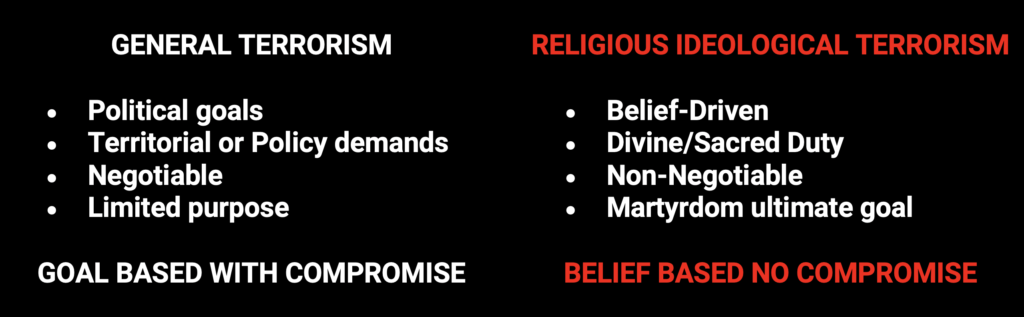
Religious ideological terrorism is widely regarded as one of the most dangerous forms of terrorism, as it is driven by a belief system which justifies violence. Divine command, sacred duty above democratic governance, a worldview of ultimate good versus ultimate evil, spiritual and afterlife reward are key drivers that succeed in drawing people to embrace the ideology. Other terrorist motivations are generally driven by a single goal encompassing political change, policy demands, territorial control, identity protection, separation, class struggle, or restructuring society. Religious ideological terrorism nevertheless encompasses a total belief system that explains life, death, morality, history, defines enemies and leaves no alternative worldview. When this is embedded into a person’s belief system, violence becomes a moral obligation without compromise.
Those who lead religious ideological movements tightly control interpretation of doctrine and are often guided by preachers who can manipulate religious texts to serve ideological objectives, reinforcing obedience and significantly reducing individual moral hesitation.
What makes religious ideological terrorism particularly dangerous is the way it exploits political grievances, social networks, identity crises, geopolitical issues, and psychological vulnerabilities, while reframing violence as a religious solution.
This is how ISIS has succeeded in penetrating social networks, embedding religious ideological narratives into concepts of afterlife reward and martyrdom.
Religious Ideological Terrorism – No “One-Type” Thinking
Extremism is often assumed to be driven by poverty, lack of education, or social marginalisation and desperation.
However, religious ideological terrorism challenges this assumption.
Not only in Sri Lanka’s case, but also in ISIS-linked cases globally, individuals have not emerged from a uniform background. Instead, those involved have come from a mix of ages, education levels, family structures, and social positions.
There is no single identifiable profile.
This diversity makes detection significantly more complex, as such individuals may mingle within social networks posing greater difficulty to identify.
ISIS-Linked Travel Cases:
Reports from international and local sources during the 2013–2016 ISIS peak period indicate that individuals from Sri Lanka travelled to Syria and Iraq in small numbers.
Key characteristics reported include:
- individuals from different socio-economic backgrounds
- some educated or economically stable
- cases involving family-linked travel patterns
- involvement of multiple individuals from the same households in some instances
While exact figures vary across reports, the consistent pattern is diversity.
This challenges the assumption that economic deprivation alone explains radicalisation.
Instead, the data points toward:
- ideological exposure
- identity-based motivation
- social or familial influence networks
- The Zahran Group: Localisation of Global Ideological Influence
The Easter Sunday attacks represent a shift from external travel patterns to the local operationalisation of extremist ideological influence.
The group led by Zahran Hashim demonstrated:
- coordinated multi-site execution
- small-cell organisational structure
- ideological framing influenced by global extremist narratives associated with ISIS
- recruitment through close social and community networks
- the ability to maintain operational secrecy over a sustained period leading up to the Easter Sunday attacks
This indicates a high level of internal cohesion and compartmentalisation within the group, where knowledge of the full operational plan was likely limited to a small number of core participants.
Importantly, this was not an isolated or spontaneous structure, but one that reflected gradual ideological consolidation over time.
However, available evidence does not support the idea of a single external command structure controlling every aspect of the operation.
Rather, it reflects a hybrid pattern seen in modern terrorism:
- local agency combined with ideological influence
- self-radicalised elements reinforced by external narratives
- The “Varied Cluster” Problem in Radicalisation
One of the most significant findings in global terrorism research is the emergence of heterogeneous extremist cluster.
These clusters may include:
- young individuals and older adults
- educated and less educated participants
- economically stable and economically struggling members
- individuals linked by family, friendship, or community ties
This diversity creates several security risks:
- Low Predictability
No single demographic indicator can reliably identify risk.
- Network-Based Spread
Radicalisation can move through trust-based networks rather than visible recruitment channels, making it significantly more difficult to detect.
- Role Flexibility
Different individuals perform different roles—ideological influence, logistical support, funding, or operational participation.
- Social Embeddedness
Some individuals remain socially integrated moving among non-Muslim circuits, making detection more difficult.
- How Influence Operates in Modern Radicalisation Networks
Modern extremist influence does not always rely on visible propaganda or overt recruitment. Research in terrorism and social psychology highlights several mechanisms:
- Identity reinforcement:Individuals adopt a worldview that provides meaning, purpose, or moral certainty.
- Group validation:Beliefs are strengthened through close social approval loops (family, peers, trusted figures).
- Gradual normalisation:Extreme ideas become acceptable over time through repeated exposure.
- Echo environments:Online and offline channels reinforce a single narrative without alternative.
This process does not require mass recruitment—small interconnected clusters can be sufficient to produce high-impact outcomes.
Early Warning Signs of Radicalisation to watch out for
- behavioural withdrawal
- ideological rigidity
- secrecy in communication
- rejection of alternative views
- moral justification of violence
- sudden identity transformation
Role of Online and Transnational Platforms to watch out for
- algorithmic exposure
- encrypted platforms
- cross-border propaganda flow
- content reinforcement loops
- Why “Hidden Appearance” Is a Security Challenge
A key feature of varied clusters is that individuals may not display uniform external indicators of radicalisation.
Some may appear:
- socially stable
- economically functional
- academically capable
- or deeply embedded in normal community life
This creates what security studies describe as visibility gaps:
outward normalcy coexisting with internal ideological transformation.
This is not unique to Sri Lanka, but a documented challenge in global counter-terrorism.
- The Broader Security Implication
The combination of ISIS-linked travel history and locally evolved extremist networks suggests a long-term structural challenge:
- Ideological influence can persist beyond territorial defeat of groups like ISIS
- Radicalisation pathways are multi-layered rather than linear
- Family and social networks can amplify ideological transmission – potential attackers can remain hidden as diplomats, businessmen, politicians, academics, activists, university students – living normal lives but preparing for an extremist attack. Note: Behavioural and ideological concealment within normal social functioning, not that any profession or social group is inherently linked to extremist activity.
- Risk cannot be assessed using single-factor models (poverty, education, or religion alone)
Structural Gaps in Prevention and Intelligence Response
- fragmented intelligence systems
- delayed threat escalation
- lack of behavioural mapping
- siloed institutional response
- over-reliance on demographic profiling
Community-Level Prevention and Early Detection
- family awareness role
- education sector role
- community reporting systems
- religious/community leadership engagement
- early intervention pathways
Disengagement and Rehabilitation
- psychological disengagement process
- rehabilitation frameworks
- reintegration challenges
- importance of non-stigmatising approaches
- risk of relapse if unmanaged
Policy Lessons for Sri Lanka and the Region
- move from profiling → behavioural analysis
- strengthen intelligence coordination
- improve early warning systems
- address ideological transmission pathways
- focus on network disruption rather than identity categories
The real threat lies in the fact that ideological radicalisation does not always produce visible attackers at early stages. This makes reliance on appearance-based suspicion ineffective, and requires a shift toward behavioural, communicative, and network-based risk detection into the national security apparatus.
Public Awareness and Community Vigilance
Public awareness is an important complementary layer in preventing extremist violence. However, this does not involve identifying individuals based on appearance, profession, or social identity. Instead, it focuses on recognising behavioural changes and risk-related patterns over time.
Communities should be aware of:
- sudden and unexplained behavioural withdrawal
- extreme ideological rigidity and rejection of alternative views
- increasing secrecy in communication and associations
- justification of violence in moral or religious terms
- significant identity shifts accompanied by isolation from previous social networks
Early awareness mechanisms are most effective when supported by:
- responsible community reporting channels
- family-based early intervention awareness
- education and institutional awareness programmes
- cooperation between civil society and security structures
The objective of public awareness is not to create suspicion within society, but to strengthen early identification of risk behaviours that may indicate religous ideological radicalisation pathways.
The security challenge going forward is not identifying a “type” of individual, but understanding how influence moves through diverse and often invisible social clusters and how national security can be protected from this secret network of varied clusters.
Prevention must be prioritized. Early behavioural detection, intelligence integration, and community-level awareness must supercede over post-incident response mechanisms.
Shenali D Waduge