Was there really a Prince Vijaya & did he arrive in Sri Lanka?
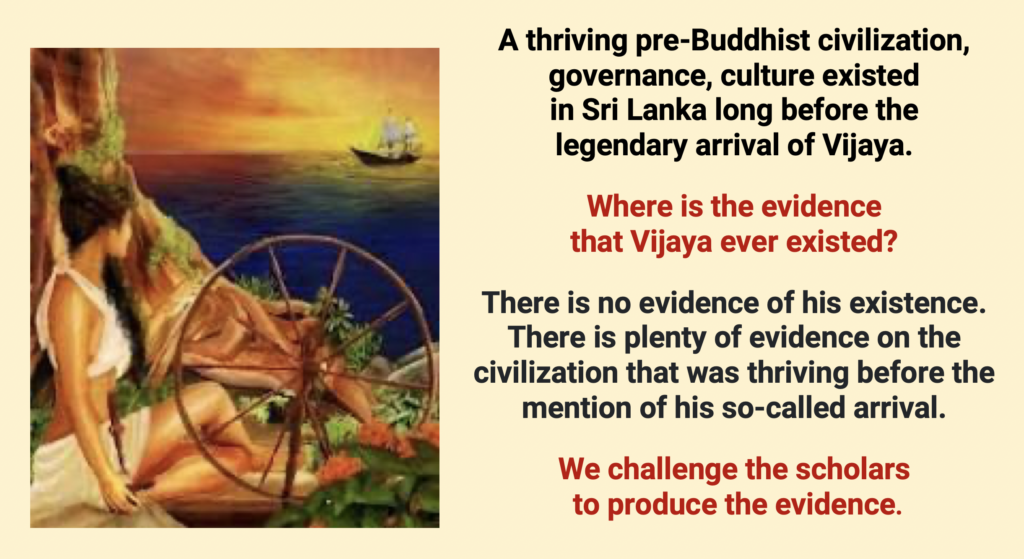
Sri Lanka reveres the Mahāvamsa as its foundational chronicle — and rightly so. Without it, much of our early history would be lost to time or victim of fake narratives as seen in the present. Yet reverence must never replace reasoning. Respect must not suspend inquiry— especially when the figure at the heart of the story, Prince Vijaya, appears at the intersection of myth, politics, and symbolic storytelling.
One figure sits at the heart of our origin story:
Prince Vijaya — the supposed founder of the Sinhala people.
And yet, when we examine this story carefully, profound questions emerges:
- Did Vijaya exist?
- Was he truly a prince?
- Where are the Indian texts to support that his father ruled as a king
- Where is his administration recorded?
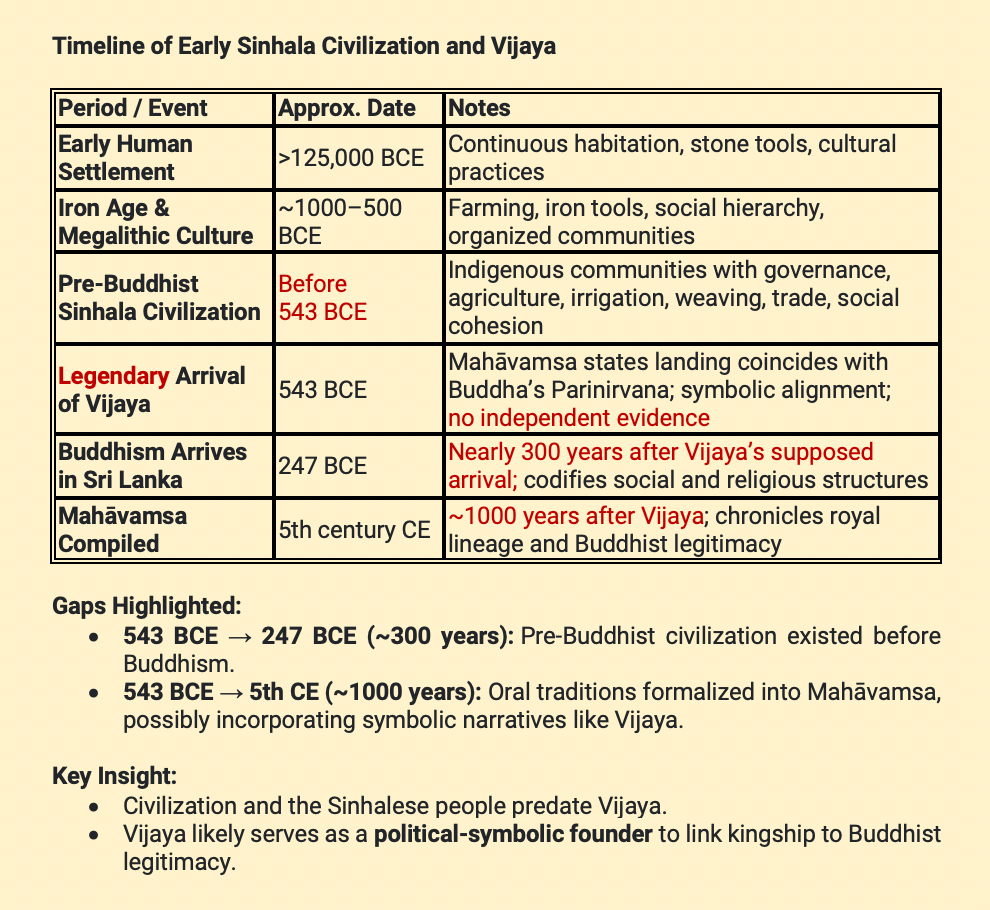
- And crucially, how does this narrative align with the historical fact that Buddhism, which the Mahāvamsa itself frames as the civilizational anchor, only arrived in Sri Lanka centuries later around 247 BCE with Mahinda, nearly 300 years after Vijaya’s supposed landing in 543 BCE?
- This raises the question: was the story of Vijaya retroactively constructed to link indigenous kingship to Buddhist legitimacy?
What if Vijaya never existed — not as a real historical person, but only as a necessary political idea?
How could Vijaya have “found” the Sinhalese when there is no evidence of Sinhalese communities, language or culture where he came from.
So he has no lineage to the Sinhalese.
This is not an attack on the Mahāvamsa. It is a deeper reading of it
If the story of Vijaya was symbolic, does this mean the Sinhalese people themselves only began with Buddhism?
Far from it.
Archaeology, anthropology, and early chronicles show that the Sinhalese — as a distinct population with language, culture, and social organization — existed centuries before the arrival of Buddhism.
Understanding this is crucial: it establishes the continuity and sovereignty of the people independent of any mythical founder.
Some may next ask:
how do we know these communities were ‘Sinhalese’?
While the term ‘Sinhalese’ as an ethnic label comes later, archaeology, language evolution, and cultural continuity clearly link these pre-Buddhist populations to the ancestors of the modern Sinhalese.
Practices such as irrigation, weaving, local governance, and settlement continuity indicate a population evolving not imported from elsewhere.
Buddhism later codified and expanded their social and religious framework, but it did not create the people themselves. The Sinhalese people already existed.
Thus, even if Vijaya was never a historical figure, the Sinhalese people already existed as a thriving population, managing land, producing culture, and forming local governance.
Kuveni, weaving and ruling her territory, embodies the complexity and sophistication of pre-Buddhist Sri Lankan civilization.
Another critical point emerges when we consider Kuveni.
If she was the ruling queen of her territory, this implies there was no male founder or dynastic father figure to anchor the Sinhalese lineage.
Could this absence have been a reason for creating Vijaya?
By inventing a male prince from India, the Mahāvamsa could provide:
- A patriarchal founder to legitimize kingship in a male-centric royal framework
- A symbolic connection to North Indian Aryan-Buddhist lineage
- A narrative that aligns the founding of the Sinhalese people with religious milestones like the Buddha’s Parinirvana.
In this sense, Vijaya may have been less a historical person and more a literary and political construct, designed to reconcile the reality of female leadership with the need for a male dynastic narrative.
While some may argue that Kuweni was not a direct genealogical ancestor of the Sinhalese, Kuveni represents the indigenous population from which the Sinhalese later emerged, inheriting their social organization, agricultural practices, and cultural skills.
Kuveni’s story illustrates that the Sinhalese did not need a foreign prince to become a people; their civilization evolved naturally, and Buddhism later became a civilizational anchor, solidifying but not creating their identity.
Kuveni, as a ruler and organizer, had children — yet their line fades from the chronicles. We need to understand that there are likely to have been leaders before her who are now lost to history.
The Mahāvamsa, however, chooses to spotlight Vijaya and his symbolic descendants. This suggests that the chroniclers were more interested in crafting a political and religious narrative than preserving local genealogies that existed before Kuweni.
The Sinhalese people, and their civilization, existed long before any legendary prince.
If the people already had governance, trade, agriculture, and social cohesion, why was Vijaya introduced?
Perhaps not to found a people, but to create a narrative anchor linking indigenous kingship to Buddhist legitimacy — a literary tool, not a historical necessity.
The civilization that existed before so-called Vijaya’s arrival
- Archaeology
Settlements at Anuradhapura, Aligala, Mantai, and other prehistoric sites show continuous human habitation from >125,000 years ago.
Iron tools, farming implements, and early urban planning predate Vijaya by centuries.
Megalithic culture (dolmens, stone burial sites) indicates social hierarchy and organized communities.
- Language and Culture
Sinhala language evolved from Prakrit, likely influenced by northern India, but local forms were already developing before widespread Buddhist influence.
Oral traditions, weaving practices (Kuveni), and local governance indicate organized social structures.
- Early Political Structures
Before Buddhism, there were local chieftains and tribal leaders (like Kuveni) who managed land, agriculture, and trade — showing political continuity.
These communities had territorial and cultural cohesion, which later Buddhist kingship codified, but did not invent.
The Thousand-Year Silence
According to the Mahāvamsa, Vijaya landed in Sri Lanka around 543 BCE.
But the Mahāvamsa itself was composed around the 5th century CE.
That is a time gap of nearly 1,000 years — plenty of time for oral legend, political need, and symbolic storytelling to crystalize into the ‘perfect prince’ narrative.
There are:
- No contemporary inscriptions
- No archaeological records
- No Indian chronicles
- No foreign accounts
- No material evidence
to independently verify Vijaya’s existence or even that of his father or forefathers.
For comparison:
- We possess inscriptions, coins, trade records, and archaeological remains for rulers who lived hundreds of years later, yet not a single contemporary trace of Vijaya exists.
- How did the name “Vijaya” travel unbroken across a millennium of oral memory — in a pre-print, pre-archive world — without distortion, duplication, or transformation?
That alone should make us pause and wonder.
Could it be that the name “Vijaya” was created or selected to serve a political purpose centuries later, rather than faithfully transmitted from history?
With the manner stories are churned in the present – we cannot rule out this possibility, can we?
We need a eureka moment!
The story of Vijaya is almost too perfect.
- He is the son of a lion-slayer — a universal heroic archetype.
- His name, Vijaya, literally means “victory”.
- He arrives on the exact day of the Buddha’s Parinirvana — a deeply symbolic alignment. (ironically compared to the manner Prabakaran created the TNT on the same day as Sri Lanka’s Republican Constitution – 22 May 1972)
- His landing marks the birth of kingship, civilization, and order.
- Just as modern political actors sometimes use symbolic dates or acts to create legitimacy, the Mahāvamsa may have used Vijaya as a retroactive symbol, aligning the founding of kingship with cosmic or religious milestones rather than recording a literal historical event
We must be wise enough to fit the puzzle together critically, using evidence and logic, and not dismiss ancient documents merely to serve modern narratives or ideological agendas.
Vijaya’s landing is meant to mark the birth of kingship, civilization, and order — a classic marker of foundation myth rather than messy human history.
Every detail aligns with symbolic timing and moral-political messaging, suggesting careful design.
Every civilization has them:
- Rome had Romulus
- Persia had heroic progenitors
- India had divine lineages
- China had Yellow Emperors
Sri Lanka, too, needed a sacred beginning.
— was the story of Vijaya a created one to fit this purpose?
The Political need for Vijaya
By the 5th century CE, Sri Lanka had become a Buddhist theocratic state.
Kingship needed:
- Sacred legitimacy
- Moral authority
- Civilizational pedigree
- Connection to the Buddha’s world
Notice the gap:
Vijaya is placed centuries before Buddhism actually arrived (3rd century BCE). Could this timing have been deliberate — a way to retroactively link indigenous kingship to Buddhist cosmology?
Why did the author of the Mahavamsa omit, the indigenous reality of Kuveni, her people, and the generations before and after her was already fully organized, culturally rich, and politically functional. They had agriculture, weaving, trade, irrigation systems, and social hierarchy — a civilization capable of sustaining itself.
So why were they not fully represented in the Mahāvamsa as the true originators of the Sinhalese?
Is it because the chroniclers needed a symbolic ancestor to sanctify kingship, unify the narrative, and align the story with religious and cosmic milestones — rather than merely recording the historical, indigenous continuity that already existed?
Fascinating thoughts!
We must also ask: who wrote the Mahāvamsa, and why?
Was it purely a monk’s personal record, or was it composed under royal direction to serve a political and religious agenda? Likely both.
The chronicler curated events, selected which stories to highlight, and shaped narratives — like that of Vijaya — to legitimize kingship, reinforce Buddhist authority, and create an unbroken civilizational pedigree.
Recognizing this intent allows us to read the text critically: not as literal history, but as a carefully crafted moral and political narrative but not to dismiss or disregard it.
Vijaya solves multiple political problems at once:
- He provides a founder king
- He links Sri Lanka to North Indian Aryan-Buddhist lineage
- He sanctifies territory
- He establishes divine timing
- He constructs an unbroken royal genealogy
In short:
Vijaya solves multiple political problems at once, not necessarily by existing as a real person, but by providing a symbolic anchor for the state.
In short: Vijaya is the perfect political ancestor — designed, not discovered
Which raises the unsettling question:
Was Vijaya discovered — or designed?
What If Vijaya is a Name, not a Man?
What if “Vijaya” was not a person, but a title?
Across ancient civilizations, founders are often named:
- “The Victor”
- “The Conqueror”
- “The Chosen”
- “The First”
“Vijaya” fits perfectly into this pattern.
Rather than a historical prince, Vijaya may represent the moment when local leadership was reorganized into a centralized Buddhist kingship model.
In other words:
Could “Vijaya” version have been used to symbolize a political transformation, rather than any physical arrival.
The Deeper Question we avoid asking
If Vijaya did not arrive from India, then something more profound emerges:
Sri Lanka’s civilization was already flourishing: human settlements, agriculture, iron technology, and urban planning long predated Vijaya.
These are facts that no one can deny & is backed by evidence.
Archaeology already supports this:
- Continuous human settlement for over 125,000 years
- Advanced irrigation systems
- Iron technology
- Urban planning
- Megalithic cultures predating Vijaya by centuries
Kuveni, weaving, ruling, and managing her polity, embodies the reality of local agency, social organization, and an active civilization — demonstrated that governance, technology, and culture did not require imported legitimacy or foreign founders.
These two facts by themselves underlines that the Mahāvamsa story may not have reported a historical arrival, but crafted a moral-political origin myth.
So why insert an external founder?
Because civilizations once believed that greatness must come from elsewhere.
But what if Sri Lanka’s greatness rose from within?
Rethinking Origins is not Rejection — it is Maturity – It is what we need to regain our lost pride.
To question Vijaya is not to reject the Mahāvamsa.
It is to read it intelligently — as a civilizational text, not a literal historical record — and certainly not as an opportunity for foreign-funded NGOs, activists, or ideologues to exploit it to cast doubt on Sri Lanka’s indigenous heritage or political agency.
The Mahāvamsa preserved:
- Royal chronologies
- Political transitions
- Religious developments
- Cultural memory
This is a far cry from histories that rely only on myths.
Mature civilizations do not fear questioning their beginnings.
They refine them.
Perhaps the most revolutionary shift in Sri Lankan thinking would be this:
THE SINHALESE do not descend from Vijaya.
Vijaya may have been invented, but the people were real.
Vijaya descends from us — as a story created to explain who we already were.
And when a civilization begins to see itself not as imported, but as indigenously evolved, something profound happens:
It stops looking outward for validation, and begins standing firmly on its own soil.
The most revolutionary shift in Sri Lankan historical thinking is to recognize that the Sinhalese do not descend from Vijaya; rather, the story of Vijaya descends from the people themselves.
By seeing the origins of governance, culture, and civilization as indigenously evolved, we reclaim our own and understand Sri Lanka’s history as continuous, self-legitimizing, and independent — a narrative that no foreign script or retrofitted legend can overwrite
This is the moment to rethink the very roots of our national imagination
I am not a historian or archaeologist.
This article does not claim to rewrite history, but to ask practical, evidence-based questions about the story of Vijaya and the origins of the Sinhalese people.
I invite scholars, historians, and archaeologists who maintain that the Sinhalese descend from Vijaya to present contemporary evidence — inscriptions, coins, archaeological findings, or historical texts — that can independently verify his existence.
Until such evidence is produced, it is reasonable to consider that the Mahāvamsa may have crafted Vijaya as a symbolic ancestor, while the Sinhalese civilization and identity evolved indigenously, long before any mythological arrival.
Let this serve as an invitation for serious scholarly debate, not a dismissal of cultural memory.
Shenali D Waduge