When Sri Lanka laughs at the FBI, RAW & MI6: How Sri Lanka’s Government is turning Foreign Intelligence findings into a National Joke
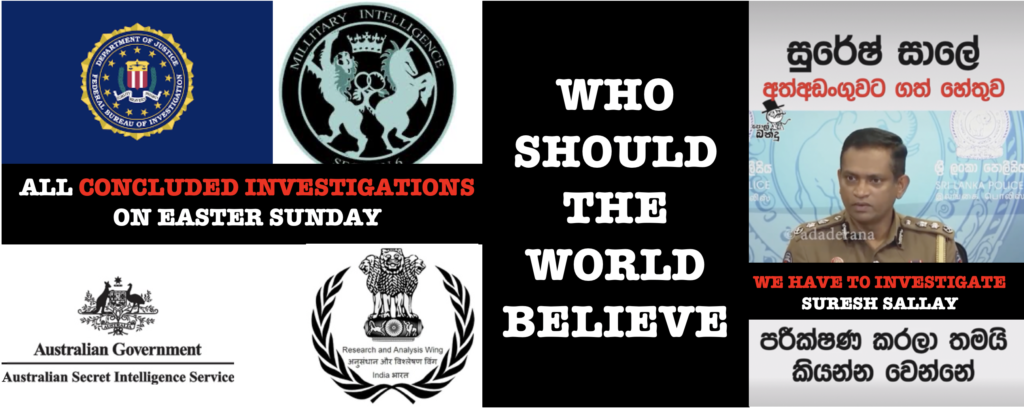
In the aftermath of the Easter Sunday terror attacks, intelligence agencies from the United States (FBI), India (RAW), the United Kingdom (Scotland Yard), and Australia (ASIO) conducted extensive investigations into the origins, execution, and failures surrounding the 21 April 2019 massacre.
Their findings revealed beyond doubt that the attacks were executed by Islamist extremists and enabled by catastrophic institutional failure – not by Sri Lankan military intelligence
Yet in 2026, Sri Lanka’s government and police appear determined to publicly ridicule, contradict, and invalidate these foreign intelligence conclusions by arresting individuals never named in any international or domestic reports.
This is no longer merely a domestic legal controversy.
It has become a diplomatic embarrassment for these countries.
What did Foreign Intelligence agencies actually conclude?
Despite differences in intelligence culture and doctrine, all foreign investigations reached the same foundational conclusions:
-
Ideological driver: Islamist extremism
The attacks were driven by:
- radical Islamist ideology
- extremist indoctrination
- international jihadist influence
- transnational terror coordination
-
Advance warnings were issued
Indian intelligence issued:
- precise alerts
- names
- locations
- target indicators – weeks before the attack.
-
Catastrophic institutional failure
The massacre was made possible due to lack of:
- threat assessment after warnings
- inter-agency coordination
- political leadership response
- operational enforcement
-
No evidence of state conspiracy
Not one foreign agency concluded:
- Sri Lankan intelligence engineered the attack
- Military intelligence facilitated the attack
- Any officer directed extremist operations
This is a key observation.
Not a single foreign intelligence or law-enforcement agency — including the FBI, Scotland Yard, Indian NIA, Australian Federal Police or US State Department — has ever named, implied, or suggested any role by Maj. Gen. Suresh Sallay or any Sri Lankan intelligence conspiracy in the Easter Sunday attacks.
If FBI + Scotland Yard + NIA + AFP all found Islamist terror networks,
but Sri Lanka alone invents an intelligence conspiracy,
Sri Lanka is effectively ridiculing the world’s most powerful intelligence agencies.
-
Responsibility lay with institutional paralysis – no coordination
The disaster resulted from:
- political interference
- command dysfunction
- bureaucratic paralysis
- security sector collapse – not intelligence failure.
Nowhere in any foreign assessment does the name of Maj. Gen. Suresh Sallay appear.
Yet today, Sri Lanka’s police have arrested him — effectively announcing:
“The FBI, RAW, MI6 and ASIO all got it wrong. We alone know the truth.”
Arrest First — Evidence Later: Institutional Humiliation
The farce deepened when police media spokespersons declared following the arrest:
“He was arrested due to evidence.”
When journalists asked what that evidence was, the reply was:
“We must investigate and find out.”
Sri Lanka has now created a new global standard of criminal procedure:
Arrest first. Look for evidence later.
This is not investigation.
This is institutional humiliation.
And by extension, diplomatic humiliation — because this arrest directly contradicts the findings of multiple foreign intelligence services.
How Governments Quietly Insult Foreign Intelligence Agencies
Diplomatic Fallout: When Intelligence Becomes Diplomacy
Foreign intelligence cooperation is built on trust, confidentiality, and institutional respect. When a host country publicly contradicts, disregards, or ridicules partner intelligence findings, the consequences are immediate and silent:
- Reduction of intelligence-sharing
• Downgrading of threat briefings
• Curtailment of classified cooperation
• Withdrawal of embedded advisory teams
• Strategic distancing by foreign defence missions
This is how nations are quietly isolated inside the global intelligence ecosystem.
No foreign agency will openly protest.
Instead, cooperation is silently reduced — and the country is left blind.
Sri Lanka is now walking directly into this intelligence isolation trap.
Foreign intelligence agencies do not issue findings lightly.
Every conclusion:
- passes multi-level verification
- undergoes forensic scrutiny
- is reviewed through legal, operational and diplomatic filters
When Sri Lanka proceeds to arrest individuals explicitly excluded from those findings, it sends a clear international message:
“Your intelligence assessments are irrelevant.”
- No intelligence service welcomes such public contradiction. It is a slap to their findings.
- No diplomatic mission tolerates such institutional disrespect.
This path inevitably invites quiet diplomatic pressure — not through statements, but through back-channel consequences and this means more trouble for Sri Lanka.
Criminalizing Intelligence Tradecraft: Strategic Suicide
Every intelligence agency on earth infiltrates extremist groups.
This includes:
- CIA
- MI6
- Mossad
- RAW
- ASIO
They:
- cultivate informants
- embed operatives
- penetrate terror cells
- manipulate extremist networks
If such infiltration is retroactively criminalized, every intelligence service on earth becomes legally paralysed.
By attempting to criminalize standard intelligence operations and expose the manner they conduct covert operations in a civil court, Sri Lanka is not protecting national security — it is dismantling it.
The Real Failure Identified by Foreign Intelligence
All international investigations converged on one uncomfortable truth:
Sri Lanka’s national security system collapsed after 2015.
This period saw:
- dismantling of counter-terror units
- imprisonment of intelligence officers shadowing individuals & extremist groups
- politicization of police and military command – creating competition & disconnect within units
- breakdown of inter-agency coordination
Between 2015–2019, extremist networks expanded without meaningful surveillance.
That vacuum — not intelligence complicity — produced Easter Sunday.
Yet instead of confronting this institutional collapse, Sri Lanka now manufactures conspiracies worsening the situation and inviting more trouble by mischief makers who would have studied the vulnerable terrain.
What Is Being Protected?
If guilt is assigned by political convenience rather than evidence, justice ceases to exist.
What replaces it is narrative engineering.
And when a government begins contradicting FBI, RAW, MI6 and Australian intelligence findings — not with evidence, but with theatrics — it publicly exposes institutional collapse.
This path guarantees only one outcome:
- Sri Lanka willlose the ability to penetrate extremist networks.
- Every intelligence officer will fear prosecution for doing exactly what intelligence officers worldwide are trained to do.
That guarantees:
- blind intelligence
- delayed response
- weak surveillance
- increased civilian vulnerability
Which means:
The next attack will find Sri Lanka more defenceless than the last.
A Direct Question to Foreign Missions in Colombo
The diplomatic missions of:
- United States
United Kingdom
• India
• Australia
have provided intelligence, forensic assistance, and counter-terror cooperation to Sri Lanka in good faith.
Do these missions now accept that:
- Their agencies were wrong —
and Sri Lanka’s present police narrative alone is correct?
If not, silence becomes complicity in a judicial farce.
This moment demands quiet diplomatic clarification — not public theatrics — to prevent irreversible damage to Sri Lanka’s intelligence credibility and regional security cooperation.
Sri Lanka sits at a critical maritime and counter-terror crossroads in:
- Indian Ocean security
- Maritime jihadist transit routes
- South Asian extremist financing corridors
- Indo-Pacific intelligence architecture
Crippling Sri Lanka’s intelligence capacity through politicized prosecutions does not merely weaken Sri Lanka.
It weakens regional counter-terror architecture itself.
This is why the Easter Sunday investigations were supported by:
- FBI
- MI6
- RAW
- ASIO
Undermining those findings now transforms Sri Lanka from a security partner into a strategic vulnerability.
No responsible foreign mission can remain indifferent to that risk.
Sri Lanka must also decide:
Will it stand with the world’s intelligence community —
or will it continue converting their professional findings into political theatre?
Because a country that mocks foreign intelligence today
will find itself dangerously alone when the next threat emerges.
Shenali D Waduge