WHO CAN REMOVE THE ATAMASTHANADHIPATHI AND HOW VALID IS THE NEW APPOINTMENT?
-
The Historical and Legal Status of the Atamasthana
The Atamasthana is the collective name for eight sacred Buddhist sites in Anuradhapura: Sri Maha Bodhiya, Ruwanweliseya, Thuparamaya, Lovamahapaya, Mirisawetiya, Abhayagiriya, Jetavanaramaya and Lankaramaya.
Their origins lie in the Anuradhapura Kingdom and the contributions of successive Sinhalese kings. The term Atamasthana appears in the Pujavaliya, while the present grouping developed through subsequent Buddhist tradition.
The office of Atamasthanadhipathi has a documented history of succession predating modern Government administration.
The Supreme Court, in Rev. Pallegama Gnanarathana v. Rev. Galkiriyagama Soratha (1988) 1 SLR 99, examined historical records including:
- A Government Agent’s record dated 25 July 1871 concerning the customary nomination and election of the Chief Priest.
- A Government Agent’s minute dated 4 September 1881 concerning the authority to remove the Chief Priest.
- Historical records of succession and appointments dating back to 1843.
The Buddhist Temporalities Ordinance No. 8 of 1905, which became operative on 1 February 1907, introduced statutory arrangements for administering the Atamasthana’s temporalities.
Most importantly, the Supreme Court recognised the established customary procedure governing succession to the office of Atamasthanadhipathi.
This is not a Government-created religious appointment. It is an established office governed by historical custom and subsequent statutory arrangements.
-
Who has the authority to appoint the Atamasthanadhipathi?
The 1988 Supreme Court judgment recognised the following historical appointment procedure:
Before 1 February 1907:
- The head of the Nuwarawewa family nominated the Chief Priest.
- The traditional Board of Electors elected him.
- The Board comprised the head of the Nuwarawewa family, three Ratemahattayas and seventeen Koralas of Nuwara Kalaviya.
From 1 February 1907:
Following the introduction of the Buddhist Temporalities legislation, the appointment process continued through the Atamasthana Committee, whose membership was drawn substantially from the same traditional sources.
Section 9 of the Buddhist Temporalities Ordinance No. 19 of 1931 establishes the three-member Atamasthana Committee as the statutory trustee.
The three members are nominated through the following channels:
- The Nayaka Thera of the Bomaluwa.
- The head of the Nuwarawewa family.
- The Mahanayakes of Malwatta and Asgiriya, together with the Nayaka Thera of Sri Pada, acting by majority.
Therefore, Malwatta participates in only one of the three statutory nomination channels. It is not the sole authority responsible for appointing the Atamasthanadhipathi.
-
Who has the authority to REMOVE the Atamasthanadhipathi?
What does the Government Agent’s minute of 12 September 1881 say?
The minute distinguishes between the Malwatte Vihara’s ecclesiastical authority over the monk and the Board of Electors’ authority to remove the Chief Priest for misconduct prejudicial to the rights or interests of the temple.
It records that:
- The Chief Priest was subject to his monastic establishment, the Malwatte Vihara, concerning his conduct as a monk.
- If he was disrobed by his Chapter, he would cease to hold the office of Chief Priest.
- However, the Malwatte Vihara could not remove him for misconduct prejudicial to the rights or interests of the temple.
- The authority to remove the Chief Priest for such misconduct rested with the Board of Electors.
The historical record does not give the Malwatte Chapter unrestricted authority to remove the Atamasthanadhipathi simply because it has disciplinary authority over a monk.
The 1988 Supreme Court judgment refers to this historical arrangement and principally addresses the customary mode of succession and appointment. It should not, however, be interpreted as conclusively determining whether the historical removal powers of the Board of Electors have been transferred to, or are now exercisable by, the present statutory Committee.
What happened to Ven. Pallegama Hemarathana Thero?
Four different matters must not be confused:
- Was he disrobed? There is no reported evidence establishing that he was disrobed.
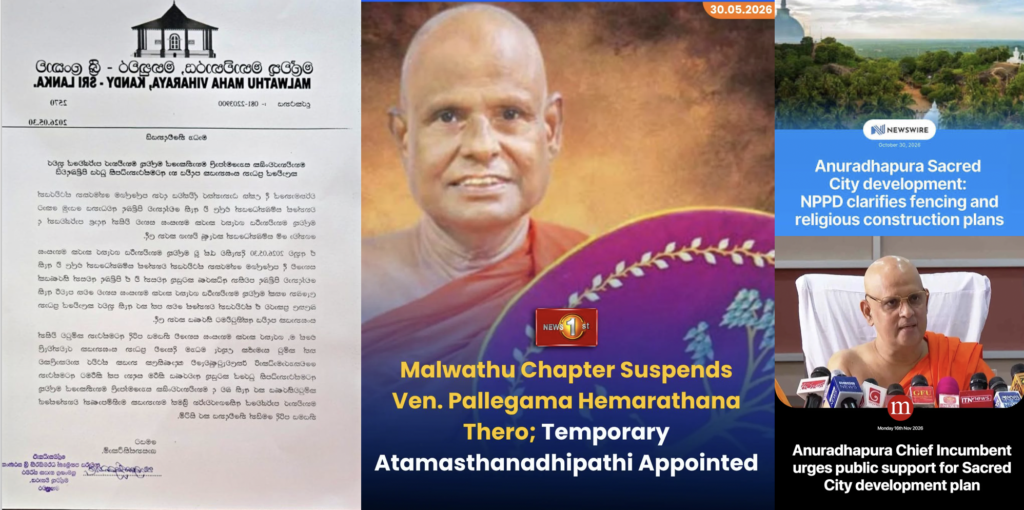
- Was he suspended from the position of Chief Sanghanayake? Yes, according to the Malwatte Chapter’s announcement.
- Was he removed from the separate office of Atamasthanadhipathi through the established customary procedure? No such removal has been established.
- Was he removed or suspended as statutory trustee under the Buddhist Temporalities Ordinance? This also requires separate examination. The existence of a statutory power to suspend or remove a trustee must be distinguished from the question of whether that power was lawfully exercised in this instance.
Suspension from Chief Sanghanayake does not automatically mean removal from Atamasthanadhipathi.
-
Are the Malwatte Chapter, Atamasthana Committee and Board of Electors the same authority?
No. They have different roles.
Malwatte Chapter – Ecclesiastical authority
The Karaka Maha Sangha Sabha exercises ecclesiastical authority within the Malwatte Chapter.
Its authority over a monk’s ecclesiastical standing must be distinguished from the customary authority to remove the Atamasthanadhipathi for misconduct affecting the temple. The historical 1881 minute itself makes this distinction.
Atamasthana Committee – Statutory trustee and recognised appointment role
The Atamasthana Committee is constituted under Section 9 of the Buddhist Temporalities Ordinance, with its statutory functions and authority governed by the Ordinance
The 1988 Supreme Court judgment recognised the Committee’s role in the customary appointment process introduced in 1907.
It is therefore necessary to establish whether the Committee independently exercised its recognised authority in the present appointment.
Historical Board of Electors – Customary authority
The 1881 minute expressly identifies the Board of Electors as having authority to remove the Chief Priest for misconduct prejudicial to the temple.
Whether and how that removal authority operates through the present Atamasthana Committee must be examined rather than assumed.
-
What exactly happened on 30 May 2026?
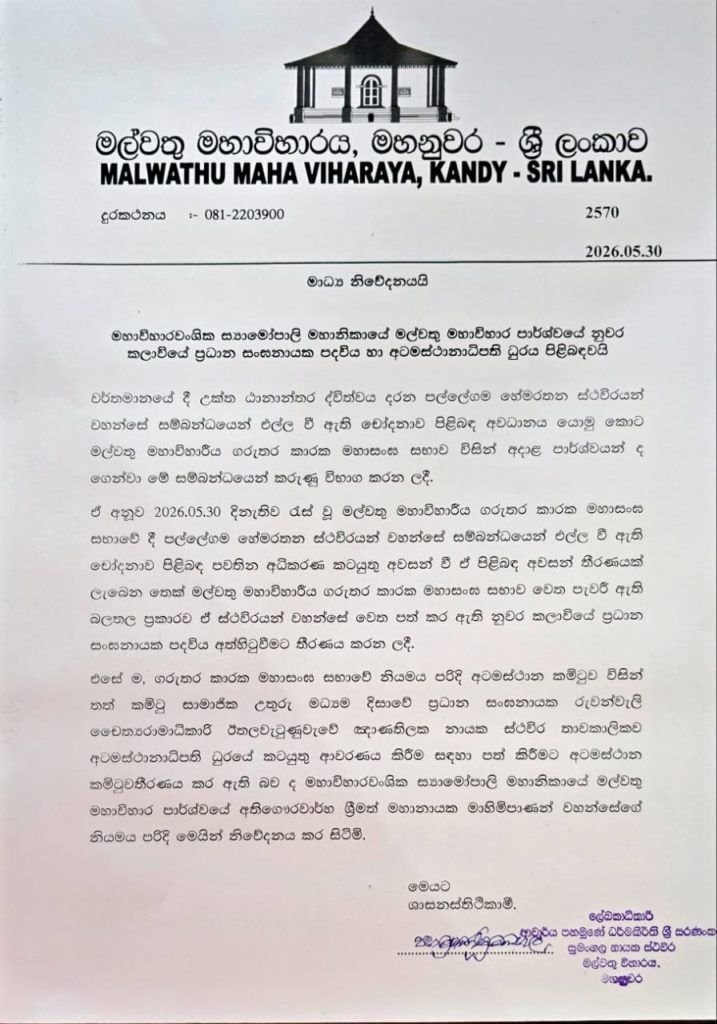
On 30 May 2026, the Malwatte Chapter announced the suspension of Ven. Pallegama Hemarathana Thero from the position of Chief Sanghanayake of Nuwara Kalaviya.
The announcement also stated that the Atamasthana Committee, acting on the directive of the Karaka Maha Sangha Sabha, had appointed Ven. Eethalawetunuwewe Gnanathilaka Thero temporarily to perform the duties of Atamasthanadhipathi.
However, published media reports were not entirely consistent. Some described the suspension as relating only to the Chief Sanghanayake position, while others reported that it extended to the Atamasthanadhipathi position as well.
Questions to the Malwatte Chapter:
- Does the Malwatte Chapter or its Karaka Maha Sangha Sabha have authority to suspend Ven. Pallegama Hemarathana Thero as Chief Sanghanayake? – If so under what authority
- Does the Malwatte Chapter or its Karaka Maha Sangha Sabha have authority to suspend him as Atamasthanadhipathi? If so under what authority
- What authority permitted the Malwatte Chapter to direct the Atamasthana Committee to appoint another monk as Acting Atamashthanadhipathi?
- Is there a historical title as Acting Aramasthanadhipathi or Temporary Atamasthanadhipathi? If so, when was this designation first recognised, under what authority, and what are the circumstances and procedures governing such an appointment?
- Was Ven. Pallegama Hemarathana Thero given formal written notice of the allegations against him, the proposed suspension and the grounds on which the Chapter intended to act? Was he given an opportunity to respond before the decision was taken?
- Was the suspension imposed as a disciplinary measure under the Chapter’s ecclesiastical authority, or was it intended to remove or prevent him from exercising the separate customary office of Atamasthanadhipathi?
- Was the decision to suspend him based on a finding of misconduct by the Chapter, or was it imposed solely because court proceedings concerning allegations against him were pending?
Questions to the Atamasthana Committee:
- Did the Committee independently decide to appoint Ven. Gnanathilaka Thero or merely implement the Malwatte Chapter’s directive?
- Was a properly convened meeting held and was the statutory quorum of two members present?
- Who participated in the decision?
- What legal or customary authority permitted the temporary appointment?
- Was Ven. Pallegama Hemarathana Thero given formal written notice of the allegations against him, the proposed suspension and the grounds on which the Chapter intended to act? Was he given an opportunity to respond before the decision was taken?
- Was the suspension imposed as a disciplinary measure under the Chapter’s ecclesiastical authority, or was it intended to remove or prevent him from exercising the separate customary office of Atamasthanadhipathi?
- Did the Committee formally resolve that the office of Atamasthanadhipathi was vacant, or did it consider Ven. Pallegama Hemarathana Thero to remain the lawful holder of that office?
- If he was not removed from office, on what legal or customary basis could another monk be appointed to perform the duties of the same office while the incumbent continued to hold it?
- Was the Public Trustee informed of the appointment, and was any approval, recognition or provisional appointment under the Buddhist Temporalities Ordinance obtained?
- Was the temporary appointee authorised to exercise the statutory functions of the Atamasthana Committee, or only to perform religious and administrative duties associated with the Atamasthanadhipathi?
- Was the decision to suspend him based on a finding of misconduct by the Chapter, or was it imposed solely because court proceedings concerning allegations against him were pending?
- Was he appointed to perform temporary administrative and trustee duties or to occupy the religious office of Atamasthanadhipathi?
- Where are the Committee’s minutes and written appointment?
The 1988 Supreme Court judgment records a previous temporary appointment in September 1977.
The incumbent Atamasthanadhipathi, Ven. Revata Nayaka Thero, was ill and personally requested the Atamasthana Committee to appoint a suitable monk to act for him for six months.
The Committee met on 14 September 1977 and unanimously approved the appointment of Ven. Pallegama Gnanaratana Thero, following the incumbent’s proposal.
This establishes a historical precedent for temporary arrangements made at the request of an incumbent who was unable to perform his duties due to illness.
However, the circumstances of the May 2026 appointment are different. It was made following a directive from the Malwatte Chapter in connection with allegations and pending court proceedings. Whether the same customary authority and procedure applied must therefore be established.
Can a monk be deprived of the practical exercise of the office of Atamasthanadhipathi, and another monk appointed to perform its duties, without first lawfully removing the incumbent through the recognised customary procedure or establishing a specific statutory authority to do so?
-
What does the Buddhist Temporalities Ordinance actually permit?
The Ordinance deals with the administration of temple property and trusteeship. Its provisions must not be extended beyond their actual wording.
- Section 9: Establishes the three-member Atamasthana Committee as the statutory trustee for the Atamasthana, prescribes its composition and provides that two members constitute a quorum.
- Section 11(2): Requires the Commissioner of Buddhist Affairs to issue an appointment letter following a valid trustee nomination.
- Section 11(3): Permits the Commissioner to make provisional arrangements where the prescribed nomination is not made or there is a dispute over the person entitled to nominate.
- Section 15: Empowers the Commissioner of Buddhist Affairs to investigate alleged misfeasance, breach of trust or neglect of duty by a trustee. Where proceedings for dismissal are contemplated, the Commissioner may preliminarily suspend the trustee, frame written charges and call upon the trustee to answer them. Following a trial, the competent court may order the removal of the trustee.
- Section 17: Empowers the Commissioner of Buddhist Affairs to make provisional arrangements for performing the duties of a trustee during specified circumstances, including suspension, vacancy, incapacity or temporary absence. A person provisionally appointed to act as trustee exercises the powers and assumes the responsibilities of a trustee under the Ordinance.
Sections 15 and 17 deal with the suspension, removal and provisional replacement of a statutory trustee. They do not expressly confer authority to remove a monk from the separate religious and customary office of Atamasthanadhipathi.
Therefore, suspension or replacement under the Buddhist Temporalities Ordinance cannot automatically be treated as removal from the religious office. The two legal capacities must be examined separately, and any connection between them must be established through the applicable customary or legal provisions.
-
Why was a new Presidential Advisory Council appointed?
On 30 October 2026, President Anura Kumara Dissanayake appointed a 32-member Presidential Advisory Council to oversee decision-making relating to the development, conservation and management of the Anuradhapura Sacred City.
Ven. Eethalawetunuwewe Gnanathilaka Thero, described as the Acting Chief Incumbent of the Atamasthana, was appointed co-chairman alongside the President’s Chief of Staff, Prabhath Chandrakeerthi.
The use of this designation raises a separate question as to the legal or customary basis on which he was recognised as Acting Chief Incumbent.
This raises further questions.
- On what legal or administrative authority was a monk whose temporary appointment as Acting Chief Incumbent remains subject to examination appointed co-chairman of a Presidential body making decisions concerning the development, conservation and management of the Anuradhapura Sacred City? Was his appointment based on his personal capacity, his temporary religious designation, or an assumption that he represents the Atamasthana institution?
- Was the Atamasthana Committee, as the statutory trustee under Section 9 of the Buddhist Temporalities Ordinance, formally consulted before the Presidential Advisory Council was constituted?
- Does the Council’s mandate extend to decisions affecting the ownership, control, management or use of Atamasthana temple property? If so, what specific statutory authority permits it to exercise or influence those functions?
The Presidential Advisory Council is not the statutory Atamasthana Committee established under Section 9 of the Buddhist Temporalities Ordinance.
A Presidential appointment cannot automatically confer:
- The religious office of Atamasthanadhipathi.
- Statutory trusteeship over the Atamasthana.
- Authority over temple property.
- Ecclesiastical powers belonging to established religious institutions.
If the Presidential Council is merely advisory, its existence does not automatically contravene the Ordinance. But if it assumes powers over temple property, religious administration or decisions reserved for the statutory trustee, its authority must be established under law.
The Presidential appointment instrument and complete terms of reference must be published.
The Council must also clarify whether the Acting Chief Incumbent participates in an individual capacity or as the representative of the Atamasthana. These are not interchangeable positions, particularly when the legitimacy of the temporary appointment itself remains under examination.
-
What is the connection to the Indian-funded Rs.7.7 billion development?
On 1 October 2026, it was reported that a proposed Anuradhapura Sacred City development programme, initially estimated at Rs.7.7 billion, had been submitted to the Indian High Commission for financial assistance.
The proposal was jointly prepared by the Urban Development Authority (UDA) and the National Physical Planning Department (NPPD). The submission followed discussions at the Presidential Secretariat on 30 September 2026.
The proposal was jointly prepared by the Urban Development Authority and the National Physical Planning Department.
The wider development proposals include expanding the Sacred City boundary from approximately 28 to 38 square kilometres and introducing new transport arrangements. Earlier discussions had also considered providing land, houses or compensation to 331 families living in the Inner City area, with possible resettlement in Lolugaswewa.
However, on 16 November 2026, Ven. Eethalawetunuwewe Gnanathilaka Thero publicly stated that there was no intention or proposal to remove residents from the Sacred City. He also confirmed that the proposed protective fence had been abandoned. The final approved position and relevant development plans must therefore be disclosed.
https://www.themorning.lk/articles/Q8YzrrPLAmnvYRO6lJlb
The project therefore raises questions beyond ordinary infrastructure improvements.
Who determines what happens to the sacred area, its boundaries, religious character, properties and surrounding communities?
Who has authority to approve interventions affecting the Atamasthana?
Can a Presidential development council make decisions affecting the sacred properties without the statutory trustee’s lawful participation and any other required religious, heritage and statutory approvals?
- Was the Atamasthana Committee, as the statutory trustee under Section 9 of the Buddhist Temporalities Ordinance, formally consulted on the proposed development programme?
- Has the Atamasthana Committee formally approved any development intervention affecting temple property, sacred sites, access routes or the administration of the Atamasthana?
- Were the necessary approvals obtained from the Department of Archaeology, Central Cultural Fund, Urban Development Authority and other competent authorities before any development decisions affecting protected heritage sites were made?
And why has the monk appointed temporarily to perform the duties of Atamasthanadhipathi now been appointed co-chairman of the Presidential body overseeing these development decisions?
Has Ven. Gnanathilaka Thero participated in the development discussions in his personal capacity, or as the representative of the Atamasthana? Has the Atamasthana Committee formally authorised him to represent the institution or endorse development proposals on its behalf?
Has the incumbent, Ven. Pallegama Hemarathana Thero, been consulted or given an opportunity to participate in decisions affecting the Atamasthana and its sacred properties?
The public must know whether the new appointee has merely accepted an advisory position or has endorsed, approved or undertaken to support the proposed development programme.
The submission of a funding proposal is not proof that the grant has been finalised or disbursed. The complete proposal, funding agreement, conditions and approved development plans must be disclosed.
There is also a difference between the initial Rs.7.7 billion proposal reported in October 2026 and the subsequent reported estimate of up to Rs.8.8 billion in the Sacred Area Development Plan. The Government must explain the difference, identify the revised project components and disclose the actual sources of funding.
The sacred heritage of Anuradhapura must not become subject to decisions made without the lawful participation of its established religious and statutory institutions.
-
Legal Position
The following principles must be upheld:
- The Atamasthanadhipathi is an established religious office, not a Government-created appointment.
- The 1988 Supreme Court judgment recognised the historical customary arrangements governing succession and appointment to the office of Atamasthanadhipathi.
- Malwatte’s ecclesiastical authority must not be confused with the customary authority to remove the Chief Priest for misconduct affecting temple interests.
- Suspension from Chief Sanghanayake is not automatically removal from Atamasthanadhipathi.
- The Atamasthana Committee must independently exercise its statutory and recognised customary responsibilities. It cannot substitute another institution’s directive for its own lawful decision or abdicate its responsibilities to another authority.
- Statutory trusteeship and the religious office of Atamasthanadhipathi must be examined separately.
- A Presidential Advisory Council cannot acquire statutory trusteeship or ecclesiastical authority merely through Presidential appointment.
- Foreign development funding, including funding from India, cannot by itself confer authority over Buddhist religious institutions, the Atamasthana or its temple property. Such authority must derive from Sri Lankan law and the applicable customary arrangements.
- Article 9 of the Constitution requires the State to protect and foster the Buddha Sasana.
- No person can be treated as having lawfully acquired the office of Atamasthanadhipathi, or authority to represent that office, merely because another religious body or the President has designated that person as Acting Chief Incumbent. The legal and customary basis of such recognition must be established.
-
Public Demand
We call upon the Government, the Malwatte Chapter, the Atamasthana Committee and all relevant authorities to:
- Publish the original signed Malwatte Chapter decision of 30 May 2026, specifying exactly which positions were suspended and under what authority.
- Disclose the Atamasthana Committee’s minutes, membership, attendance, resolution and written appointment of Ven. Gnanathilaka Thero.
- Establish whether Ven. Pallegama Hemarathana Thero was lawfully removed from the office of Atamasthanadhipathi and, if so, disclose the specific legal or customary authority, procedure and decision under which such removal was effected.
- Clarify whether the historical removal authority of the Board of Electors is exercised through the present Atamasthana Committee and what procedure applies.
- Publish the Presidential Advisory Council’s appointment instrument and complete terms of reference.
- Establish the limits of the Council’s authority over the Atamasthana, its religious administration and sacred properties.
- Disclose the complete Rs.7.7 billion development proposal submitted to the Indian High Commission, any subsequent revised estimates including the reported Rs.8.8 billion figure, the proposed funding arrangements, conditions, approved components and all relevant agreements.
- Ensure that no development or administrative committee usurps the lawful authority of the Atamasthana’s religious leadership or statutory trustee.
- Subject any disputed removal, temporary appointment or administrative intervention to independent judicial scrutiny.
- Establish whether Ven. Gnanathilaka Thero was appointed to represent the Atamasthana in the Presidential Advisory Council in his personal capacity or as its recognised religious head, and disclose the authority under which he was permitted to represent the institution or make commitments concerning its interests.
THE FUNDAMENTAL QUESTION
If Ven. Pallegama Hemarathana Thero has not been disrobed, if his removal from the separate office of Atamasthanadhipathi has not been established through the recognised customary procedure, and if the legal basis and procedure governing the temporary appointment of another monk have not been disclosed, on what authority is another monk being recognised as Acting Atamasthanadhipathi, exercising the functions of that office and participating in decisions concerning the future development of the Sacred City?
The Atamasthana is not an administrative project of the Government, the Malwatte Chapter or a foreign-funded development programme. It is an ancient Buddhist institution with its own historical, religious, customary and statutory foundations.
The Sangha must remain above political patronage, foreign influence and personal interests. No monk, irrespective of his ecclesiastical rank, position or authority — including the Maha Nayaka Theros — should compromise the dignity, independence and moral authority of the Sangha for political favours, personal benefits or foreign funding.
The robes of the Sangha carry a responsibility greater than political allegiance, personal advancement or material gain. The authority of the Maha Sangha derives from the Dhamma, its moral standing and the trust placed in it by the Buddhist public. That trust must never be bartered for political recognition, government patronage or foreign financial assistance.
The duty of the Sangha is to safeguard the Buddha Sasana, not to become an instrument of political agendas or foreign government programmes. No monk should use his religious position to legitimise decisions that compromise Buddhist heritage, undermine established institutions or bypass lawful procedures.
This responsibility applies to every monk, from the highest ecclesiastical authority to the individual incumbent of a temple.
Religious rank must never become a licence to act without accountability.
The Maha Nayaka Theros, in particular, carry a responsibility to uphold the independence and integrity of the Sangha, protect the Buddha Sasana and ensure that no individual monk or institution compromises these responsibilities.
The Sangha must lead by moral example, not political convenience.
The Buddha Sasana must never be traded for political favours, foreign funds or personal advancement.
Shenali D Waduge