
Why encouraging Separatism in Sri Lanka is Strategically Dangerous for India
It is crucial to understand the real nature of India’s regional doctrine the modus operandi changes with each government but the objective remains the same. India’s geopolitical goal has been political hegemony over its neighbors, regional dominance, strategic containment of rivals (China/Pakistan), buffer-state control and to expand its sphere of influence. As a result, Nepal, Bangladesh, Bhutan, Maldives and Sri Lanka are regularly prone to all types of interferences & interventions by India via geopolitical engineering.
This doctrine is not partnership-based regionalism. It is coercive geopolitics that treats neighboring sovereign states as subordinate strategic players rather than independent nations. This hegemonic mindset has repeatedly destabilized South Asia, eroding trust in India, sovereignty of these nations, and long-term regional security.
India has historically used “ethnic separatism” as a geopolitical tool. India helped weaponize terrorism & separatism in Sri Lanka. We know too well the manner India helped train Sri Lankan Tamil militant groups, armed & funded them, provided ideological legitimacy and thereafter applied diplomatic pressure. As a result, scores of armed Tamil groups ran amok, LTTE emerged the most ruthless, Sri Lanka suffered 30 years of bloodshed, lost over 100,000 innocent lives and half of Sri Lanka’s independence was spent on ending terror resulting in permanent instability in multiple forms and formats.
Such conduct constitutes direct violation of the UN Charter principles of sovereignty, territorial integrity, and non-intervention, setting a dangerous precedent that undermines the very international legal norms India itself depends on for survival.
International Law Principle: Ex injuria jus non oritur
Maxim: Law does not arise from injustice.
Territorial or sovereignty claims cannot arise from illegal acts, including forced migration, colonial resettlement, or external intervention.
British colonial-era Tamil migration to the North/East does not grant sovereignty.
Indian facilitation of LTTE or external support cannot create a legal homeland.
Uti possidetis juris — colonial administrative boundaries remain legally binding at independence.
Burkina Faso v. Mali (ICJ, 1986)
The ICJ ruled that colonial administrative boundaries at independence are legally binding, regardless of ethnic or tribal distribution. Ethnic claims cannot override sovereign borders.
Sri Lanka’s colonial and post-independence borders are internationally recognized.
Tamil demographic concentration in the North/East does not legally create a separate homeland.
Reinforces uti possidetis juris, preventing fragmentation based on ethnicity.
UN Resolutions on Cyprus (N. Cyprus / Turkey, 1974)
UN Security Council Resolutions 541 & 550 declare Northern Cyprus is not a legitimate sovereign state, despite large-scale demographic settlement by Turkish citizens.
International law does not recognize sovereignty created by population transfer or military intervention.
Even if the Sri Lankan Tamil population were large and/or supported by external actors, international law does not recognize territorial claims created or encouraged externally.
Western Sahara / Morocco (ICJ Advisory Opinion, 1975)
ICJ ruled that ethnic or tribal links to neighboring states (e.g., Morocco) do not create a legal right to annex Western Sahara.
Emphasizes self-determination within existing borders, not secession imposed by foreign or demographic claims.
Tamil claims citing “ethnic kinship with Indian Tamils” do not grant legal right to secede from Sri Lanka.
Legitimizes Sri Lanka’s unitary sovereignty.
Tibet / China Settlement (UN General Assembly, 1959–1965)
UNGA recognized that large-scale demographic settlement by an external state does not legitimize sovereignty.
Even if Tamil migration or political support from India had occurred, it cannot legally create a separate state.
Indonesia – West Papua
UN HRC and international legal commentators reject sovereignty claims based on transmigration or demographic engineering.
Confirms that imported population or settler presence does not justify secession.
Crimea / Russia (UN GA 68/262, 2014)
UN General Assembly confirmed that demographic changes or external support do not confer territorial legitimacy.
Annexation attempts are invalid under international law.
Even foreign backing for Tamil Eelam does not change Sri Lanka’s legal sovereignty.
Continuing this same tactic is structurally suicidal for India.
The terrain that allowed India to provide the landscape for intervention is not the same and cannot be repeated now. The eyes that ignored India’s interference then will not do the same now. Besides, India is now one of the world’s most internally fragmented states.
That which India boasts of “unity in diversity” can easily be manipulated & mobilized against India.
– 22 official languages
– 2000 plus ethnic groups
– 6 major religions
– hundreds of tribes
– strong state-wise nationalism
These factors can easily be packaged into internal insurgencies that will emerge more powerful than any foreign boots.
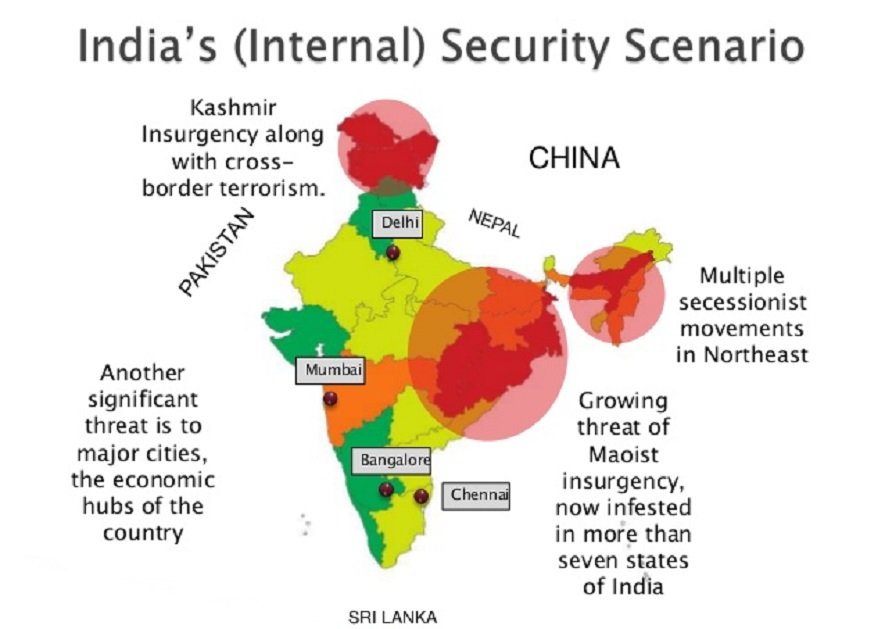
India currently suffers Islamist separatist issue in Kashmir, Punjab Khalistan revival, Nagaland sovereignty bid, Kuki-Meitei ethnic war in Manipur, ULFA in Assam, Tribal militancy in Meghalaya, insurgency in Mizoram, ethnic militancy in Tripura, Maoist insurgency in Central India, Tamil separatist quest in Tamil Nadu.
In short, India is structurally fragile while being the big bully to its neighbors.
Weaponizing separatism abroad only trains geopolitical actors how to fracture India itself. A lesson India wishes not to learn.
Tamil Nadu separatism predates Sri Lanka’s Tamil separatist quest
Historical Sequence:
- 1930s–40s → Dravida Nadu movement in India
- 1940s–60s → DMK separatist ideology
- 1970s → Tamil militancy in Sri Lanka (with Indian facilitation)
This means:
Sri Lankan Tamil separatism is not indigenous — it is derivative and externally stimulated.
India exported its unresolved Tamil Nadu problem into Sri Lanka.
This externalization strategy temporarily relieved internal pressure but created long-term regional instability and permanent blowback risks.
Demographic Reality: The Tamil Homeland Logic Collapses
| Population Group | Approximate Size |
| Tamil Nadu Tamils | ~75 million |
| Sri Lankan Tamils | ~2.3 million |
Tamil Nadu Tamils outnumber Sri Lankan Tamils over 30 times.
This creates a fatal geopolitical contradiction:
If Tamil self-determination is valid, then:
- The only viable territorial homelandis Tamil Nadu, not Northern Sri Lanka.
Which means:
Encouraging Tamil separatism in Sri Lanka legitimizes territorial claims against India itself.
This turns Tamil separatism from a foreign policy tool into a direct existential threat to Indian territorial integrity
Colonial Demographic Engineering Realities:
Large sections of Sri Lankan Tamils:
- Were transported by British colonial authorities
- Came from Tamil Nadu as plantation labor
- Do not represent indigenous territorial continuity
- Other than newly created fake narratives, there is no proof of a separately & independently held area under non-Indian Tamil rulers. (Sri Lanka was invaded on several occasions by South Indian rulers – some invaders settled. Settlers have no claim to a separate homeland)
Under international jurisprudence, colonial-era population transfers do not generate sovereign territorial entitlement, invalidating fabricated homeland narratives
Therefore:
- Homeland claims lack historical depth
- Territorial sovereignty arguments weaken
- Indigenous nationhood claims collapse
This further strengthens that Tamil Nadu — not Sri Lanka — is the civilizational Tamil core.
International Law: Why Tamil Eelam has No Legal standing
Under international law, secession is justified only as a result of:
- Colonial domination
- Foreign military occupation
- Systematic racial oppression
Sri Lankan Tamils:
- Vote
- Hold office both in public & private capacity
- Form political parties
- Govern provinces
- Possess language rights
- Exercise civil freedoms
- Own property / land and wealth
Therefore:
There is no legal basis for external self-determination (secession).
Hence, Tamil Eelam has no standing in international law.
Why Tamil Nadu / Tamil Eelam quest endangers India directly
If ethnic homeland logic is normalized, India becomes instantly balkanizable.
| Ethnic Group | Secession Claim |
| Tamils | Tamil Nadu |
| Sikhs | Khalistan |
| Nagas | Nagalim |
| Kukis | Kukiland |
| Kashmiris | Azad Kashmir |
| Mizos | Greater Mizoram |
| Bodos | Bodoland |
This transforms India into a permanent fragmentation battlefield.
No other major global power carries this many simultaneous internal fracture lines. This makes India uniquely vulnerable to externally stimulated destabilization
The Kashmir Paradox
India argues:
Kashmir separatism = terrorism + illegality.
But promotes:
Sri Lankan Tamil separatism = human rights + self-determination.
This creates a devastating legal contradiction.
Which international actors exploit:
If Kashmir has no right to separate, neither does Northern Sri Lanka.
or
If Northern Sri Lanka has that right, Kashmir does too.
India cannot logically defend both positions.
This contradiction severely weakens India’s diplomatic credibility and provides adversaries powerful legal and narrative leverage against India in international forums.
Geopolitical Disaster Scenario
If Sri Lanka fragments:
- Chinese naval presence emerges in Tamil Eelam
- Western intelligence installations follow
- NATO maritime surveillance expands
- Indian Ocean security collapses
- Southern Indian coastline becomes exposed
This produces direct military threat to India.
This would effectively complete India’s strategic encirclement arc — from Pakistan in the west, China in the north, and hostile maritime presence in the south.
China is subtly building economic relations across India’s South Indian states with Tamil Nadu economic engagement the highest.
Tamil Nadu is China-linked primary manufacturing hub for
- Electronics – Tamil Nadu is India’s electronics manufacturing capital (Foxconn, Pegatron, Wistron, Salcomp, BYD, Flex, Lite-On, Compal)
- Apple Supply Chain Shift – Tamil Nadu is China’s external factory base
- Foxconn Sriperumbudur mega campus
- Pegatron Chennai campus
- Tata iPhone manufacturing plants
- Footwear + EV + Electronics Cluster Domination (Tamil Nadu hosts large Chinese/Taiwan industrial groups)
- Pou Chen
- Hong Fu
- Feng Tay
- BYD suppliers
- EV battery component firms
The Strategic Reality India Ignores the reality that India has traded long-term security for short-term influence
History repeatedly demonstrates that empires collapse not from external invasion, but from internal fragmentation amplified by strategic arrogance.
Short-term leverage over Colombo has:
- Created long-term regional instability
- Invited global interference
- Opened doors to Chinese expansion
- Trained separatist ideologies
Encouraging separatism in Sri Lanka is one of the most strategically self-destructive policies India has pursued in particular persisting with the anti-Sinhala Buddhist agenda in the North & East using a variety of local pawns.
India’s regional hegemony or global power-player goal cannot come at the cost of keeping its neighbors destabilized or even remote controlling these nations.
The moment India launches such a covert-overt mission India’s enemies will be helping India’s neighbors to destabalize India. India needs to rethink its old-fashioned tactics.
It:
- Weakens India’s territorial integrity
- Strengthens internal fracture lines
- Invites foreign destabilization
- Creates long-term security threats
When will India learn – a fragmented neighborhood produces a fragmented India.
Regional bullying produces regional resistance. Regional resistance inevitably evolves into internal destabilization once geopolitical rivals intervene.
India’s pursuit of short-term hegemony abroad now threatens its long-term survival at home — a cautionary lesson in strategic arrogance.
Shenali D Waduge


