17 Years After the Defeat of the LTTE: How the LTTE Destroyed Tamil Democracy & Outsourced Tamil Politics
Before the LTTE came into the picture, it is good to go back in time to the manner in which American, British evangelical movements set up missionary schools where the Sinhala Buddhist majority did not live and provided English missionary education jobs, positions to Tamils. This was how the colonials created an elite group of people that were happy to be their lackeys. An analysis of the positions held by minorities pre-1948 provides proof. It was no surprise when they created the first ethnic political party, demanded 50-50 representation at a time when the Indian-laborers outnumbered the 1911 artificially created “Ceylon-Tamils” and thereafter moved on to the 1949 creation of the ITAK party seeking a Tamil State though calling themselves the Federal Party. In all of these maneuverings the Church played an integral role. This was later to culminate into the Catholic-Action movement within the armed forces that attempted a coup to oust Prime Minister Sirimavo Bandaranaike. L H. Mettananda’s Catholic Action book is a must read to understand the greater dynamics.
At this point it is important to link the self-determination movement that emerged in Tamil Nadu. Not surprisingly, the Church played a key role in Tamil Nadu as well. In fact, it was Bishop Caldwell who coined the term Dravida Nadu and it is anyone’s guess whether Tamil Eelam was coined by the same entity too. When pre-conflict and post-conflict protests for a separate state in Sri Lanka generate men & women in cassocks the answer is not difficult. When inspite of internationally banning LTTE, the LTTE fronts operate in Christian-West states, the answer is further sealed. LTTE’s ideologue was Christian Anton-Balasingham, his Australian wife was the initial trainer of child soldiers. Nordic nations were heavily involved during the conflict. Eric Solheim a key player throughout even attended Balasingham’s funeral. Did he attend Lakshman Kadiragamar’s funeral?
Thus, the architects of self-determination or a bid for a separate state is not the LTTE – it was the Christian-elite Tamil politicians that the colonials created.
From the creation of the first ethnic political party – to the demand for equal representation when they were hardly 10%, to post-independence creation of a political party seeking a separate Tamil State, to their objection to Tamil low caste gaining education in 1957, to the 1976 Vaddukoddai Resolution was steered by Tamil politicians and not Prabakaran or LTTE.
We must distinguish this clearly.
Prabakaran only hijacked the concept to justify his dictatorship while the Tamil politicians were happy to ride on it believing eventually they would take over the political mantle.
This was probably what the Tamil politicians like Chelvanayagam, Amirthalingam had planned.
This is where the Tamil politicians erred. Prabakaran had no such plans to pass power to the elite Tamil leaders. In fact, he began eliminating them one after the other.
The entire cream of Tamil politicians whether they were in a Tamil political party, the UNP, the SLFP or even independent –were all assassinated.
The only one’s left behind were those that the LTTE created in 2001 and others who out of fear parroted LTTE’s will.
Not only were the Tamil politicians silenced with the gun the Tamil people too lived in fear, except those who thought the newly found power via the gun sufficed to rule over their own.
The TNA election manifestos of 2001, 2004 & even 2010 openly advocated for LTTE as sole representative of the Tamil people.
But no representative kills their own or shoots at their own.
The LTTE did not rise to dominance through democratic consensus – it rose through fear, assassinations, intimidations, forced obedience and the elimination of rivals.
It is true that Tamil politics before LTTE was not politically uniform either – divisions as a result of religion, caste, regional interests and ideological disagreements prevailed. The same scenarios are prevalent in Sinhala politics as well. However, the will of the people prevailed.
The LTTE opposed such parliamentary principles, a factor LTTE’s counterpart in the South, the JVP also adopted.
Then came the 2001 War on Terror with the 9/11 attacks, the strategy changed and LTTE created its political wing and began politically engaging and lobbying. It was no surprise that the Nordic-Indian brokered ceasefire agreement resulted in 2002 and a visibly uncomfortable Prabakaran sat at his first press conference.
Inspite of these exterior change’s dissidents were eliminated and silenced with the gun. Democracy was just on paper.
Tamil political space became militarized and centralized around one unquestionable authority & his will. Rival Tamil militant groups including TELO, EPRLF, PLOTE, EROS & many others were violently neutralized and eliminated. Mahaththaya the deputy leader of the LTTE was tortured and killed for becoming an agent of India.
Prabakaran’s message was clear:
- There could be only one-armed movement
- Only one political narrative
- Only one leader
- Only the leaders chosen structure
- Only one acceptable version of Tamil nationalism.
Anyone functioning outside this became a traitor and eliminated.
All the Tamil politicians who are free to express their views today were all living in fear under Prabakaran.
Ironically, the Armed Forces — who helped restore that space for free expression —are now subject to criticism from those who benefitted from the very freedom they helped create.
After the 1987 Indo-Lanka Accord that merged the North & East – the 1st ever election was held in 2013 after LTTE in the North and 2008 in the East. Had LTTE & Prabakaran continued to prevail C V Wigneswaran or any other would never have become Chief Minister. Democracy returned to North after almost 25 years because LTTE was defeated by the political leadership together with the armed forces.
Even from 2001 onwards Tamil political parties survived under enormous threat to their lives. A single mistake in a statement would have cost them their lives. After 2009 they found their voice and not surprisingly their voices targeted those that gave them the voice to speak without fear.
Did Tamils truly have democratic freedom under LTTE dominance?
Could parents freely refuse child recruitment?
Could civilians openly criticize taxation or extortion?
Could journalists write independently?
Could religious leaders openly challenge militant authority?
Could rival political visions safely exist?
Could the TNA politicians speak as they do now under LTTE?
Could the nexus of LTTE fronts mushrooming in western climes set up if Prabakaran was alive?
One of the LTTE’s greatest political successes was convincing large parts of the outside world that it alone represented Tamil aspirations, even after systematically eliminating alternative Tamil leadership.
This narrative became internationally powerful because fear inside LTTE-controlled areas rarely allowed open contradiction. Silence was mistaken for consensus.
However, we cannot underestimate foreign intel – who would have known the reasons for Tamil acquiescence. Unless the scenario serve their own agendas.
If Tamil politicians groomed under colonial rule became dislodged from the basic needs of the Tamil people whom they claimed to represent, post 2009 the lack of Tamil political engagement with the people has seen this distance expand.
Other than making statements about a separate homeland, finding fault with the Sinhalese, shouting at Buddhist pilgrims, humiliating the Buddhist theroes in Buddhist temples in the North and East have any of these Tamil politicians championed for Tamil education, employment, vocational training, against drug/alcohol and other social menaces?
All of the Tamil politicians are going to Geneva, appealing to Tamil Nadu, seeking appointments with Western NGOs, INGOs, diplomats but have done little or nothing for the Tamil people.
Why should Tamil politicians look outward for political legitimacy rather than inward amongst their local community and their needs.
Every statement made in parliament or in public has nothing about the common problems that the ordinary Tamil people are going through. The day-to-day realities of the Tamil people living in Sri Lanka has been replaced with a plethora of demands that has nothing to do with what the majority of the Tamil people want or ask for.
The same is applicable to the LTTE overseas networks – all they do annually is hold events, collect funds from various campaigns, lobby foreign governments, UNHRC & UN entities, emotionally mobilize campaigns, retain international lawyers – but have they build a home even for the LTTE cadres that are injured or maimed or the families whose sons & daughters have sacrificed their life? All we see annually is a group of less than 20-30 people wailing holding photos of dead LTTE.
As a result, an uncomfortable question arises seventeen years after the defeat of the LTTE:
Are Tamil political leaders representing the practical aspirations of the Tamil people living in Sri Lanka today — or are they increasingly compelled to align themselves with the expectations of overseas political networks and external interests that continue to manipulate grievance politics?
Ordinary Tamil families living in the North and East require:
- jobs,
- education,
- investment,
- functioning institutions,
- social stability,
- and long-term economic opportunity.
Yet political discourse frequently returns instead to symbolic international campaigns, external appeals, and emotionally charged separatist-era rhetoric.
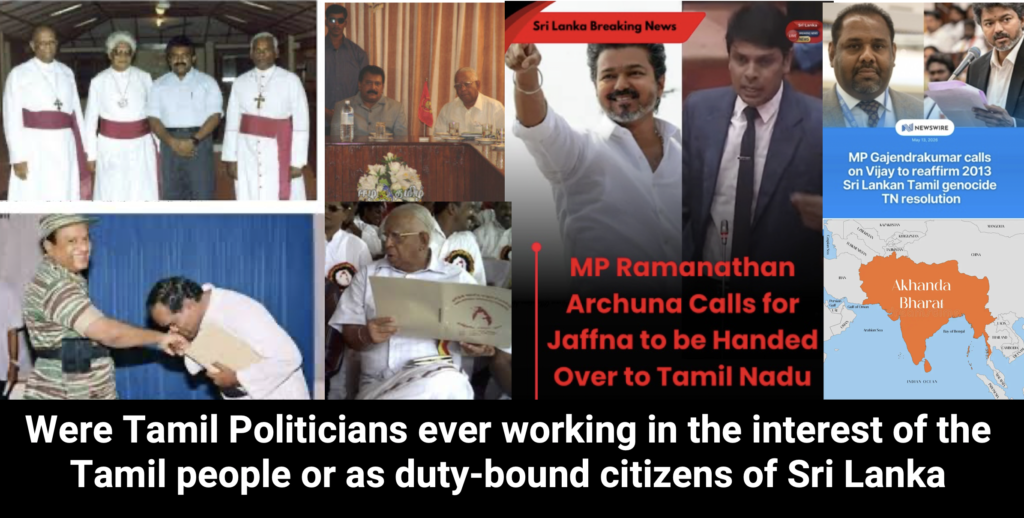
For example, MP Gajendrakumar Ponnambalam has repeatedly appealed for international involvement, foreign accountability mechanisms, and external pressure regarding Sri Lanka’s ethnic conflict.
More recently, MP Ramanathan Archchuna generated controversy after publicly suggesting in Parliament that Jaffna should be handed over to Tamil Nadu, claiming Tamils there would receive better protection.
Such statements raise deeper questions:
If Tamil political leadership itself increasingly looks outside Sri Lanka for protection, validation, or political direction, then what message does this send to ordinary Tamil people trying to rebuild stable lives within Sri Lanka itself?
This exposes a huge vacuum. The Tamil people has no reliable Tamil leaders.
This creates a dangerous long-term vacuum:
leadership becomes shaped not necessarily by the needs of the people living in the North and East, but by:
- diaspora funding pressures,
- emotional separatist narratives abroad,
- foreign geopolitical interests,
- and international political incentives.
Meanwhile, ordinary Tamil families increasingly seek something far simpler. Having experienced 30 years of fear – they want to just live in peace.
The tragedy is that many ordinary Tamils already coexist peacefully with other communities in daily life far more successfully than some political narratives — both local and overseas — are willing to acknowledge.
Even today, many Tamils who openly criticize LTTE violence risk intimidation, labeling, isolation, or accusations of betrayal within certain political spaces.
This itself reveals how deeply fear-based political culture became normalized.
Real democracy requires the right to disagree without fear.
The LTTE denied that freedom not only to Sinhalese, Muslims, or the Sri Lankan State — but to Tamils themselves.
This is one of the greatest contradictions at the center of the LTTE legacy.
A movement that demanded self-determination externally denied democratic self-determination internally.
Even the annual commemorative culture surrounding the LTTE reflects this contradiction.
Where are the equal memorials for:
- Tamil moderates killed by militants?
- rival Tamil movements annihilated by the LTTE?
- dissenting Tamil intellectuals?
- Tamil policemen murdered for serving the state?
- parents whose children were forcibly recruited?
Why are only certain Tamil deaths politically remembered?
Because memory itself became politicized.
Seventeen years after the defeat of the LTTE, Sri Lanka continues to face not only the consequences of war, but the consequences of decades of fear-based political conditioning and externally sustained grievance politics.
Real political dignity for Tamil people can never emerge from fear, militancy, dependency on foreign validation, or enforced ideological conformity.
LTTE is no more but the ordinary Tamil people now experience multiple threats from within their own.
After the military defeat of the LTTE in 2009, the earlier narrative portraying the conflict as “Sinhala oppressor vs Tamil victim” has became increasingly difficult to sustain in its original form.
As a result, the focus has shifted toward allegations framed around “genocide,” “war crimes,” and international accountability mechanisms. Many ordinary Tamils themselves are beginning to recognize the wider political, institutional, fundraising, lobbying, and geopolitical dimensions attached to the continuation of these narratives seventeen years after the conflict ended.
Post-war generations living in Sri Lanka seek stability, education, economic opportunity, and normalcy rather than permanent emotional mobilization rooted in conflict-era politics.
As a result, sections of overseas LTTE-linked networks face a growing challenge in sustaining international narratives that rely on historical conflict mobilisation, particularly as younger generations and many within Sri Lanka itself place greater emphasis on development and coexistence than on prolonged political grievance and hatred.
Shenali D Waduge