1,900 YEARS OF BUDDHIST JURISPRUDENCE vs 368 YEARS OF MIXED ENGLISH–ROMAN-DUTCH LAW. THE LAW WE ADOPTED SACRIFICING THE ROOTS OF RIGHTEOUSNESS
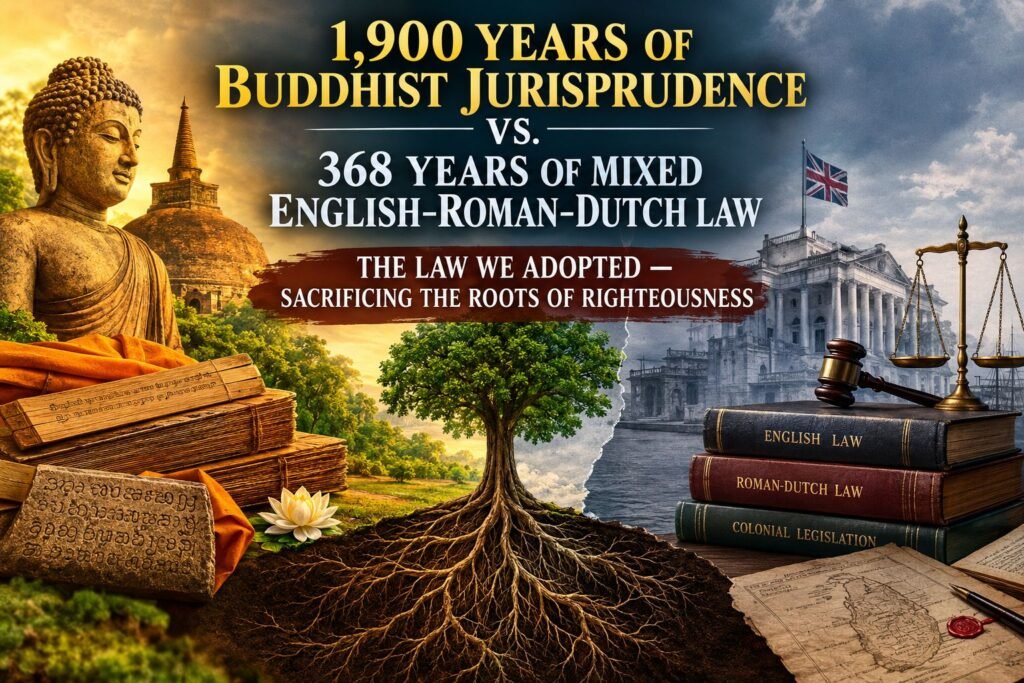
Sri Lanka today operates under a foreign infused mixed legal system. Roman-Dutch law forming the foundation of common law together with English legal principles & a handful of customary laws. WHAT HAPPENED TO THE LEGAL AND JURISPRUDENTIAL TRADITION THAT EXISTED IN SRI LANKA BEFORE EUROPEAN OCCUPIED COLONIAL RULE?
BEFORE THE COLONIAL LEGAL SYSTEM
Buddhism was established in Sri Lanka in the 3rd century BCE.
For nearly 1,900 years before the Dutch introduced Roman-Dutch Law, Sri Lankan civilization developed within a deeply Buddhist social, political and legal environment.
Historical scholarship identifies the early Buddhist community, its institutions, rules, customs and relationship with the law of the land. The Vinaya provided a sophisticated legal system for the Buddhist monastic community, while Buddhist norms also influenced lay social conduct and Sri Lankan legal traditions.
Sri Lanka therefore did not begin its legal history with Europe.
Sri Lanka already had institutions, customs, systems of governance, dispute resolution and jurisprudential traditions far before western civilizations started.
Europe did not bring civilization or law to a civilization that had none.
Europe arrived centuries later to a civilization that already existed.
This is the pride that every citizen should feel.
This pride must then lead them to ask what happened thereafter & how can we regain that pride
EUROPEAN COLONIAL RULE
1505 — Portuguese arrived
1658 — Dutch
The Dutch took control of the Portuguese territories.
Under Dutch rule Roman-Dutch Law became part of the legal system of those territories.
The Dutch codified Indian Thesavalamail law for the imported Indians who worked on their plantations.
1796 — British
The British took over the Dutch possessions & thereafter from 1815 the entire Island.
BUT THE BRITISH DID NOT SIMPLY REPLACE ROMAN-DUTCH LAW WITH ENGLISH LAW.
The British retained the existing Dutch legal system in the maritime territories and expressly directed that justice should, be administered according to the laws and institutions that had existed under Dutch rule.
Ironically the British did not themselves follow Roman Dutch law.
The British made legislative changes in 1835 legislation but continued the laws and institutions that existed under the Dutch Government in the Maritime Provinces with a few alterations.
English law and English legal principles were additionally entered into the legal system through legislation and judicial development.
So the legal system that emerged in then Ceylon was neither purely Dutch nor purely English.
It became a colonial mixture.
This is the legal cocktail that modern Sri Lanka continues post-independence.
1948 — INDEPENDENCE – CEYLON BECOMES A DOMINION
Independence did not result in returning to the social order or legal system that existed before 1505.
Sri Lanka’s leaders chose to continue the mixed English-Roman-Dutch law
Until 1971, the Privy Council in London remained Ceylon’s final court of appeal.
Questions concerning the law of Ceylon were ultimately determined by the highest appellate court sitting in Britain.
WHO HAD THE FINAL SAY ON SRI LANKAN LAW EVEN AFTER “INDEPENDENCE”?
At independence, Ceylon continued its mixed English–Roman-Dutch legal system.
Under its Dominion constitutional arrangements, the British Privy Council in London remained the final court of appeal.
Several questions emerge:
- WHO GAVE UK PRIVY COUNCIL JURISDICTION TO RULE REGARDING CEYLON?
What constitutional or legal instrument gave the British Privy Council final appellate jurisdiction over Ceylon post-1948?
- WHO GAVE UK PRIVY COUNCIL JURISPRUDENTIAL AUTHORITY?
What legal principle authorized the Privy Council to determine, interpret or develop Roman-Dutch law as applied in Ceylon?
- WERE THERE LIMITS TO THAT AUTHORITY?
Could a foreign appellate tribunal legitimately alter or reinterpret Roman-Dutch law as applied in Ceylon?
- WHAT IS THE STATUS OF THOSE DETERMINATIONS TODAY?
If particular Privy Council determinations materially altered or developed Roman-Dutch law in Ceylon, can their continuing legal authority be questioned today on grounds arising from constitutional sovereignty, decolonization, legal continuity, or applicable international-law principles?
The question is not why Ceylon permitted the Privy Council to hear its appeals.
The question is whether the British Privy Council had valid legal and jurisprudential authority to determine, interpret and develop Roman-Dutch law in Ceylon — and whether the validity of such determinations can be questioned today.
This is something for Sri Lanka’s legal luminaries and legal institutes/students to examine.
1972 — THE REPUBLIC
The Privy Council appellate connection ended.
Yet the Republican Constitution too continued the mixed English-Roman-Dutch law
Today, we have:
A LEGAL TRADITION INTRODUCED UNDER DUTCH COLONIAL RULE THAT HAS SURVIVED FOR 368 YEARS.
1978 – OUR PRESENT CONSTITUTION
The Constitution declares that:
SOVEREIGNTY IS IN THE PEOPLE.
Article 3. – Judicial power is exercised as part of that sovereignty.
Article 4. – The Constitution gives Buddhism the foremost place and places a duty on the State to protect and foster the Buddha Sasana.
Article 9. – And then comes a particularly important provision:
ARTICLE 16 – preserves:
“all existing written law and unwritten law”
THIS RAISES A FUNDAMENTAL QUESTION
If mixed English-Roman-Dutch law — can survive through legal continuity…
WHAT ABOUT THE INDIGENOUS LAW THAT PREVAILED BEFORE COLONIAL RULE THAT EVEN INVADER RULERS FOLLOWED?
ARTICLE 16 DESERVES A CLOSER LOOK
It preserves existing written and unwritten law.
WHICH INDIGENOUS LAWS AND CUSTOMS SURVIVED?
WHICH WERE RECOGNISED AS LAW?
WHICH WERE DISPLACED BY COLONIAL LAW?
WHICH STILL EXIST AS UNWRITTEN LAW?
DOES ARTICLE 16 HAVE ANY ROLE IN RECOGNISING THAT PRE-COLONIAL INDIGENOUS JURISPRUDENCE?
This legal question needs research.
The question is not only for lawyers. It is a question about national identity, sovereignty and continuity. A legal system does more than determine disputes. It reflects the values, duties, responsibilities and social order that a society considers important. If that connection with its ancestral jurisprudential roots is severed, a nation becomes legally and socially rootless.
This is what we now see happening at all levels.
The issue is not whether Roman-Dutch law is good or bad.
The issue is not whether everything European must be rejected.
The issue is much more fundamental:
HAS A SOVEREIGN SRI LANKA EVER SERIOUSLY EXAMINED THE LEGAL TRADITION THAT EXISTED BEFORE COLONIAL RULE?
For centuries, Sri Lanka developed within a Buddhist civilisation.
Then colonial powers arrived.
A Dutch legal tradition was introduced.
The British retained it.
English law was added in other areas.
Independence came in 1948.
Republican status came in 1972.
And today, Sri Lanka remains governed partly by a legal inheritance whose roots reach back to 1658.
If there is a demand to say pre-Colonial social-political-legal order should return – why should that call be negated by those who claim a foreign infused system should remain operational?
SO THE QUESTION IS NO LONGER A COLONIAL QUESTION
It is a question for the SOVEREIGN PEOPLE OF SRI LANKA.
WHAT LAW SHOULD GOVERN SRI LANKA?
WHAT PART OF OUR INDIGENOUS JURISPRUDENCE SURVIVED?
WHAT DID COLONIAL RULE DISPLACE?
WHAT DOES ARTICLE 16 ACTUALLY PRESERVE TAKEN TOGETHER WITH ARTICLE 9?
And perhaps most importantly:
AFTER CENTURIES OF FOLLOWING LAW THAT CAME THROUGH COLONIAL RULE —
IS IT TIME FOR SRI LANKA TO EXAMINE, DOCUMENT AND UNDERSTAND ITS OWN INDIGENOUS JURISPRUDENCE?
Before deciding what law should govern us tomorrow,
we must first understand the law we inherited —
and the legal civilisation that existed before it.
The issue is far more than a call to remove a legal system that is foreign.
That we have abandoned the former legal roots is why we are today legally rootless.
When a Nation loses its legal roots – the people cannot comprehend the justice, or the social order we aspire to maintain through the rule of law. This together with a foreign infused educational system creates people disconnected from their own civilization.
Sri Lanka’s civilization did not begin nor was it built on Roman-Dutch law or English law or European Courts or Missionary Education.
For 1900 years the Nation had its own systems, governance, customs & dispute resolution mechanisms.
Before it is forgotten it needs to be identified.
In recovering indigenous jurisprudence we need not reject everything European. What is valuable can be continued but pride of place must return to the indigenous order.
Before demanding the return of ancient legal systems – people must first know what that Buddhist jurisprudence was and how it helped build a sustainable & righteous society.
It needs to be studied, taught and its merits must be internalized.
If Article 3 of the present constitution deems sovereignty is in the people – then that sovereign people have the right to ask what their law should be.
Article 3 taken together with Article 9 and Article 16 allows the people to explore that historical & civilizational significance of Buddhist jurisprudence having given the Buddha Sasana the foremost place with mandatory duty placed upon the State to protect & foster it.
The question is has the State fulfilled its mandatory requirement?
This question has to be answered by every Govt taking office.
Knowing what we lost – will help value what we lost
We cannot blame the occupiers.
They occupied the land.
They introduced their laws & customs.
We followed blindly.
At least after independence – a national due diligence should have been done.
If a people’s indigenous social and legal order was displaced by centuries of foreign occupation, surely that people cannot be denied the right to demand corrective measures to restore what was displaced.
As far as we know, the Sinhala language and Buddhist jurisprudence formed the principal foundations of the island’s civilisation for centuries before colonial occupation. That historical displaced demands examination.
The biggest failure of post-independence was the failure of local leaders to identify what was ours, what was replaced, what survived, what can be recovered and what should legitimately form part of modern Sri Lanka.
However, the colonized minds of local leaders failed to take on this task.
OTHERS VALUE THEIR IDENTITY.
WHY DON’T WE VALUE OURS?
Later day arrivals, who make up minority and immigrant communities often work to preserve their language, culture, values and traditions — even seeking recognition for them in the laws of their habitat.
Because they know the value of what they inherited.
So why do those who inherited an ancient civilization fail to recognise, protect and preserve their own civilizational heritage?
If we do not value what is ours, why should anyone else?
It is not too late for the State to create a task force of academics, constitutional lawyers, university students, Buddhist scholars etc to gather from inscriptions to historical records & Buddhist social order to rediscover the missing pieces of our history.
We have inherited foreign institutions, foreign terminology, foreign jurisprudential traditions, foreign administrative structures while abandoning our own foundation. Many will be happy to continue this path for it becomes easier to manipulate people who feel no roots.
If we do not know our roots an entire society becomes vulnerable to embracing every new ideology, imported social theory and external perceptions of rights.
Ironically, nations that were created go in search of their roots while Sri Lanka with a historically rich civilization are happy to give up their roots.
Sri Lanka must therefore firstly identify the legal & jurisprudential traditions that existed before invader rule, document these customs & legal practices, identify which practices can be replaced and introduce these teachings in schools, universities, legal institutes etc.
A Constitution cannot create a civilisation by itself. Laws cannot manufacture conscientious citizens by themselves. Courts cannot create social morality by themselves. These institutions can protect, regulate and guide society — but they ultimately operate within a civilisation and its values. If the foundations beneath them have been forgotten, constitutional engineering alone cannot repair the problem.
We see governments happy to make amendments to Constitution or even dabble with changing the Constitution – none of these efforts will succeed until & unless Sri Lanka is rooted in the social order that built the Nation and the legal framework that developed conscientious and righteous individuals. That is the democracy that Sri Lanka needs to re-embrace not cut & pasting terms and phrases that are foreign.
Shenali D Waduge