Ven. Gnanasara Thero: Where is the written law authorizing removal of a Buddhist Theros robes & producing a Thero to Court in prison attire
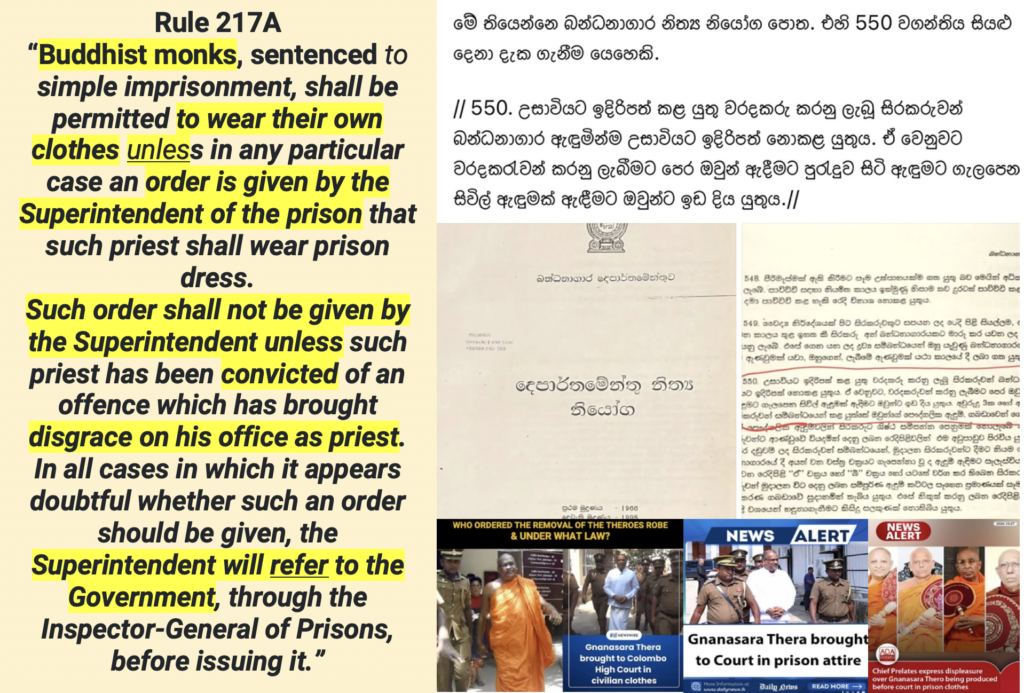
Seeing Ven. Gnanasara thero brought to courts in civilian clothing struck a deep nerve among Buddhists & non-Buddhists alike. It was not simply that a prisoner was taken to court in prison attire. It was the manner in which an ordained Buddhist Thero was brought outside the court and visibly paraded in prison attire. For Buddhists, the robe is not ordinary clothing. It represents ordination, the Sangha and the Buddha Sasana.
That sight hurt. It was felt as a humiliation not only for one Thero to entire Buddhist community in Sri Lanka & abroad. Yet, the action hurt the Buddhists but it did not break the spirit of the Buddhists. The action in fact rallied the Sangha and the Buddhist Community. It was an outcome that was overlooked. We now take the emotion to question the law.WHERE IS THE WRITTEN LAW THAT AUTHORISED IT?
Buddhists may be hurt, but they are not broken. We now demand to see the written law that permitted the removal of a Buddhist Thero’s robes and his production before court in prison attire.
-
The specific Prison Rule
The 25 June 1902 Gazette expressly introduced a special Prison Rule under the then section 76 of the Prisons Ordinance, 1877.
Rule 217A
“Buddhist monks, sentenced to simple imprisonment, shall be permitted to wear their own clothes unless in any particular case an order is given by the Superintendent of the prison that such priest shall wear prison dress.”
(THIS ORDER HAS AN EXCEPTION)
A Buddhist monk shall be permitted to wear his own clothes.
For an ordained Buddhist monk, those own clothes are his robes.
There is, however, a restricted exception.
But the Superintendent of Prisons is not given an unrestricted power to order a Bhikkhu to wear prison dress.
-
Restricted Exception
“Such order shall not be given by the Superintendent unless such priest has been convicted of an offence which has brought disgrace on his office as priest.”
This means the Superintendent cannot give an order to change the Robe unless the Bhikku has been:
“convicted of an offence WHICH HAS BROUGHT DISGRACE ON HIS OFFICE AS PRIEST.”
The key words are
“offence which has brought disgrace on his office as priest.”
It does not say a conviction automatically permits removal of the Robes.
-
THE UNDEFINED LEGAL QUESTION
The rule does not define:
what constitutes “disgrace”;
who determines whether an offence has brought disgrace on the office of a priest;
whether the criminal court must make that finding;
whether the Superintendent can make that finding;
whether Government can make that finding and take the decision to disrobe;
whether the Maha Sangha must make that determination;
whether conviction for a particular offence automatically constitutes such disgrace.
This is the grey area in Rule 217A:
the Rule imposes the condition, but does not say who has the authority to determine whether an offence has “brought disgrace on his office as priest.”
That is an issue of legal interpretation.
But interpretation cannot simply convert a conditional provision into an unrestricted power to remove the robes of an ordained monk.
-
Rule 217A further states:
“In all cases in which it appears doubtful whether such an order should be given, the Superintendent will refer to the Government, through the Inspector-General of Prisons, before issuing it.”
This reinforces that the Superintendent does not have an unrestricted power to order a Bhikkhu to wear prison dress.
Where there is doubt, the matter must be referred to Government through the Inspector-General of Prisons before the order is issued.
This clearly means
- The Superintendent cannot simply decide to order prison dress without satisfying the conditions of Rule 217A.
- Where it is doubtful whether the order should be given, the matter must be referred to Government through the Inspector-General of Prisons.
- Rule 217A does not expressly give Government an independent power to remove a Buddhist monk’s robe.
- A referral to Government is not the same thing as an express power to disrobe.
Thus, Rule 217A provides for a referral to Government through the Inspector-General of Prisons, but does not expressly state that Government has an independent power to order the removal of the monk’s robes
Rule 217A also does not expressly state that the Superintendent can himself determine that an offence has “brought disgrace on his office as priest.”
The Rule therefore leaves unanswered who has the legal authority to make that determination.
In such a scenario, the removal of the robe cannot be based on an arbitrary decision; the decision-maker must identify the lawful authority and the conditions under which that authority is exercised
The next question, therefore, is whether Rule 217A has ever been expressly repealed, amended or superseded by any subsequent Prison Rule, Gazette or other written law—and, if so, what exactly was changed.
Until a subsequent rule, Gazette or other written law is identified which expressly repeals, amends, replaces or otherwise overrides Rule 217A, Rule 217A must be examined as part of the existing written law governing the treatment of Buddhist monks in prison.
LET US NOW APPLY THAT TO VEN. GNANASARA THERO
There are several questions emerging from the Rule 217A & its application to the Ven. Thero:
What offence was he convicted of, what did the Court actually find that he did, and does that conviction constitute an offence “which has brought disgrace on his office as priest”?
- The Court convicted the Thero on four counts of contempt of court and imposed an effective sentence of six years’ rigorous imprisonment. But where in the judgment is there a finding that the offence “has brought disgrace on his office as priest”?
- Does Rule 217A permit the removal of his robes? In other words, was his conviction for an offence “which has brought disgrace on his office as priest”?
- The judgment in C.A. (CC) Application No. 04/2016 contains no finding that his offence had “brought disgrace on his office as priest.”
- If the judgment contains no such finding, the State must identify the lawful authority and decision by which it determined that the condition in Rule 217A had nevertheless been satisfied.
- The Prison authorities now rely on a “more than three years” rule requiring prison clothing when a prisoner is produced before court. Where exactly is this written? Identify the Rule, Standing Order, Gazette or other written law.
- The legal question is: where is the written law that gives the prison authorities the power to remove the robe?
- Rule 217A expressly deals with Buddhist monks sentenced to simple imprisonment. The next legal question is therefore: what specific written provision governs the wearing of religious robes by a Buddhist monk who is serving a sentence other than simple imprisonment?
And does that provision expressly authorise removal of the monk’s robes?
Let us now turn to Sri Lanka’s Constitution & Article 9.
“The Republic of Sri Lanka shall give to Buddhism the foremost place and accordingly it shall be the duty of the State to protect and foster the Buddha Sasana…”
while assuring other religions the rights under Articles 10 and 14(1)(e).
The Supreme Court has recognised that “Buddha Sasana” is broader than merely the abstract religion of Buddhism and encompasses the Sangha, ordination, Upasampada and recognised Buddhist practices and institutions.
Article 9 is directly relevant when the State’s action concerns the robe of an ordained Buddhist monk.
The Prison Rule specifically recognises the monk’s right to wear the robe.
Article 9 imposes a constitutional duty on the State to protect and foster the Buddha Sasana.
Therefore, where the Prison Rule contains an unresolved ambiguity concerning the treatment of an ordained Buddhist monk whose conviction is more than a simple imprisonment, the provision should not casually be interpreted in a manner that undermines the constitutional protection of the Buddha Sasana.
If the Prison Rule genuinely leaves a grey area:
- Who determines whether a criminal conviction has brought disgrace on the office of a Buddhist priest? Prison Rule does not provide an answer.
- The Government cannot simply assume such a power where the written law does not expressly confer it, particularly where the matter concerns the Buddha Sasana protected by Article 9.
- The Superintendent cannot remove the Bhikkhu’s robes unless the legal conditions and authority required by Rule 217A or another applicable written law have been satisfied.
- Then there is Article 14(1)(e) “the freedom, either by himself or in association with others, and either in public or in private, to manifest his religion or belief in worship, observance, practice or teaching.” The robe is not merely an ordinary piece of clothing. For an ordained Buddhist monk, it is connected to ordination, religious identity and Buddha’s teachings.
Rule 217A does not make imprisonment the ground for removing the robes of a Buddhist monk. It expressly provides that a Buddhist monk sentenced to simple imprisonment “shall be permitted to wear their own clothes.”
The exception is narrowly conditioned upon the monk having been “convicted of an offence which has brought disgrace on his office as priest.”
In the case of Ven. Galagodaaththe Gnanasara Thero, the State must therefore identify the judicial finding or other lawful basis upon which it asserts that the offence of which he was convicted has brought disgrace on his office as priest. A mere conviction and sentence of imprisonment do not reproduce the additional statutory condition contained in Rule 217A.
The Rule does not confer upon the Superintendent an unrestricted power to determine that an ordained Buddhist monk has disgraced his office. Indeed, where it appears doubtful whether the order should be given, the Rule expressly requires reference to Government through the Inspector-General before the order is issued.
Any ambiguity must also be considered in the context of Article 9, which places a constitutional duty on the State to protect and foster the Buddha Sasana.
Accordingly, a general prison-administration interpretation cannot simply be substituted for the specific monk-related rule without identifying the legal provision which authorises such an interpretation.
The absence of an express power does not create an unrestricted power by implication. Where a Prison Rule gives a power subject to specific conditions, those conditions must be satisfied. An authority cannot enlarge its own power beyond what the law permits.
If the law does not confer the power, the exercise of that power may be ultra vires.
Rule 217A does not expressly confer upon Government an independent power to order the removal of a Buddhist monk’s robe.
A reference to Government cannot, be converted into an implied power to disrobe.
The scope of Government’s authority must be found in the written law — not assumed.
PRODUCING A BUDDHIST THERO BEFORE COURTS
Regulation 550 of the Prison Standing Orders is directly relevant to the question of court attire.
It states that a convicted prisoner should not be brought before court in prison uniform, but should be permitted to wear the clothing normally worn before conviction.
For an ordained Buddhist monk, the clothing normally worn before conviction is his Buddhist robes.
If Regulation 550 provides for the prisoner to appear before court in the clothing normally worn before conviction, what written rule overrides that provision in the case of a Buddhist monk?
Other Applicable laws referring to clothing:
Prison Ordinance s.62
→ clothing must be according to rules under s.94.
Prison Ordinance s.94
→ rules must be properly made and Gazette-approved.
1920 Prison Rules
→ recognised as the body of rules subsequently amended.
2022 Gazette
→ amended specific numbered rules but did not identify 217A among them.
Historical Prison Rule
→ expressly dealt with clothing before court and said civil clothes.
1902 Rule 217A
→ specifically dealt with Buddhist monks.
2026 Prison spokesman
→ claims a more-than-three-years rule, but the actual written provision has not yet been produced.
The prison authorities should therefore now identify the legal provision under which a Thero was instead produced before court in prison/lay clothing and not his robe.
THE CASE OF VEN. GNANASARA THERO RAISES TWO DISTINCT LEGAL ISSUES
- Application of Rule 217A — Rule 217A expressly permits a Buddhist monk sentenced to simple imprisonment to wear his own clothes, subject only to the stated exception where the priest has been convicted of an offence which has brought disgrace on his office as priest. The Rule does not confer an unrestricted power on the Superintendent or Government to remove the monk’s robes. The legal question is what written conditions for the exception were applied and who made the determination to remove the robes
- Application of Regulation 550 — If Regulation 550 requires a prisoner to be produced before court in the clothing worn before conviction, then the question is whether any subsequent written provision lawfully overrides that requirement in the case of a Buddhist monk. For the Thero, the clothing normally worn before conviction was his Buddhist robe.
If the Government or Prison Authorities cannot identify the written provision which authorised the removal of the Thero’s robes and his production before court in prison clothing, the legality of that action must be questioned.
The State cannot rely on a general statement that “prison regulations” require it.
The actual Rule must be identified.
If no such overriding provision exists, the exercise of the power may be ultra vires and may raise fundamental rights issues.
The issue regarding the derobing of Ven. Gnanasara Thero is far more than removal of a piece of clothing. For an ordained Buddhist monk, removing the robe and publicly producing him before court in lay or prison clothing has a religious and dignitary dimension that cannot be dismissed as an ordinary prison-administration matter.
The question is therefore not whether prison authorities may regulate prisoners generally. The question is whether the written law gives them the power to do this to an ordained Buddhist monk, and whether that power was lawfully exercised.
Clearly there are 2 specific acts of violations that have taken place
- Removal of the Robe (Superintendent has no powers / Did he refer to the Govt while the Govt too has only been given referral power not to determine to remove robe)
- Producing the Thero before Court in prison attire
What are the legal avenues against the 2 acts:
- Challenge the legality of the removal of the robes
Court of Appeal — Writ
- Seek certiorari to quash the decision/order requiring removal of the robes, if there is an identifiable administrative decision.
- Seek mandamus requiring the authorities to comply with the applicable Prison Rule where a legal duty exists. If the action is continuing, seek appropriate relief to prevent its continuation.
What the prison authorities must answer is whether it had lawful power under Rule 217A or another written provision to remove the robe?
- Challenge the production of the Thero in prison attire
- Court of Appeal’s writ jurisdiction. Regulation 550 governs production before court,
- If the dept claims “more than three years” – where is the written provision supporting this. If the decision was made without lawful authority or contrary to the applicable rule, certiorari/mandamus can be sought.
- Fundamental Rights — Supreme Court
- If either act amounts to executive or administrative action infringing a fundamental right, an Article 126 application can be made to the Supreme Court. The Constitution provides a one-month period from the infringement.
- Human Rights Commission of Sri Lanka
- File a complaint concerning the alleged fundamental-rights violation. The Commission can investigate complaints made by the affected person or by a person acting on behalf of the affected person, and can also investigate on its own motion. If the HRCSL complaint is lodged within one month, the period during which the complaint is pending is excluded when calculating the Article 126 one-month period.
- State liability / compensation
- Examine a claim against the State for loss, injury or other legally actionable harm caused by unlawful acts or omissions of State officers (differs from FR applications)
- the applicable delict/tort and State-liability law, and, where the evidence establishes the ingredients of an offence, the applicable criminal law.
- Action against the responsible prison officials
- Once the facts are established, identify:
Who ordered it?
Who approved it?
Who implemented it?
Who knew the applicable Rule?
Who ignored or misapplied it?
- Disciplinary proceedings against responsible officers;
criminal complaint, if the evidence establishes the ingredients of a specific offence; proceedings concerning abuse or unlawful exercise of official power, where applicable.
- Action by the Maha Sangha
- Formal position from the appropriate Sangha authority on whether removal of the robe from an ordained Bhikkhu is consistent with the Vinaya and recognised Buddhist practice.
- Place that position before the relevant State authorities and courts where legally relevant.
- Request the Government to clarify what authority it relies upon for removing the robes of an ordained Buddhist monk.
THE LEGAL QUESTION
WHERE IS THE WRITTEN LAW?
REMOVAL OF ROBES
- What written law authorised the removal of the Thero’s robe?
- If the prison authorities rely on Rule 217A, that Rule does not give the Superintendent an unrestricted power to remove the robe.
- Rule 217A raises specific unanswered legal questions:
- Who determined that the Thero’s offence had “brought disgrace on his office as priest”?
- Where is that determination recorded?
- After a matter is referred to Government through the Inspector-General of Prisons, who has the legal authority to decide whether the Thero’s robes are to be removed?
- Where does Rule 217A expressly confer a power on Government to order the removal of the robes?
- If the prison authorities are relying on another Rule, Regulation, Standing Order, Gazette or written law, identify the exact provision and the legal authority under which it was made.
PRODUCING A THERO BEFORE COURT
- What written law overrides Regulation 550, which provides for a prisoner to wear the clothing normally worn before conviction?
- In the case of an ordained Buddhist Thero, the clothing normally worn before conviction is his Buddhist robe.
- If the authorities rely on the claim that a prisoner serving a sentence of more than three years must appear in prison attire, where is that requirement written?
- Identify the exact Rule, Regulation, Standing Order or Gazette provision.
The State cannot justify the exercise of a power without identifying the written law that confers that power.
Shenali D Waduge