JUSTICE FOR GNANASARA THERO: IS THE DISROBING OF A BUDDHIST MONK BY PRISON AUTHORITIES A VIOLATION OF ARTICLE 9 AND THE CONSTITUTION?
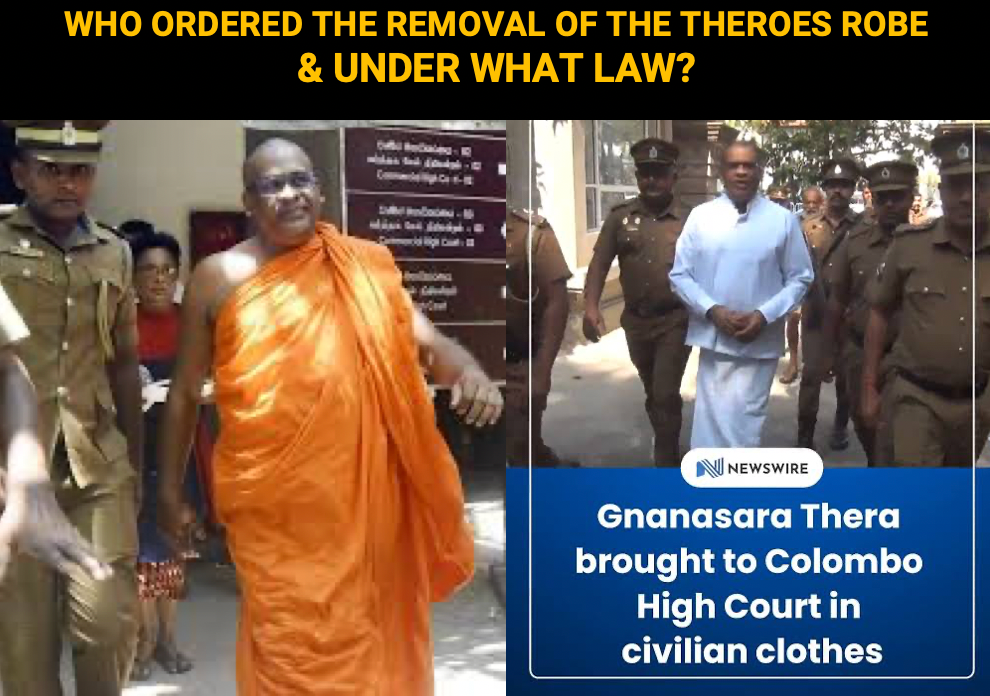
THE REMOVAL OF THE ROBES RAISES A SERIOUS CONSTITUTIONAL QUESTION
The Court of Appeal ordered implementation of a prison sentence.
But public reports do not state that the Court ordered the removal of Ven. Galagodaaththe Gnanasara Thera’s robes.
However, Prison authorities say they removed the robes and issued ordinary prison attire.
An Anunayake Maha Thera has now formally asked that the robes be restored.
This creates a simple question:
WHO ORDERED THE REMOVAL OF THE ROBES — AND UNDER WHAT LAW?
THE ANSWER MATTERS
Article 9 gives Buddhism the foremost place and expressly makes it the responsibility of the State to protect and foster the Buddha Sasana.
Article 9 must be read together with Articles 10 and 14(1)(e), which protect freedom of religion and the manifestation and practice of religious belief.
The robe of an ordained Buddhist monk is an integral expression of his religious identity and practice.
Ven. Gnanasara Thera is serving a sentence arising from a conviction for contempt of court. The sentence does not, by itself, entail prison authorities to remove his religious robes.
A sentence for contempt restricts liberty. It does not, by itself, authorise interference with the religious robes of an ordained Buddhist monk or justify treatment that diminishes his religious dignity
If the State removes the robes, the issue is no longer simply about prison clothing. It becomes a question of whether the State itself has interfered with a constitutionally protected religious practice — and whether that interference is lawful.
The State cannot simply say ‘He is a prisoner, so his robes must be removed.’ Imprisonment is the sentence. Removal of the robes is a separate State action requiring its own legal authority and justification.
THE QUESTIONS
- Did the Court order the removal of the robes?
- If not, which prison authority ordered it?
- What specific law, rule, regulation or Gazette authorised it?
- Did the prison authority have specific legal power to remove the religious robes of an ordained Buddhist monk, or was the decision ultra vires?
- How was the State’s constitutional responsibility under Article 9 to protect and foster the Buddha Sasana considered before removing the robes?
- What consideration was given to Articles 10, 12 and 14(1)(e), including freedom of religion and the manifestation and practice of religious belief?
- Was the relevant Maha Sangha consulted?
- What prison, security or other lawful purpose required the removal of the robes?
- Why was removal necessary when the sentence arose from contempt of court, and what specific security or prison-management concern required interference with his religious robes?
The State may rely on the general requirement concerning prison clothing.
But that does not automatically answer the separate constitutional question concerning religious robes.
Prison Rule 46 requires prisoners to wear prison clothing as directed.
But the existence of a general prison-clothing requirement does not, by itself, answer the separate question of whether that rule authorises the removal of the religious robes of an ordained Buddhist monk.
That specific legal authority must be identified.
WHAT THE THERO’S LAWYERS SHOULD DO
Immediately obtain:
- the complete Court of Appeal order;
- the written prison order removing the robes;
- any circular, standing order, prison regulation or written instruction relied upon to require removal of the robes;
- the name and authority of the decision-maker;
- the precise legal provision relied upon;
- the written reasons;
- any instruction concerning his appearance before court.
Then ask the Court to determine:
- Whether the removal of the robes was a consequence of the Court’s order, or a separate exercise of administrative power by prison authorities.
- If it was a separate administrative decision, on what legal authority was that decision made and what constitutional considerations were applied?
- Was the decision-maker legally empowered to make that decision? If the prison authority had no legal power to remove the robes, was the decision ultra vires — beyond the authority conferred upon it by law?
- Was the decision recorded with reasons, and were the constitutional responsibilities and rights engaged by the decision considered?
- Was the removal of the robes lawful, necessary and constitutionally compatible?
- If there is no specific legal authority, the lawyers should consider challenging the administrative act of removing the robes separately from the prison sentence itself.
WHAT THE BUDDHIST WORLD SHOULD DO
Buddhist leaders and organisations worldwide should ask one question:
WHY WAS THE RELIGIOUS ROBE OF AN ORDAINED BUDDHIST MONK REMOVED BY A STATE PRISON AUTHORITY WHEN THE PUBLICLY REPORTED COURT ORDER CONCERNS IMPRISONMENT — NOT REMOVAL OF HIS ROBES?
They should demand immediate:
- restoration of the robes pending determination of the issue;
- clarification from the Sri Lankan Government;
- clarification from the Commissioner General of Prisons;
- the position of the Maha Sangha;
- international Buddhist support for the protection of the Buddha Sasana and the religious dignity of an ordained monk.
REQUEST TO UN SPECIAL PROCEDURES
The relevant UN Special Procedures should seek clarification from Sri Lanka on:
- Who ordered the removal?
- What law authorised it?
- How was Sri Lanka’s constitutional responsibility under Article 9 to protect and foster the Buddha Sasana addressed?
- What consideration was given to freedom of religion and the manifestation and practice of religion or belief under Articles 10 and 14(1)(e)?
- Was removal necessary and proportionate?
- What legal authority justified interference with the religious robes as part of the implementation of the sentence?
The Special Procedures should also distinguish between the lawful enforcement of a court sentence and any separate administrative action taken by prison authorities.
The question is whether enforcement of a contempt of court sentence required — or lawfully authorised — interference with the religious robes of an ordained Buddhist monk.
This does not require interference with Sri Lanka’s judiciary.
It concerns a separate question: whether State action by prison authorities affected the religious freedom and dignity of an ordained Buddhist monk in custody, and whether that action was lawful.
THE COURT ORDERED IMPRISONMENT.
THE PRISON REMOVED THE ROBES.
THESE ARE TWO DIFFERENT ACTS.
WHO ORDERED THE SECOND?
UNDER WHAT LAW?
FOR WHAT PURPOSE?
AND WHY WAS IT NECESSARY?
THE SENTENCE MAY BE A MATTER FOR THE COURT.
THE REMOVAL OF THE ROBES IS A SEPARATE EXERCISE OF STATE POWER
— AND THE STATE MUST EXPLAIN HOW THAT ACTION IS COMPATIBLE WITH ITS CONSTITUTIONAL RESPONSIBILITY UNDER ARTICLE 9 TO PROTECT AND FOSTER THE BUDDHA SASANA.
IF THAT POWER HAS BEEN EXERCISED,
LET THE STATE IDENTIFY ITS LEGAL AUTHORITY.
LET THE STATE BE MADE TO ANSWER.