Sri Lanka’s Silent Shift from Sovereignty to India-Centric System Dependence – Removing Security Forces from Jaffna & Wanni
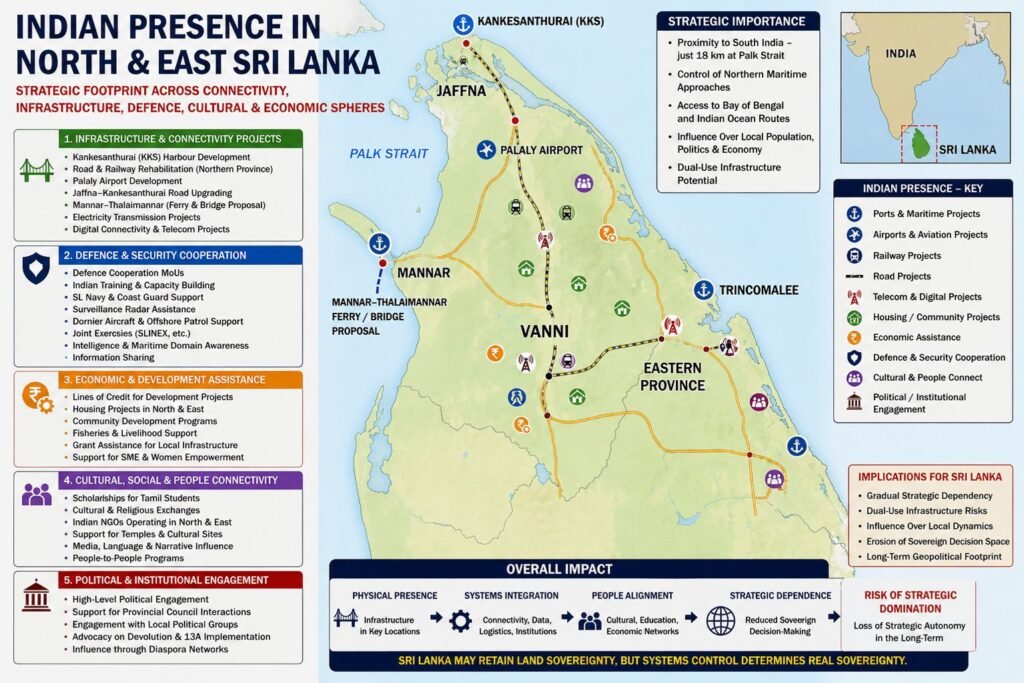
Calls for reducing or removing Security Forces camps in Sri Lanka’s Northern Province in particular the Jaffna & Wanni security forces, are being promoted as post-conflict normalization, reconciliation, and civilian land release. These developments must be read as part of Sri Lanka’s broader transition from sovereign security control toward system-based dependency systematically instigated across Sri Lanka but visibly seen in the North and East strategic arc.
This issue cannot be treated lightly. Such a decision cannot ignore wider geopolitical reality and implications that are being built around regional connectivity.
- growing external economic and infrastructure penetration
- maritime competition in the Indian Ocean
- strategic interest in Sri Lanka’s northern maritime corridor
- evolving regional power influence
- cross-border logistics links
- cross-border people connectivity
The first and most visible pressure points of this transformation are Jaffna and Wanni, where military reduction, land release, and conversion of strategic infrastructure are already being advanced.
This is not symbolic.
It is structural.
It affects Sri Lanka’s:
- sovereignty
- maritime control
- territorial continuity
- national security resilience
- unity, sociocultural and political integrity
Jaffna and Wanni are not post-war zones.
They are part of Sri Lanka’s most sensitive and vital northern frontiers.
- WHY MILITARY PRESENCE WAS PLACED IN THE NORTH – IS REASON WHY MILITARY PRESENCE SHOULD REMAIN
Sri Lanka’s security doctrine (N.Q. Dias era) identified the North as a permanent vulnerability due to:
- proximity to South India
- illegal maritime movement
- illegal immigration
- smuggling routes across the Palk Strait
- external influence exposure
- strategic maritime access
This was never temporary.
It was a security doctrine that was relevant then and is relevant now and crucial in the foreseeable future. This is so because the competition for dominance over the Indian Ocean region is at a crossroads between great powers, shaping the future of our country.
The Northern Areas, especially the Wanni jungles, became more critical during the separatist conflict when:
- arms smuggling
- offshore logistics
- external coordination networks
- jungle hideouts and most importantly, terrorist training bases
were actively used.
The situation was compounded by short-sighted decisions of the post-Sirimavo government that removed some of the security camps in the Northern areas, enabling a Tamil-separatist movement to cross the shore, hide, build logistics, train and attack the Sri Lankan state.
- WHY ARE THE NORTHERN AREAS STILL STRATEGICALLY VULNERABLE AND CRITICAL FOR NATIONAL SECURITY
Today, the same vulnerabilities continue in modern form:
- illegal fishing and resource exploitation
- narcotics trafficking across Indian Ocean routes
- human smuggling networks
- maritime intelligence gaps
- external influence activity
- competition among external powers for dominance of marine & natural resources within the EEZ.
The North + East form a single strategic arc linking:
- Palk Strait
- Bay of Bengal approaches
- Indian Ocean shipping lanes
- Trincomalee deep-water harbour region
This is why the 1987 Indo-Lanka Accord referenced both North & East.
Weakening the North+East strategic arc directly impacts Sri Lanka’s:
- National security & strategic resilience for the national defence posture against separatism and extremism
- maritime sovereignty
- trade security
- energy routes
- national defence posture
- Cultural integrity, unity & the safeguarding of vital national heritage sites.
For the island nation of Sri Lanka:
The keys to enter & exit must not only legally belong to Sri Lanka but also be under its exclusive non-negotiable control.
Maritime security = National survival of Sri Lanka.
- SECURITY FORCES = NATIONAL RESILIENCE SYSTEM
Security Forces in the North are not just military units.
They provide:
- coastal surveillance
- anti-narcotics operations
- intelligence networking & monitoring
- disaster and pandemic response
- emergency logistics
- humanitarian assistance
- dominance & defence of vital national infrastructure and assets
During COVID-19 and floods, they:
- ran entire logistics operations
- supported isolated communities
- maintained essential services
- enabled national emergency response – filling a key gap in national civilian capacity & capability.
Security Forces provide – Cultural and Civilizational Security Layer
- protection of archaeological sites in North
- security for pilgrimage routes
- protection of Buddhist theroes under constant attacks
- prevention against vandalism of national heritage & ruins
- Land encroachment and the prevention of illegal settlements that affect natural population growth & expansion.
- Security Forces’ role in safeguarding heritage, civilian rights & religious movements.
These sites form part of Sri Lanka’s civilizational security architecture in the Northern Frontier, one that is constitutionally binding.
Removing them removes more than “military presence”.
It removes State identity, erases history and most importantly, the capacity for crisis response & people’s hope for safety.
It threatens and removes state capacity during crisis response & people’s hope for safety and security; if denied, a failure in providing human security for the citizens is an inalienable and undeniable responsibility of a State.
- WHAT REDUCTION ACTUALLY MEANS
If Northern military infrastructure is reduced, Sri Lanka will face:
- weaker coastal surveillance
- slower response to trafficking networks
- intelligence blind spots while enabling space for the growth of external & spy/intelligence networks.
- reduced disaster response capability
- loss of rapid deployment readiness
- erosion of state presence in frontier zones
- creates gaps in the erosion of national identity, history, heritage and people’s rights to safety and security. Thirty years of separatist conflict and religious extremism have provided an abundance of painful lessons & experiences.
Strategic Loss of Palali Military Air Capability
- Palali airbase conversion risk (transferring a military base into a civilian airport expansion pressure)
- Loss of rapid military airlift capability
- Loss of evacuation and reinforcement corridor
- Irreversibility of civilian conversion of military airbases
- Impact on Jaffna Security Forces HQ strategic depth
- Conversion of Palali airbase into a strategic air transportation hub aligned with Indo-Pacific security frameworks, including QUAD and Indian Ocean Region (IOR) connectivity and logistics architectures, risks progressively reducing Sri Lanka’s independent control over critical northern air mobility infrastructure: more critically impacting Sri Lanka’s traditionally held non-aligned policy.
The Palali airbase conversion is not an administrative upgrade but a strategic reclassification of a wartime military asset into a civilian airport, permanently reducing the State’s rapid military airlift capability, later to be converted into a regional air hub for external use.
Reduction of the Jaffna Security Forces HQ and conversion of Palali airbase must be viewed as interconnected strategic shifts, not as separate administrative decisions and as seriously undermining Sri Lanka’s national security.
More critically:
Once dismantled, operational capability cannot be quickly rebuilt, and what about the cost to rebuild and relocate such infrastructure elsewhere, and the time involved?
What about the security gaps during the transition period?
Does the Sri Lankan government have the fiscal capacity and the will to undertake such a strategic transformation of the existing national defence system, which was built over decades based on battle experience?
A more important question is whether the external powers with vested interests will allow such commitment by the Sri Lankan government to align and restore its defence system strategically, which might undermine their geostrategic and geopolitical interests?
Closure of Security Camps in Jaffna & Wanni results in loss of:
- terrain knowledge
- intelligence networks
- local operational familiarity
- logistical depth
- Abandoning strategically important defence grounds that were defended at the cost of many young and brave lives.
These take decades to develop, not months, and billions of government money that could otherwise be invested in state capacity building for national development.
- EXTERNAL INFLUENCE & SOFT TRANSFORMATION
The North sits at a strategic intersection of:
- India proximity
- Indian Ocean access
- post-war reconstruction flows
- infrastructure and connectivity projects
Geopolitical influence today comes in different forms.
- Infrastructure
- development funding
- diplomacy
- education networks
- cultural & religious transformation
- all types of connectivity corridors
The question is not “who controls land”.
It is:
Who shapes systems operating on that land?
Sovereignty today is not only about land ownership. It is about who operates the systems that function on that land: logistics, data, transport, energy, and connectivity networks.
Modern sovereignty is determined not by territorial ownership alone, but by control over operational systems running on that territory — roads, railways, airports, and other logistics infrastructure; data, energy, and connectivity networks; and, more significantly and harmful
cultural penetration & externally-led sociocultural reshaping.
This aspect reshapes people’s thinking and realigns them to a foreign-controlled model.
Sri Lanka may well legally control the land, but what happens when systems operating on that land are controlled by external forces, and once outsourced, Sri Lanka has little or no say!
- WHO IS PUSHING FOR THE REDUCTION OF SRI LANKA’S MILITARY FROM JAFFNA & WANNI?
Pressure for reduced military presence comes through:
- demilitarisation and defence reform frameworks
- UNHRC post-conflict reconciliation narratives
- devolution advocacy groups
- external policy influence networks
- diaspora-driven political campaigns
- incremental integration based on connectivity, infrastructure, institutional alignment, and people-to-people networks can evolve into structural dependence, reducing Sri Lanka’s sovereign decision-making capacity and ultimately resulting in Sri Lanka’s strategic absorption into a foreign-dominated regional system.
The language used is:
- reconciliation
- normalization
- development
- civilian governance
- defence sector reforms, modernization and restructuring
In modern geopolitics, control is exercised not only through territory but through infrastructure, logistics systems, and connectivity networks that operate on that territory.
But missing from the discussion is one reality:
Strategic vacuum will always get filled — it is never left empty.
There are many historical lessons: a state that fails to enforce precise decisions with regard to national security and defence will perish, never to recover for centuries!
This is what should worry Sri Lanka’s political & defence leadership.
- THE REGIONAL POWER REALITY
Small states do not operate in isolation.
In South Asia, influence is shaped through:
- economics
- infrastructure
- maritime access
- security partnerships
- cultural & religion
- ethnicity & historical roots of common identity
Sri Lanka’s location makes it inherently strategic.
Therefore:
Reducing strategic presence in the Northern areas without a fitting military replacement capability creates dependency vulnerabilities that are difficult to reverse.
- MODERN THREATS ARE NOT MILITARY ALONE
Today’s threats include: these syndicates often work in cohesion
- separatist and extremist networks
- narcotics economies
- cyber-financing systems
- digital radicalisation pipelines
- coordinated destabilisation campaigns
- social media influencers / narrative creators (pose the biggest threat)
- non-governmental organizations and foreign-funded proxy networks
State weakening does not begin with war.
It begins with:
- reduced surveillance
- reduced presence
- reduced readiness
- reduced reinforcements
- reduced capabilities and preparedness
- increased cultural & educational integration
- increased proxy activities and anti-regime intelligence networking
- increased external dependence
- increased external footprints
- increased information warfare shaping national mindset, transforming consciousness
Then the surprise emerges: Sri Lanka was and is not ready, and Sri Lanka is being exploited right in front of our eyes!
- HISTORICAL WARNING — WHAT SRI LANKA ALREADY EXPERIENCED
Strategist N.Q. Dias identified the Northern areas as a permanent strategic choke point.
After 1977, weakening northern security architecture contributed to:
- loss of surveillance depth
- growth of militant networks
- offshore arms logistics
- expansion of separatist violence
- nearly 30 years of war
- loss of state control and governance
This created early surveillance gaps in a region already identified as a permanent strategic frontier!
The lesson is clear:
Weakening strategic presence and intelligence creates space for the escalation of elements that will threaten Sri Lanka at every level and at every time.
- MODERN LESSON — 2019 EASTER ATTACKS
Sri Lanka also learned that:
Even after peace periods:
- threats can re-emerge
- networks can evolve
- intelligence gaps are exploited
The 2019 Easter Sunday attacks proved that stability is not permanent, peace is fragile, and state armed forces were not ready, and the intelligence network was paralysed.
WHAT IS REALLY AT STAKE
Removing or reducing the Armed Forces from Northern Areas is not administrative reform.
It is a strategic restructuring.
It affects:
- sovereignty control
- maritime dominance
- intelligence coverage
- emergency response capacity
- territorial continuity and connectivity
- restraints on external powers, proxy networks and foreign intelligence activities.
Most importantly:
For the people of Northern areas, military presence is not just security.
It is:
- guaranteed assistance (in numerous forms), security & protection
- disaster response
- emergency logistics
- protection of infrastructure
- stability during crises
- state presence in vulnerable zones
- Protection and preservation of heritage & state identity as per Sri Lanka’s Constitution.
Northern areas are strategically important for providing a safety buffer to Anuradhapura, a place that has historically been under constant threat since its establishment as the first Kingdom of Sri Lanka; together they form the central security corridor between the north and the rest of the island.
Anuradhapura, out of all places, is the most sacred and sensitive heritage of Sri Lanka; specially to Buddhist and Sinhalese. Therefore, the continued existence of security camps in the Wanni is critical to safeguard Anuradhapura and not to repeat the kind of heinous massacre that took place at Jayasri Maha Bodhi committed by LTTE.
Wanni functions as Sri Lanka’s central defence buffer zone linking the Northern frontier to the national interior security belt. Giving up this access is administrative & security hara kiri.
For civilians in Jaffna and Wanni, the presence of Security Forces is not an abstract military policy — it is immediate protection during disasters, crises, and instability, and, most importantly, untold numbers of other support networks for civilians by military forces since the end of the conflict in 2009.
No foreigner will look after one’s own like one’s own.
The critical question remains whether Sri Lanka has the fiscal capacity, technological base, and institutional depth to develop and sustain advanced military and surveillance systems capable of replacing the operational gaps that would be created by a reduced Security Forces footprint in Jaffna and Wanni.
Reforming, modernising, and restructuring the national defence system is not a simplistic administrative exercise; it cannot be at the behest of foreign advice or pressure to satisfy their geopolitical and geostrategic interests!
Reforming, modernising, and restructuring the national defence system requires long-term strategic foresight – wisdom in national security design, sustained investment, and defence planning that goes far beyond visible political electoral cycles.
National defence can never be in conflict with political interests.
At present, there are concerns regarding uneven regional development and strategic neglect in areas such as Mannar, which already shows signs of limited infrastructure prioritisation, ethnic, cultural and religious divisions and disunity despite its geographic importance to the nation’s survival.
If similar patterns of reduced strategic investment extend to Wanni as a result of removing the armed forces’ presence in a jungle terrain that the LTTE exploited to the fullest, the resulting gaps could significantly weaken Sri Lanka’s northern defensive depth, maritime monitoring capacity, and rapid-response capability while creating more gaps for the expansion of foreign intelligence networking, regional exploitation and subsequent outcomes.
In geopolitical terms, the Northern-Eastern maritime corridor remains one of the most sensitive segments of the Indian Ocean region. Any sustained reduction in state security infrastructure risks gradually alters the strategic balance of the island’s sovereignty and creates vulnerability for strategic resources in the EEZ for exploitation.
For a small island nation situated within a highly competitive maritime environment, the key issue is not only current policy, but the long-term trajectory of sovereignty protection, system resilience, and strategic autonomy.
The real question is not whether camps should exist.
It is: Can Sri Lanka afford to lose permanent state presence and capability in its most sensitive frontier region?
Because once lost, it cannot be easily regained or rebuilt — and in a situation of financial strain, surrendering what little security presence and capacity remains physically, effectively exposes the state to external strategic dominance, a condition that is politically irreversible once it takes root.
Protecting our country demands serious & honest factoring in the past, current & future security threats while maintaining national independence & making national security decisions free from foreign & external pressure.
What is ours must remain ours not only legally but in terms of control as well.
Who will be accountable for the strategic miscalculations (if it is to ever happen) in national security and the defence of our state?
Is there an accountable and sustainable process, a resilient homegrown system of national security policy making, and set of experts who (who are also capable of understanding and navigating amid internal and external pressures and demands) could honestly advise on a critical national survival issue under the current context, while taking into account the states’ national interests, while fulfilling the citizens’ aspirations for a secure and peaceful country that experienced brutal 30 years separatist conflict, two armed insurrection in 1971 and 1988-1990 era and a religious extremism and terrorism in 2019?
These are defining decisions that will shape the future of national security and sovereignty. Any move to restructure the defence architecture must come only after these critical questions are rigorously examined, transparently debated, and responsibly answered. To proceed without such scrutiny is to risk compromising not just strategy, but the very sovereignty we are duty-bound to protect.
Shenali D Waduge
SRI LANKA: Silent shift from Sovereign Control to India-Centric System Dependence