Is there a “maha molakaru” Mastermind behind the FlyDubai flight – comparing Al-Hammami with Zaharan Hashim
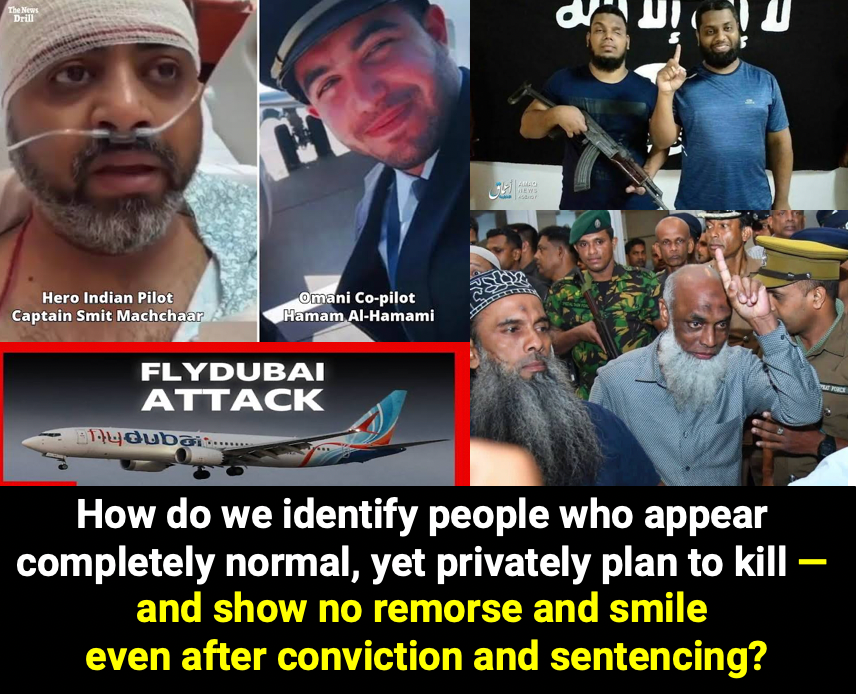
34-year-old Zahran Hashim, leader of the NTJ, was identified as the leader behind the Easter Sunday suicide attacks in Sri Lanka that killed 269 people in 2019.
Fast forward to 2026.
29-year-old Hammam al-Hammami, an Omani national born to an Omani father and Syrian mother, was the co-pilot of Flydubai flight FZ1073 from Dubai to Tel Aviv.
The two cases are not being presented as the same organisation or the same terrorist network. The question is more fundamental:
What happens when warning signs of extremism are identified — but the individual is still able to reach a position from which he can cause mass casualties?
And what happens when seemingly ordinary people — colleagues, professionals, neighbours, even those we trust — privately develop an intention to kill innocent people?
How can even the intelligence and security apparatus recognise an individual who appears completely normal, but is privately planning to kill?
Just as intelligence on Zahran’s extremism had been flagged over years by different sources, Oman had reportedly identified Hammam as a security concern and removed him from flying duties.
How did he then obtain access to another commercial cockpit?
This is the question that connects the two cases.
The issue is not simply whether an extremist was detected.
The real test of security is what happens after detection.
If one institution identifies an individual as a security concern, does that information follow him when he changes employer, changes country, changes profession or seeks access to another sensitive position?
Hammam was reportedly removed from flying duties by Oman Air. Yet he later reached the cockpit of a Flydubai passenger aircraft.
Zahran was investigated, searched for, placed under an arrest warrant and repeatedly flagged through intelligence.
Yet he remained operational and ultimately helped prepare the Easter Sunday attacks.
Detection without prevention is not security.
Intel dossiers on Zaharan was available from 2015 onwards. Law enforcement in Oman also reveal that Hammam while co-pilot at Oman Air in 2024 held extremist material, regularly visiting extremist websites and was removed from flying duties and given a desk role. He eventually left Oman Air and joined FlyDubai.
If one aviation employer considered him a risk to remove him from flying, how did that information not pass through to other airlines who risked putting him on a commercial flight.
What information was known about Hammam at each stage of his aviation career — and what information was passed to the next institution?
If Oman Air had identified a security concern serious enough to remove him from flying duties, aviation investigators now need to establish whether that concern was formally communicated, to whom, and whether it was available to those responsible for subsequently assessing his suitability for another commercial cockpit.
Zaharan Hashim did not become a suicide bomber on the day of Easter Sunday. Likewise Hammam did not become a radical on 30 September 2026.
His Linkedin profile is interesting
- Worked for Oman Air until Feb 2025
- Royal Air Maroc from June 2025 to January 2026
However, the profile is now deleted.
However as per reports Royal Air Maroc says it did not employ him as a pilot. Another report says he underwent 3months training but was not hired. It is interesting to find out why he was not hired. But why did FlyDubai employ him? This is for FlyDubai to now investigate.
Let us also go through the global media reports. CNN claims Hammam held extremely restrictive views especially regarding women. He opposed women working, insisted wife wears a niqab and stop working after marriage and also criticized mixed-gender workplaces. Then why did he choose to be a pilot?
The disturbing point is that extremist ideology does not necessarily announce itself through a person’s profession or outward appearance.
A person can simultaneously be a professional, colleague, husband, son and apparently ordinary member of society while privately developing an extremist worldview.
The danger is not that an extremist looks different.
The present danger is that an extremist may look completely ordinary until ideology becomes action. This is where Islamic terrorist ideology differs to other non-Islamic terrorism.
As per Wall Street Journal more than 3000 screenshots had been recovered from his deleted X account with posts hostile to women working as well as other radical views.
Let us be clear that holding deeply religious or conservative views do not make a person a terrorist but extremist material plus security concerns plus removing from flying plus extremist online viewing plus obtaining access to a passenger cockpit and thereafter deliberately attempting to bring an aircraft down – does.
There are other alarming reports which need to be fully scrutinized but reveal that on the day of the attacks video footage of the cockpit, the Israeli aircraft and images of al-Zawahiri the former Al Qaeda leader was shown. There is much for investigators to piece together.
Whether this was an individual attack or an attack spearheaded by a group – the ideology being followed is the same and this is what makes the ideology more dangerous than other terrorist ideology. A lone radical is just as dangerous as radicals trained by a group.
Australian connection
There is a striking parallel between Hammami with the Easter Sunday bomber Jameel Mohamed who studied aerospace engineering at Kingston University in London 2006-2007 then went for postgraduate studies to Swinburne University Melbourne where he remained until 2013. Friends claim he became radical while in Australia and returned to Sri Lanka as a “completely changed person”.
Australian intelligence had investigated Jameel for links to ISIS fighter Neil Prakash. Sri Lanka’s Presidential Commission identified Jameel as “Abu Hamza” within Zaharans group.
Australia’s Victoria Police & ASIO are also investigating Hammami who came to Australia as a student in 2014 to study engineering at RMIT in Melbourne. His Australian visa had been cancelled in 2019.
He is said to have completed a 3 year distance-learning aviation management degree at Buckinghamshire New University in the UK & graduated in 2023.
The golden question is how do wealthy educated Muslims going to study in Western states become radical enough to want to kill innocent non-Muslims?
More importantly no person says “I am going to become a terrorist” but how can we identify people who appear perfectly normal but are privately developing extremist ideology dangerous enough to kill?
So how do we identify someone who appears perfectly normal while privately developing an extremist ideology dangerous enough to kill innocent people?
This is where security policy faces its most difficult challenge.
The answer cannot be to judge a person because he is Muslim.
But neither can a fear of appearing “anti-Muslim” prevent authorities from acting when there are credible indicators of violent extremism.
The test must be conduct, evidence and credible intelligence — not religion.
What is the person saying? What material are they consuming or producing? Who are they communicating with? Are there links to extremist networks? Are there preparations for violence? Have credible security agencies previously identified a concern?
A Muslim is not a security threat because he is Muslim.
A person who is preparing violence is a security threat because of what he is planning to do.
ZAHRAN DID NOT BECOME A TERRORIST ON EASTER SUNDAY
Zahran Hashim did not suddenly become a suicide-terror mastermind on 21 April 2019.
His extremist activities, propaganda, associates and movements had been known to Sri Lankan authorities for years.
- There were investigations.
- There were intelligence reports including foreign intel giving exact target locations
- There were dossiers.
- There were searches & discovery of over 100kg of explosives & testimonies from those arrested to being trained as suicide bombers
- There was an arrest warrant in 2017 / AGs dept had 3 files on Zaharan since 2017
- There was the discovery of explosives months before Easter.
- And there were warnings identifying the threat.
The question is therefore not simply:
“Why did nobody know?”
“What happened after they knew?”
What happened on 30 September 2026 to FlyDubai flight FZ1073 / Boeing 737 MAX 8
Boarding – Dubai
- Hamam al-Hammami was the co-pilot operating from Dubai to Tel Aviv
- 182 passengers
- Nothing abnormal to the passengers or rest of crew.
- Scheduled departure 0705 UAE time / climbed approximately 34,000 feet
- More than 2 hours – flight proceeded normally
- Flight expected to land in 3 ½ hours
Something changes after 2 hours
- As per the captain the co-pilot excused himself to pray.
- Captain was suddenly attacked with the aircrafts emergency crash axe
- Co-pilot attempted to take control of the aircraft.
- 0921 UAE time – Aircraft goes into a massive descent (Reuters estimate more than 16,000 feet in 30 seconds)
- Captain fights with co-pilot while injured & attempted to reach the cockpit door – eventually he succeeded to open it.
Cockpit door is opened
- Passengers enter & physically restrain Hammam
- Aircraft transmits emergency signals
- At 0935 code 7500 given indicating unlawful interference/hijacking.
- Aircraft enters Jordan briefly before turning to Saudi Arabia – for emergency landing
- 0945 Saudi time – emergency landing at Prince Sultan bin Abdulaziz International Airport in Tabuk
The heroes
- The captain Smit Machchhar – an Indian with 9750 hours of Boeing 737 flying experience. Served as senior commander & line-training captain with SpiceJet before joining FlyDubai.
- Inspite of being hit with the emergency crash axe, he continued fighting the copilot and managed to open the cockpit door giving passengers room to intervene & stop the co-pilot from bringing the plane down.
His actions were critical. He did not simply survive the attack; he fought to prevent the aircraft from being taken over.
- A 6 year old – Nina Manes needed to use the toilet & her mother accompanied her to the front of the aircraft close to the cockpit
- They heard struggling & shouting inside cockpit
- They alerted flight attendant & people nearby
- Round about the same time the captain had managed to force open the cockpit door though injured
- The passengers saw an injured captain & the co-pilot attempting to damage the controls.
- Yaniv Hayun – an Israeli plumber rushed to the cockpit, grabbed Hammam the co-pilot and pulled him away from the controls. He realized the plane was descending and grabbed the controls & managed to stabilize the aircraft. An off-duty pilot who was also a passenger then came & took over the controls. Yanly the plumber has to be applauded for stabilizing the plane.
- Several other Israel’s are worthy of mention – Dr Shota Musaey – a doctor gave emergency treatment / Asaf Rajuan – a fellow passenger helped restrain the co-pilot while several other passengers also intervened. 5 passengers have been already nominated for Israeli Presidential Award for Civilian Heroism.
When the institutional barrier failed, ordinary people became the last line of defence.
After landing:
- UAE investigators declare co-pilot attacked captain with emergency axe & attempted to take control of aircraft.
- UAE Attorney General describes attack as a terrorist act
The cases of Hammam al-Hammami and Zahran Hashim reveal a disturbing common pattern:
- warning signs existed, yet the systems responsible for preventing access to danger failed.
- Hammam had reportedly shown signs of radicalism and was removed from flying duties by Oman Air and placed in a desk role — yet he later obtained a co-pilot position with Flydubai.
- In Sri Lanka, Zahran and his network were under investigation for years, with search warrants, intelligence reports, extremist dossiers and repeated warnings — including a specific warning before Easter Sunday identifying Zahran, his associates and potential targets. Yet the attacks still took place.
- The difference is that on FZ1073, passengers and crew acted in time to stop the attack; on Easter Sunday, despite the intelligence available to the authorities, the system failed to stop the attackers before they reached their targets.
HOW DO WE PROTECT ORDINARY MUSLIMS WITHOUT PROTECTING EXTREMISTS FROM SCRUTINY?
Ordinary Muslims must not be treated as suspects because of the actions of extremists.
But neither can accusations of “hate speech” or “Islamophobia” become a reason to ignore credible warnings about particular individuals engaged in extremist activity.
Sri Lanka has experienced this problem before.
In 2016, Justice Minister Wijeyadasa Rajapakshe informed Parliament that 32 Muslims from four families had travelled to Syria to join ISIS. Muslim MPs protested his statement and the controversy eventually contributed to his removal from the Justice Ministry.
Whatever one’s political position on that episode, the wider question remains:
If raising a specific security warning becomes politically or communally dangerous, how can authorities act on the next warning before it becomes the next attack?
The answer is not collective suspicion.
The answer is evidence-based scrutiny.
Protect the innocent community. Identify the extremist individual. Investigate the evidence. Act on credible warnings.
Non-Muslims cannot be expected to become the guinea pigs who discover too late that an extremist warning was ignored simply because the community leaders gang up to shout ‘hate speech’.
Hammam was reportedly removed from flying duties after extremist concerns were identified, yet later reached another commercial cockpit. Zahran was investigated, searched for, placed under an arrest warrant and repeatedly flagged through intelligence, yet remained free to build his network and prepare the Easter attacks. The real failure is not identifying extremists — it is failing to act on the warning signs once they are known. We have to wonder whether inaction came as a result of the bogus political correctness that had embedded society or simply fear of taking action given the ultimate outcome.
DID POLITICAL FEAR STOP A SECURITY ALERT?
We have to ask whether authorities sometimes hesitate to act on credible extremist warnings because of the political and communal consequences of doing so.
- Was it lack of information?
- Was it failure to communicate information?
- Was it bureaucratic failure?
- Was it institutional rivalry?
- Or was there a fear of being accused of discrimination, Islamophobia or hate speech if action was taken against individuals from a particular community?
Whatever the answer, the consequence is the same if a credible threat is left unaddressed.
Political correctness cannot become a security protocol.
The protection of an entire community from prejudice and the protection of society from violent extremists are not contradictory objectives. In fact, both require the same principle:
Judge individuals by evidence and conduct — not by religion.
SO — IS THERE A “MAHA MOLAKARU”?
We do not yet know whether Hammam acted alone.
Investigators need to establish:
Who influenced him?
Who did he communicate with?
What extremist material shaped his thinking?
Why did he choose this particular flight?
Why Tel Aviv?
Was the attack planned in advance?
Did anyone know?
Did anyone assist?
Did anyone facilitate his access to the cockpit?
And most importantly — did anyone know enough to stop him before 30 September 2026?
Whether Hammami was acting alone or whether Zaharan acted in a group – that they followed the same ideology is undisputed. This is what makes the plight more serious than other terrorist threats.
The world should not wait for another aircraft, another church, another hotel or another gathering of innocent people to discover the answer.
Because the lesson of both Hammam and Zahran is painfully simple:
The warning signs may appear long before the attack.
The question is whether anyone acts on them and why action was not taken when it could have been taken.
Saving innocent lives must come before worrying about whether confronting an extremist will upset the extremist or their masterminds.
The priority of security must be clear:
Protect the people the extremists intend to harm — not the sensitivities of those preparing to harm them.
Lives must come before political correctness.
Shenali D Waduge