
MATARA AMBULA HOTEL DEMOLISHED IN JAFFNA: ARE SINHALESE SECOND-CLASS CITIZENS IN NORTHERN SRI LANKA?
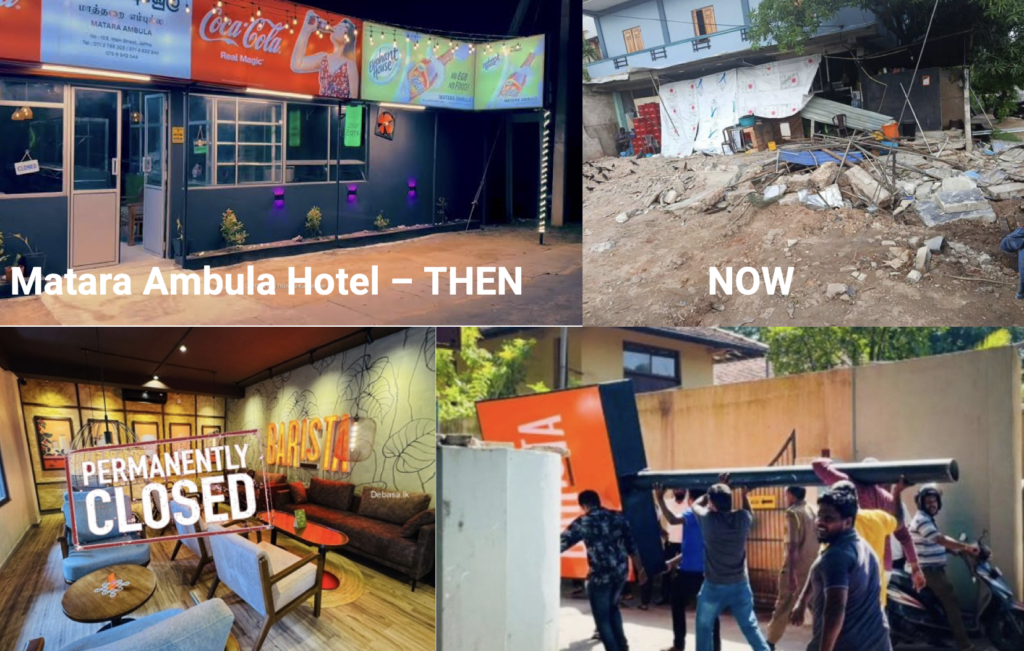
A Sinhala family’s restaurant demolished after nearly nine years of business raises urgent questions about ethnic discrimination, selective enforcement and the right of Sinhalese to live, work and worship anywhere in Sri Lanka. Where are the NGOs, diplomats, UN & UNHRC speaking for the rights of the Sinhalese?
A Sinhala family from Matara went to Jaffna, opened a restaurant, built a livelihood, employed 23 people from Sinhala and Tamil communities and served customers for nearly nine years.
On 25 November 2026, workers from the Jaffna Municipal Council demolished the front section of their restaurant, Matara Ambula Hotel. The demolition became public through reports and videos published on 26 November.
The timing of the demolition raises another question. It took place on 25 November, immediately before Prabhakaran’s birthday on 26 November and Maaveerar Naal, the LTTE commemorative event,. Was this timing purely coincidental? If the structure had allegedly violated RDA regulations for years, why was the demolition carried out at this particular moment? The authorities must answer these questions with evidence, not dismiss them as speculation.
The Police say the structure encroached on Road Development Authority land and that the demolition followed a Magistrate’s Court order.
The family has questioned the manner in which the demolition was carried out. Reports have also raised allegations of selective enforcement and anti-Sinhala prejudice within the Council. Those allegations require investigation, and the court order and enforcement records must be examined. Was this the only structure violating RDA?
Incidentally, Jaffna Mayor V. Mathivathani lit the first lamp at the Municipal Council commemoration of Thileepan, an LTTE member. This raises further questions about the political environment in which Sinhala residents and businesses must operate.
But let us not allow this incident to be buried under a debate about a restaurant’s frontage.
WHY DOES THE RIGHT OF A SINHALA CITIZEN TO LIVE, WORK AND CONDUCT BUSINESS IN JAFFNA NEED TO BE QUESTIONED AT ALL?
Is Jaffna not part of Sri Lanka?
Does a Sinhala family require approval from Tamil politicians to establish a business there?
Does a Sinhala citizen become an outsider upon entering a Tamil-majority district?
Can a Sinhala family purchase land, build a home, send its children to school, obtain employment, operate a business and practise Buddhism without facing obstruction?
Can a Sinhala-speaking person approach a police station, government office or court and exercise constitutional language rights without being disadvantaged?
Can a Sinhala litigant understand proceedings, submit documents in Sinhala and obtain interpretation and translations as guaranteed by the Constitution?
These are not demands for privilege. They are basic rights of citizenship.
THE NORTH IS NOT THE PRIVATE PROPERTY OF ANY ETHNIC COMMUNITY
Sri Lanka is one country. Its citizens have equal citizenship.
No province, district, local authority or political party owns the territory it administers. No ethnic majority has the authority to decide which other communities may or may not live within its boundaries.
Every Sri Lankan citizen has the constitutional freedom to reside in any part of the country. The North is not an ethnic reservation.
The right to reside anywhere in Sri Lanka cannot depend on ethnicity.
The right to own property cannot depend on ethnicity.
The right to conduct business cannot depend on ethnicity.
The right to practise religion cannot depend on ethnicity.
The right to use one’s language cannot depend on ethnicity.
The right to equal protection of the law cannot depend on ethnicity.
Yet the experience of Sinhala residents and returnees in Northern Sri Lanka deserves serious examination. The decline of the Sinhala population during the conflict, the displacement of families, the difficulties surrounding return, disputes over land, opposition to Sinhala settlements, controversies over Buddhist religious sites, vandalism on Buddhist sacred sites, humiliating treatment to Buddhist theros and allegations of selective treatment raise questions that cannot be dismissed merely because they are politically uncomfortable to address.
A Jaffna resident, poet Somasundramoorthy Pathmanathan, recalled:
“Up to 1977, practically all the bakeries were run by Sinhalese.”
He also recalled that Sinhalese bakers delivered bread to people’s homes.
SINHALA WORKERS WERE ONCE PART OF EVERYDAY LIFE IN JAFFNA
Before 1977, practically all bakeries in Jaffna were run by Sinhalese, according to Jaffna poet and teacher Somasundramoorthy Pathmanathan. During the April New Year, when Sinhala bakeries closed, residents recall that bread became unavailable. Sinhala workers were once an integral part of Jaffna’s everyday economy.
DISCRIMINATION IS NOT ONLY A MOB ATTACK
Discrimination can take many forms.
It can happen when a family is prevented from returning to its home.
It can happen when a lawful property claim is obstructed.
It can happen when a business is selectively targeted.
It can happen when a child cannot access education in the child’s mother tongue.
It can happen when a government office fails to provide the language services required by law.
It can happen when a Sinhala-speaking accused person cannot understand court proceedings or obtain the interpretation guaranteed by Article 24.
It can happen when a Buddhist monk faces obstruction in exercising lawful religious rights, or when a Buddhist historical site is vandalized and prevented from carrying out religious rituals.
It can happen when a complaint is ignored, a threat is not investigated, or a citizen cannot obtain an effective remedy.
A citizen does not have to be driven out at gunpoint to be made unwelcome.
Administrative obstruction, economic exclusion, selective enforcement and denial of access to justice can also undermine equal citizenship.
WHAT EXACTLY IS HAPPENING TO SINHALESE IN THE FIVE NORTHERN DISTRICTS?
This investigation must examine Jaffna, Kilinochchi, Mullaitivu, Mannar and Vavuniya — not through political slogans, but through evidence.
It must establish:
How many Sinhalese lived in each district before the conflict, and how many live there today?
Which Sinhala families were displaced, and what happened to their homes and land?
Have returning families been able to reclaim their property?
Have Sinhala residents faced political opposition, intimidation or pressure to leave?
Are Sinhala-owned businesses treated equally by local authorities?
Are Sinhala children able to access education in their mother tongue?
Are Sinhala citizens able to obtain public services in Sinhala?
Are the constitutional language rights of Sinhala-speaking litigants respected in Northern courts?
Are Buddhist temples, monks, pilgrims and archaeological sites protected under the same law?
Are Sinhala fishermen, farmers and workers able to pursue their livelihoods without discriminatory restrictions?
Do police investigate complaints by Sinhala residents with the same urgency?
Are Sinhala victims of LTTE violence and their families given recognition, justice and appropriate assistance?
Are local politicians encouraging equal citizenship, or promoting an environment in which Sinhala residents are portrayed as outsiders?
Are Sinhala residents able to register births, marriages, deaths, land deeds and other legal documents in Sinhala without unnecessary delays or additional obstacles?
Can Sinhala-speaking people obtain police statements, complaints, investigation updates and copies of official documents in a language they understand?
Are Sinhala families able to access state land, housing assistance, compensation and government development programmes on equal terms?
Are Sinhala Buddhist pilgrims able to visit sacred sites, conduct religious observances and access temples without intimidation or obstruction?
Are Sinhala residents represented in local decision-making processes affecting their homes, businesses, religious sites and livelihoods?
Have complaints concerning vandalism, threats, destruction of property or obstruction of religious activities been investigated and prosecuted?
Are Sinhala families who were displaced by LTTE violence able to return, reclaim property and rebuild their lives without being labelled outsiders or colonisers?
Every allegation must be tested.
Every official explanation must be examined.
Every relevant court order, Gazette, land record, census return, police complaint and local authority decision must be brought into the open.
THE CONSTITUTION CANNOT BE APPLIED SELECTIVELY
Articles 12, 14, 18, 22 and 24 of the Constitution are not decorative provisions.
Article 12 guarantees equality before the law and equal protection of the law, and prohibits discrimination on grounds including race and language.
Article 14 protects freedom of movement and residence, lawful occupation and trade, and the freedom to manifest religion.
Article 14(1)(f), which protects the freedom to enjoy and promote one’s culture and use one’s language.
Articles 18 and 22 establish the framework for official languages and languages of administration.
Article 24 is particularly important. Sinhala and Tamil are the languages of the courts throughout Sri Lanka. A party may initiate proceedings, submit pleadings and other documents, and participate in court proceedings in either Sinhala or Tamil. A person who does not understand the language used in court is entitled to interpretation and translation as provided by the Constitution. These are constitutional protections, not favours granted by a court or government official. A Sinhala-speaking litigant in Jaffna must not be denied the ability to understand, participate in or obtain justice through the legal process.
Constitutional Language Discrimination Against Sinhala-Speaking Citizens in the North
Article 22(1) makes Tamil the language of administration in the Northern and Eastern Provinces.
Article 24(1) consequently makes Tamil the designated language of courts in these areas, with court records and proceedings maintained in that language.
Article 14(1)(f) guarantees every citizen the right to use their own language.
However, Sinhala-speaking citizens in the North do not have Sinhala as the default language of their local courts, unlike citizens in the rest of the country.
Although Article 24(2) allows citizens to use Sinhala in court, why should Sinhala-speaking citizens in North have to rely on translation to access justice in their own country?
These protections are not reserved for Sinhalese in Sinhala-majority areas, or Tamils in Tamil-majority areas. They belong to citizens throughout Sri Lanka.
If a Sinhala citizen cannot practically exercise these rights in Jaffna, that is not a small administrative inconvenience. It is a matter of constitutional equality.
THE QUESTION THAT MUST NOW BE ANSWERED
The Matara Ambula Hotel demolition must be investigated fairly.
If the structure violated the law, the law must be enforced.
But if enforcement was selective, if ethnic prejudice influenced the decision, or if the family was denied due process, those matters must be exposed and addressed.
And the investigation must not stop there.
For decades, the experiences of Sinhala families in the North have received far less public attention than they deserve. Their displacement, their property claims, their religious rights, their livelihoods and their access to public institutions must be documented with the same seriousness applied to the grievances of every other community.
SINHALESE ARE NOT FOREIGNERS IN JAFFNA.
THEY ARE NOT FOREIGNERS IN KILINOCHCHI, MULLAITIVU, MANNAR OR VAVUNIYA.
THEY ARE CITIZENS OF SRI LANKA.
The historical record cannot be rewritten to suit contemporary political demands. The island’s ancient hydraulic civilisation, its great reservoirs, stupas, monasteries, cities and irrigation networks stand as enduring evidence of the Sinhala kings and queens who built, governed, defended and sustained this country over centuries. This history is part of Sri Lanka’s national heritage. It cannot be erased, appropriated or reduced to an ethnic political dispute.
Nor can anyone use the language of self-determination, historical grievance or minority rights to claim exclusive ownership of territory within a country that belongs to all its citizens. No community has the right to deny another community the freedom to live, worship, work and own property in any part of Sri Lanka. A demand for equal rights cannot become a licence to deny equal rights to others.
Tamil political leaders and diaspora groups regularly accuse Sri Lanka of discriminating against Tamils and take these allegations to international forums. But what about discrimination against Sinhalese in Tamil-majority areas?
- Barista, Nallur: Faced organised protests over selling meat products near a Hindu temple and eventually closed its outlet.
- Matara Ambula, Jaffna: A Sinhala-owned restaurant operating for years was demolished, raising questions about selective enforcement and possible ethnic discrimination.
If Tamils demand equal rights and protection in Sinhala-majority areas, why should Sinhalese not enjoy the same rights and protection in Tamil-majority areas?
Equality and non-discrimination cannot be one-way demands.
No political party can redraw the boundaries of citizenship along ethnic lines. No local authority can convert constitutional rights into ethnic privileges. No political leader can decide that a Sinhala citizen is a foreigner in Jaffna, just as no one can deny a Tamil citizen the right to live in the South.
THE NORTH IS PART OF SRI LANKA. SINHALESE HAVE EVERY RIGHT TO LIVE THERE.
IF SRI LANKA IS ONE COUNTRY, THEN EQUAL RIGHTS MUST APPLY IN EVERY DISTRICT, TO EVERY CITIZEN, UNDER THE SAME CONSTITUTION AND THE SAME LAW.
NO DOUBLE STANDARDS. NO ETHNIC EXCLUSIVITY. NO SECOND-CLASS CITIZENS.
Shenali D Waduge


