How Western States and the UN enabled the Political continuation of LTTE Separatism

No one else but the West defined the Liberation Tigers of Tamil Eelam (LTTE) as among the world’s most lethal terrorist organizations. LTTE pioneered suicide bombing, assassinated two national leaders and a foreign leader on foreign soil, forcibly recruited children, ethnically cleansed civilian populations, and ran one of the most sophisticated transnational terror-financing and narcotic networks ever uncovered. As a result, the LTTE was formally banned by the United States, United Kingdom, Canada, the European Union, and India.
Yet seventeen years after its total military defeat, the LTTE’s core political project — the territorial separation of Sri Lanka — continues openly, legally, and aggressively from Western democratic shores and through United Nations mechanisms. This is perturbing and creates a profound legal contradiction.
How can a terrorist organization be banned, yet its ideological objective be permitted, protected, funded, and internationalized from international shores?
The answer exposes a deeply uncomfortable truth:
Western governments and the UN system did not terminate the LTTE project — they transformed, institutionalized, and legitimized it.
Through diaspora lobbying, judicial pressure, legal activism, and UN institutional processes, the separatist agenda has been repackaged as human rights advocacy, enabling the political continuation of a defeated terrorist movement not so much in the interest of Tamils but to the advantage of the nations & UN that is promoting it.
This is not only hypocrisy.
It constitutes a systematic violation of international law.
The Strategic Transformation: From Armed Terrorism to Proxy Political Warfare
In May 2009 the LTTE was defeated in the battlefield.
Yet, LTTE’s international infrastructure did not collapse.
It took a sudden strategic turn:
The battlefield shifted:
- From weapons → to courts
- From suicide bombs → to sanctions
- From jungle warfare → to lobbying
- From insurgency → to international legal activism
This produced a new warfare doctrine:
Proxy Separatism — where foreign states permit their legal, political, financial, and institutional systems to be used to advance separatist objectives against a sovereign nation.
To cover its geopolitical intent – Western governments banned the LTTE as an armed organization and has continued to ban it, while doing so Western governments also protects and facilitates LTTE’s ideological, political, and financial continuation through diaspora networks operating under NGO, advocacy, legal, academic, and cultural identities.
This can be seen in the manner Western govts allow open display of LTTE insignia, even massive cutouts of LTTE leader.
This artificial policy — banning LTTE terrorism while legitimizing separatism — creates the greatest loophole in global counterterrorism law.
The Core Legal Breach: Derivative State Responsibility
Under international law, states are responsible not only for their direct actions, but also for what they knowingly enable.
This principle is codified in:
Article 16 – International Law Commission Articles on State Responsibility (ARSIWA)
A state is internationally responsible if it knowingly aids or assists another actor in the commission of an internationally wrongful act.
Western states:
- Know the LTTE’s separatist objective
- Know the continuity of its diaspora networks
- Know the sustained political warfare targeting Sri Lanka
Yet they:
- Permit organized fundraising
- Provide political platforms
- Protect lobbying networks
- Allow judicial weaponization
- Facilitate UN-level advocacy
This establishes derivative state responsibility.
Let’s look at some examples:
Canada: Parliamentary Legitimization of Separatism
Despite banning the LTTE in 2006, Canada hosts the largest and most politically active LTTE-linked diaspora infrastructure in the world.
- Ontario legislature repeatedly passed “Tamil Genocide Education” resolutionsdriven by diaspora lobbying.
- Canadian MPs routinely attend Tamil Eelam remembrance events, including commemorations of LTTE leadership held in the pretext of “civilian deaths”.
- LTTE-linked organizations continue systematic fundraising under NGO and cultural banners.
- Shop windows, restaurants have large cut outs of LTTE leader & LTTE emblems.
Legal consequence:
Under UNGA Resolution 2625, Canada’s toleration of political mobilization aimed at territorial separation of Sri Lanka constitutes direct violation of international law.
Canada has effectively laundered separatist warfare through democratic legitimacy.
United Kingdom: Terrorist ban without enforcement
Although the LTTE was banned in 2001:
- Tamil Eelam lobbying networks operate openly.
- Annual Mullivaikkal events glorify separatist narratives.
- UK parliamentarians host diaspora advocacy campaigns.
- British courts permit universal jurisdiction cases built almost entirely on diaspora-generated material.
Britain banned the gun — but legalized the political trigger.
Germany: Cosmetic Enforcement, Functional Continuity
- Despite banning the LTTE in 2000, German authorities have repeatedly raided fundraising and propaganda networks, only for the same organizations to reappear under new legal names, same leadership, same objectives.
- Germany enforces surface compliance while permitting operational continuity.
France:
LTTE-linked cultural associations continue to fundraise and hold political events with minimal enforcement.
Australia:
Parliamentary lobbying and diaspora media campaigns actively propagate separatist narratives.
South Africa:
LTTE-aligned NGOs operate openly, framing separatist goals as “humanitarian advocacy.”
India:
Certain states have historically provided tacit support to diaspora lobbying and academic activism promoting separatism.
These patterns show that the transformation of terrorism into political activism is not limited to one region — it is a systemic global phenomenon, facilitated by Western and friendly states alike.
Violation of the UN Charter: Non-Interference & Territorial Integrity
UN Charter Article 2(4)
Prohibits threats or coercion against territorial integrity.
UN Charter Article 2(7)
Prohibits intervention in domestic jurisdiction.
Modern international law recognizes non-kinetic intervention, including:
- Legal warfare
- Sanctions lobbying
- Judicial harassment
- Diplomatic coercion
- Narrative warfare
By:
- Hosting separatist lobbying networks
- Permitting legal harassment campaigns
- Sponsoring UN resolutions driven by diaspora activism
- Western states violate both the letter and spirit of the UN Charter.
This transforms human rights advocacy into geopolitical coercion.
Selective Enforcement as a Geopolitical Tool
Countries like Sri Lanka are uniquely targeted despite clear evidence of defeating terrorism, conducting civilian rescues, and upholding national law.
Meanwhile, global powers ignore, excuse, or minimize other ongoing insurgencies, civil wars, and separatist movements when politically inconvenient.
This exposes that international law, human rights advocacy, and UN oversight are being used selectively as instruments of strategic leverage, not impartial justice.
The Friendly Relations Declaration: The Forgotten Legal Weapon
UNGA Resolution 2625 (1970)
No State shall organize, assist, foment, finance, incite, or tolerate subversive activities aimed at the partial or total dismemberment of another State.
This single clause legally collapses Western permissiveness.
Allowing:
- Political separatist mobilization
- Fundraising
- UN advocacy
- Narrative warfare
constitutes toleration of subversive activity, a direct breach of international legal obligations.
Terrorist Financing Law: Political Warfare is still terrorist support
Under:
- International Convention for the Suppression of the Financing of Terrorism (1999)
- FATF standards
States must suppress all financial support to terrorist objectives, not merely violent acts.
The LTTE objective — Tamil Eelam separatism — remains unchanged.
Only the method has changed.
Thus:
- Funding political advocacy
- Financing lobbying networks
- Supporting judicial harassment
constitutes continuation of terrorist support under international law.
UN Institutional Complicity: Leadership Bias, Evidence Laundering & Resolution Warfare
Structural Capture of UN Human Rights Machinery
Successive UNHRC and OHCHR leadership figures have exhibited systematic bias against Sri Lanka, including:
- Navanethem Pillay
- Zeid Ra’ad Al Hussein
- Michelle Bachelet
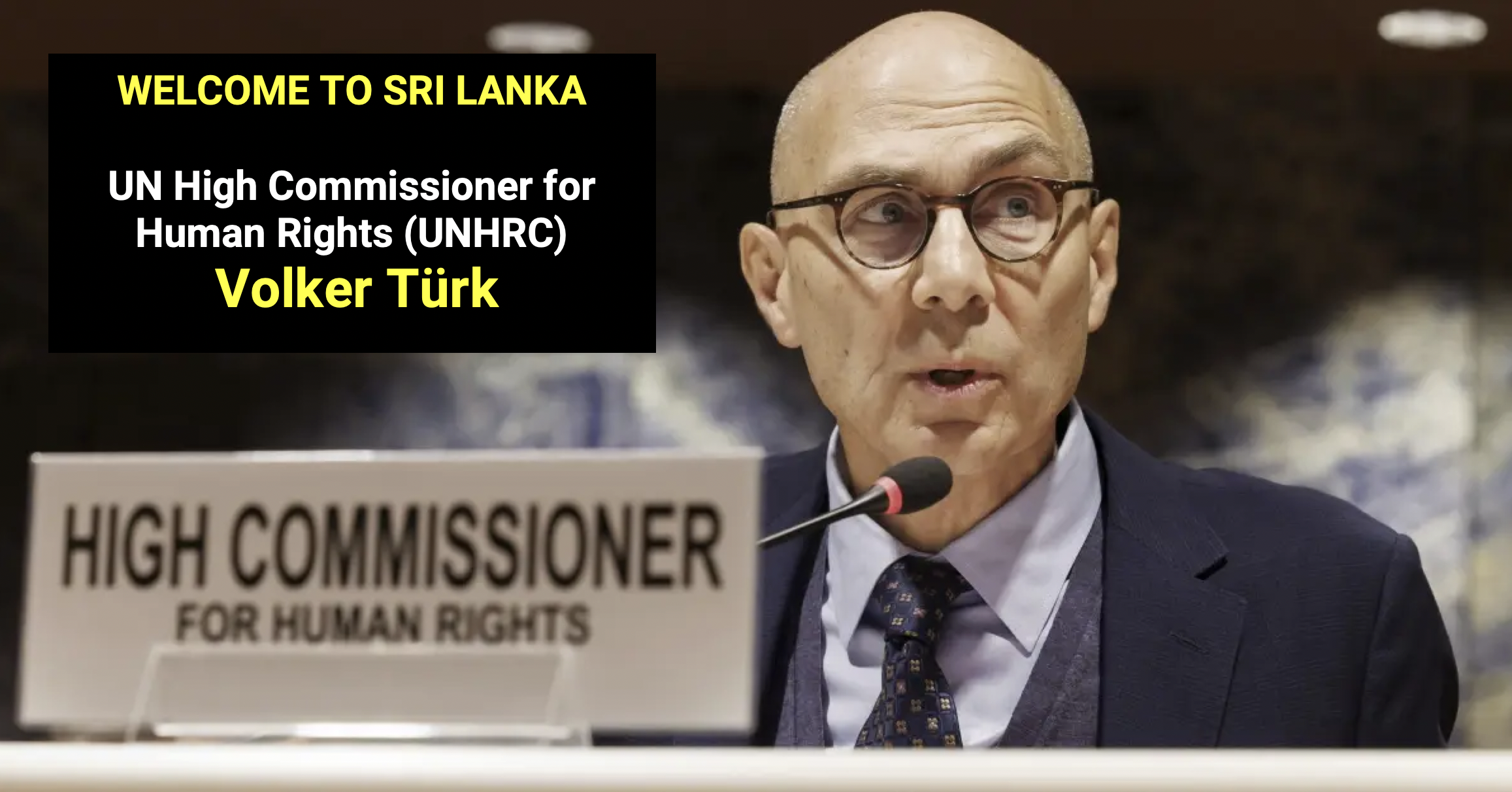
- Volker Türk
Under their leadership, Sri Lanka became the most persistently targeted country in the UNHRC system, despite:
- Defeating one of the world’s deadliest terror groups
- Conducting the largest humanitarian hostage rescue operation in modern warfare
Direct Accountability of UNHRC Leadership
How can UNHRC leaders — past and present — claim impartiality while systematically targeting the country that eradicated one of the deadliest terror groups in modern history?
Successive heads — Pillay, Al Hussein, Bachelet, Türk — not only accepted diaspora submissions without verification, they institutionalized them into UN resolutions.
Legal scholars should ask:
Does accepting evidence from politically motivated diaspora networks constitute a breach of due process at the UN level?
The persistent failure to challenge this sets a dangerous precedent: that defeated terrorists can legally weaponize the world’s human rights machinery against sovereign states.
Weaponization of UNHRC Resolutions
Key resolutions:
- 25/1 (2014)
- 30/1 (2015)
- 34/1 (2017)
- 40/1 (2019)
- 46/1 (2021)
- 51/1 (2022)
- 57/1 (2024)
These resolutions:
- Circumvent state consent
- Mandate intrusive international mechanisms
- Demand legal restructuring
- Impose external accountability structures
None of these are legally binding.
Yet through diplomatic coercion and economic pressure, they are transformed into domestic legal obligations.
Think Tanks and NGOs: The Silent Enablers
Most Western policy and human rights think tanks that claim independence — including major UN-affiliated policy institutes — have either ignored or actively facilitated the LTTE diaspora’s political agenda.
These organizations provide:
- Analytical cover for diaspora narratives
- Policy recommendations favoring “international accountability” against Sri Lanka
- Research funding that indirectly legitimizes separatist objectives
Their failure to question this hypocrisy amounts to institutional complicity, creating an echo chamber where defeated terrorists enjoy de facto immunity under the guise of human rights advocacy.
Witch-Hunt against Former Army Leaders
Targeting National Heroes
While the LTTE diaspora and their international allies continue to pursue political and legal objectives, the Sri Lankan military leaders who defeated a 30-year terrorist campaign are now under unprecedented scrutiny and legal harassment.
Nowhere else in the world are the victorious defenders of national security hounded for ending terrorism on this scale.
This selective targeting is not accountability — it is intimidation, a legal and political strategy designed to rewrite history, punish success, and embolden foreign leverage.
The pressure has been such that even the President has referred to them as “soldiers” and not “war heroes”
The Sovereignty Trap: How Weak Governments Are Used to Convert UN Resolutions into Domestic Law
This is the most dangerous mechanism currently undermining Sri Lanka’s sovereignty.
Non-binding UNHRC resolutions are:
- Politically forced onto weak governments
- Accepted by compromised leadership
- Converted into co-sponsored commitments
- Transformed into local legislation
- Thereafter weaponized as international legal leverage
Case Study: UNHRC Resolution 30/1 (2015)
Sri Lanka co-sponsored its own international prosecution architecture, agreeing to:
- Foreign judges
- Hybrid courts
- International investigators
- Legal restructuring
- Even recommendations to change Sri Lanka’s Constitution
This created a permanent sovereignty trap:
Once domestic law is amended, international pressure converts into internal legal obligation.
Thus, the UN and Western governments no longer need resolutions — they now operate through Sri Lanka’s own legal system.
This is coercive lawfare through political infiltration.
UN Evidence Laundering: Darusman Panel & OHCHR Mechanisms
Darusman Panel (2011)
- No mandate
- No judicial authority
- No evidentiary verification
- Heavy reliance on:
- Anonymous diaspora submissions
- NGO advocacy reports
- LTTE-linked testimony
This violated:
- Natural justice
- Due process
- Evidentiary integrity
OHCHR Evidence Collection Mechanisms (OISL & Successors)
- Evidence gathered outside Sri Lanka
- No judicial standards
- Heavy diaspora sourcing
The UN has transformed into a litigation platform for diaspora separatist networks.
The Deeper Geopolitical Function
Sri Lanka’s Indian Ocean location grants it exceptional strategic importance.
Human rights mechanisms provide:
- Sanctions leverage
- Diplomatic coercion
- Military access bargaining
- Strategic alignment pressure
Soft Power Weaponization
Human rights mechanisms, diaspora lobbying, and legal activism are not neutral. They serve as levers for Western geopolitical influence in the Indian Ocean and South Asian region.
The LTTE diaspora becomes a convenient proxy, enabling foreign states to shape domestic politics without military engagement.
This exposes the dual standard: legal prohibition of violence, but political permission for separatist agendas.
The LTTE diaspora becomes a geopolitical pressure tool, enabling influence without military engagement.
Thus:
- Diaspora activism → strategic utility
- Human rights discourse → coercion mechanism
- International law → selective enforcement weapon
The Weaponization of Ideology: Two Terror Models — One Strategic Threat
History shows that terror movements weaponize ideology in different ways.
The LTTE frontline cadres and child soldiers were overwhelmingly poor, rural, and came from low castes. They were forcibly recruited and psychologically conditioned.
In contrast, educated elite Tamil youth — especially within the diaspora — were deployed as international propagandists, legal activists, fundraisers, and political lobbyists, constructing global legitimacy, legal warfare strategies, and diplomatic pressure networks that sustained the LTTE project.
Contemporary Islamist terrorism follows a starkly different pattern.
Here, highly educated, middle-class youth are directly indoctrinated into operational terrorism, including suicide missions and complex attacks — as demonstrated in Sri Lanka’s Easter Sunday attacks. This shatters the Western myth that poverty causes terrorism. Ideological indoctrination — not economic deprivation — is now the dominant driver of high-impact terrorism.
Although the LTTE’s battlefield structure was dismantled, its transnational architecture remains. Thousands of former LTTE operatives — including intelligence handlers, financial coordinators, and overseas logistics agents — were resettled in Western states as asylum seekers, often facilitated by the same NGO and legal networks that continue to lobby for them today.
Given the LTTE’s proven ability to conduct overseas assassinations, including the killing of an Indian Prime Minister, the possibility of contract killings, covert destabilization, and transnational intimidation cannot be dismissed.
Allowing diaspora-led ideological activism and legal warfare to operate unchecked under human rights cover creates a direct national security vulnerability for Western states.
Sri Lanka is not confronting history, but a transformed, legally shielded continuation of the same threat — now waged through courts, institutions, and international pressure rather than overt violence.
In this context, diaspora activism ceases to be political expression and becomes a strategic extension of asymmetric warfare.
Proposal for a New Department of Public Prosecution
Emerging Threat:
Recent proposals to establish a new Department of Public Prosecution is likely aimed at providing a legal bypass around existing laws that explicitly prohibit foreign intervention in Sri Lanka’s internal affairs.
If implemented, this department could be leveraged to institutionalize UNHRC resolutions, diaspora narratives, or foreign legal influence directly into Sri Lankan law — effectively converting international political pressure into domestic enforcement.
Its ultimate goal appears to be the legalization of external oversight over internal governance, creating a permanent mechanism for sovereignty erosion.
The Central Legal Paradox
If a terrorist organization is banned militarily, but its political project is legally protected and internationally promoted — has terrorism truly been defeated, or merely outsourced?
Western governments and the UN system have constructed a legal architecture that protects separatist political warfare while claiming to oppose terrorism.
This is not moral failure.
It is systemic legal contradiction.
By tolerating, facilitating, and institutionalizing the political continuation of LTTE separatism, Western states and UN bodies have:
- Violated the UN Charter
- Breached anti-terror financing treaties
- Engaged in unlawful intervention
- Undermined territorial integrity
- Compromised UN neutrality
- Triggered derivative state responsibility
Where are the Guardians of International Law?
Leading international legal authorities, scholars, and human rights luminaries — from the International Court of Justice to prominent UN legal advisors — have largely remained silent on this blatant contradiction.
Why is it acceptable that terrorism is outsourced politically, while the very institutions designed to prevent it claim neutrality?
Are the world’s most respected legal minds unaware, or complicit through selective interpretation?
The silence of think tanks and legal scholars on this matter raises uncomfortable questions about the intellectual capture of international law by geopolitical interests.
This is not oversight — it is a systemic failure of moral and legal courage.
The narrative must now reverse:
The central question is no longer why Sri Lanka defeated terrorism — but why Western governments and the UN allowed terrorism to politically survive.
Until this contradiction is confronted, international law itself stands exposed — not as a system of justice, but as an instrument of geopolitical power.
Shenali D Waduge