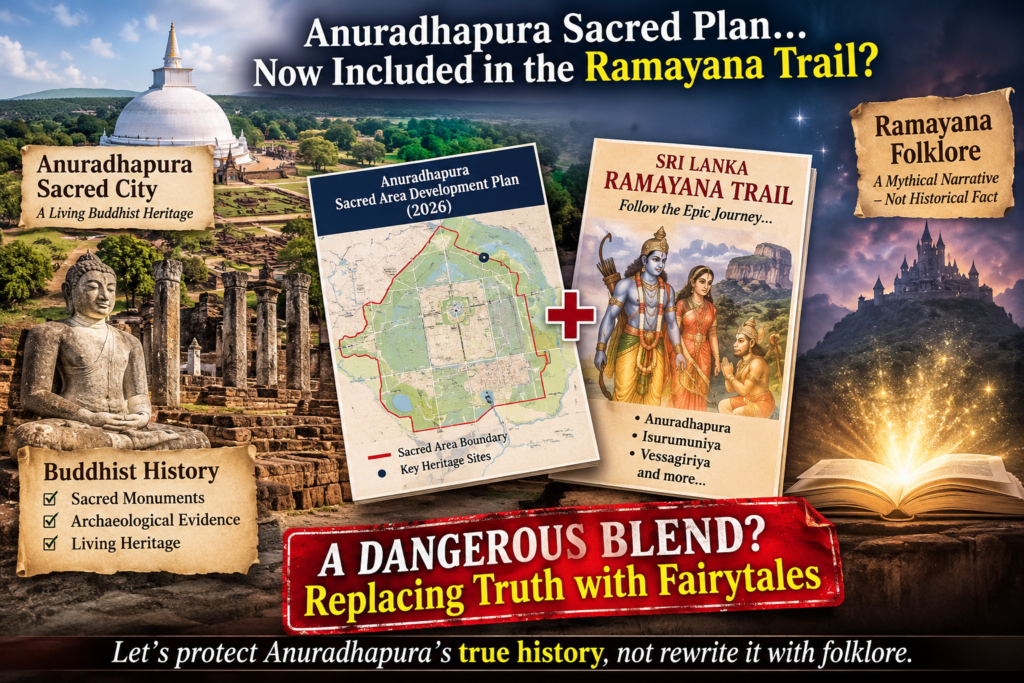
RAMAYANA TRAIL IN SRI LANKA (1998–2026): THE PROGRESSIVE INCORPORATION OF ANURADHAPURA’S BUDDHIST HERITAGE INTO RAMAYANA TOURISM NARRATIVES
Ramayana-related tourism promotion in Sri Lanka – 1997–1999
1997 – Initial Indian proposal
- An Indian familiarisation team reportedly suggested establishing a Hindu pilgrim centre at Seetha Eliya, Nuwara Eliya.
https://www.lankaweb.com/news/items/2019/06/04/ramayana-and-sri-lanka-part-3/ (Kamalika Pieris)
30 December 1998 – Ministry of Tourism initiative
- Tourism Minister: Dharmasiri Senanayake.
- President: Chandrika Bandaranaike Kumaratunga.
- An unnamed Indian journalist and tourism consultant was engaged by the Ministry to identify projects to attract Indian tourists.
- Proposed a Ram temple complex on 39 acres at Seetha Eliya.
- Planned to attract Indian pilgrims.
- Proposed bringing 800 Indian pilgrims between 6–15 January 1999.
- Ministry reportedly advanced Rs.80,000 to a local Buddhist temple’s chief prelate to organise the programme.
- Forty Buddhist organisations protested.
- Maduluwawe Sobitha was among the opposing monks.
- The Minister undertook to refer the matter to President Kumaratunga.
Source: TamilNet, 30 December 1998 –
https://www.tamilnet.com/art.html?artid=2575&catid=13
January 1999 – Indian pilgrimage programme
- Approximately 800 Indian devotees reportedly participated in a ten-day bhajan programme.
- Manoj Mody Foundation of India was reportedly involved.
- Approximately Rs.200,000 was reportedly contributed towards temple renovation.
1999 – Holy City proposal
- Ministry of Tourism reportedly considered developing Seetha Eliya as a Holy City.
- Approximately 35 acres surrounding the temple were proposed for development.
- The proposal reportedly used Anuradhapura and Kataragama as models.
- Parking, pilgrimage facilities and additional land acquisition were considered.
- The proposal encountered environmental and local opposition.
https://www.lankaweb.com/news/items/2019/06/04/ramayana-and-sri-lanka-part-3/ (Kamalika Pieris)
December 1999 – United Nations ESCAP publication
- Saman Kelegama’s article in the Asia-Pacific Development Journal, Volume 6, No. 2, page 102, records that Sri Lanka was developing Ramayana-associated places such as:
- Sita Eliya
- Ravana Waterfalls
- The objective was to attract Indian tourists and pilgrims.
- The article discusses targeting 5% of India’s estimated 10 million inter-State tourist market.
Key historical finding
- Ramayana-related tourism promotion was already receiving Sri Lankan Ministry of Tourism attention by 1998.
- The reported 1999 Seetha Eliya Holy City proposal explicitly used Anuradhapura as a development model.
- This establishes investigating if present Anuradhapura Sacred City Plan is part of the 1999 proposal.
- Outstanding documents to obtain:
- 1997 Indian delegation records,
- 1998 Ministry project file,
- consultant’s identity and report,
- 80,000 payment voucher,
- parliamentary Hansard,
- Presidential referral, and
- the original 1999 Holy City proposal.
Ramayana-related tourism promotion in Sri Lanka – 2000-2009
2000
No new Ramayana Trail government decision or formal promotional launch located so far.
- Seetha Amman Temple was already functioning as a tourist destination.
- The 1998–1999 initiative had an established physical destination to build upon.
- No new ministerial appointment, Ramayana Trail committee, government funding allocation or parliamentary statement for 2000 has been identified.v
- 1500 locals and 1000 foreign visitors visited the Seetha Amman Temple in 1999 as recorded by Kamalilka Pieris.
2001
Finding: No specific Ramayana tourism policy or government initiative located.
- No identified official announcement of a Ramayana Circuit.
- No identified committee appointment or island-wide site-selection programme.
- No verified Indian Government agreement concerning Ramayana tourism.
2002
Finding: No specific Ramayana Trail initiative located.
The available tourism statistics and economic records document the broader tourism industry, but do not establish a Ramayana-specific government programme.
2003
Finding: No specific Ramayana Trail announcement, project approval or government funding record located.
The Central Bank’s annual report discusses bilateral tourism promotion with countries including India and other states, but report does not refer to Ramayana tourism.
https://www.cbsl.gov.lk/sites/default/files/cbslweb_documents/publications/annual_report/archives/en/2003_13_Chapter_09_en.pdf (Central Bank)
2004
Finding: Organised Ramayana tourism promotion
A 2021 research paper, Issues and Challenges on Developing and Promoting Ramayana Trail Tourism in Sri Lanka, states:
- Sri Lanka Tourism Development Authority (SLTDA) and Sri Lanka Tourism Promotion Bureau undertook efforts to promote Ramayana tourism as a niche product for the Indian market from 2004.
- The promotional branding used two names:
- Ramayana Circuit
- Ramayana Yathra (subsequently).
This places institutional tourism promotion before the widely publicised 2006–2008 developments.
Sources:
2005
Finding: No independently verified Ramayana-specific government decision located.
The Sri Lanka Tourist Board’s 2005 Annual Statistical Report provides tourism-sector data, but no established Ramayana-specific allocation or official programme for that year.
https://www.scribd.com/document/36052112/Anual-Report-2005
2006
Finding: The Ministry of Tourism publicly discussed establishing a Ramayana Trail.
- Ramanujan, Secretary, Ministry of Tourism, reportedly stated that plans were being made to establish a Ramayana Trail to encourage Indian tourists.
- This is a significant transition from promoting individual locations to developing a connected tourism circuit.
https://www.lankaweb.com/news/items/2019/06/04/ramayana-and-sri-lanka-part-3/ (Kamalika Pieris)
2007
Institutional development reported
Finding: A Ramayana Trail Committee was established and the Government reportedly decided to develop Ramayana-associated sites.
| Person | Reported position |
| N. C. Kiriella | Chairman, Ramayana Trail Committee |
| Dr. Suriya Gunasekera | Sri Lankan prehistory specialist |
| Dr. Subash Chawla | International Ramayana specialist |
| B.M.U.D. Basnayake | Additional Secretary, Ministry of Tourism |
| S. Kalaiselvam | Director General, SLTDA |
Government activities included restoration and maintenance of Ramayana-associated sites.
- Kalaiselvam reportedly told Press Trust of India that the Government had decided to develop these sites.
2008
Major international promotional launch
17 January 2008 – New Delhi
Sri Lanka Tourism launched Following the Trails of Ramayana.
Key details:
- Approximately 50 Ramayana-associated sites identified.
- Target of 120,000 Indian tourist arrivals.
- Kalaiselvam publicly presented the initiative.
- Former cricket captains Arjuna Ranatunga and Aravinda de Silva appointed tourism brand ambassadors.
- US$1 million promotional budget allocated for the Indian market.
- Seetha Eliya, Tam Bodha, Ussangoda and Rumassala were among the locations identified.
Sources:
- https://www.rediff.com/news/report/rama/20080117.htm
- https://www.oneindia.com/2008/01/17/lanka-bids-trail-of-ramayana-to-attract-indian-tourists-1200568140.html
18 March 2008 – Indian Parliament
- India’s Tourism and Culture Minister, Ambika Soni, responded to a Rajya Sabha question concerning Sri Lanka’s proposed development of Ramayana-associated sites.
Additional 2008 development:
- A contemporary November 2009 report records that Sri Lanka had also appointed a subcommittee in 2008 to develop a Buddhist Pilgrim Travel Trail covering the SAARC region. This should be investigated alongside the Ramayana Trail because both religious-tourism initiatives were being pursued during the same period.
- https://www.southeastasianarchaeology.com/2009/11/24/scholars-speak-out-against-ramayana-trail/ (scholars speak against Ramayana Trails)
2009
International presentation and public controversy
16 July 2009 – Indian Cultural Centre, Colombo
N.C.K. Kiriella, Chairman of the Ramayana Trail Executive Committee, presented:
Ramayana and Ravana – The Sri Lankan Version.
He introduced the committee members:
- Suriya Gunasekera
- Subash Chawla
- M.U.D. Basnayake
- Kalaiselvam
His presentation discussed the historical claims associated with Ramayana and Ravana in Sri Lanka.
https://www.rarebooksocietyofindia.org/postDetail.php?id=196174216674_10151923843591675& (Text of Kiriella’s presentation)
November 2009 – Royal Asiatic Society controversy
The Ramayana Trail attracted criticism from Sri Lankan academics and archaeologists.
The controversy concerned:
- Historical authenticity of the locations.
- Promotion of mythology as historical fact.
- The Tourism Authority’s responsibility in marketing these sites.
- Potential consequences of creating an officially promoted historical narrative without archaeological proof.
Source:
Susantha Goonatilake – Inventing Archaeology: The Tourist Board’s Ramayana Trail.
Chronology: 2000–2009
| Year | Finding |
| 2000 | Seetha Amman Temple already operating as a tourist destination; no new Trail decision located |
| 2001 | No specific initiative located |
| 2002 | No specific initiative located |
| 2003 | No specific initiative located |
| 2004 | Academic research retrospectively identifies organised tourism promotion beginning |
| 2005 | No independently verified new initiative located |
| 2006 | Tourism Ministry Secretary reportedly announces Ramayana Trail plans |
| 2007 | Ramayana Trail Committee and site-development initiative reported |
| 2008 | International launch, approximately 50 sites, US$1 million promotional budget |
| 2009 | Committee chairman’s international presentation, reported 50-site selection and academic controversy |
Five major issues emerging from this phase
- Institutional involvement: The initiative moved into the hands of the Ministry of Tourism, SLTDA and a dedicated Ramayana Trail Committee.
- Indian market targeting: Indian Hindu pilgrims and tourists were explicitly identified as the intended market.
- Public expenditure: The reported US$1 million promotional allocation in 2008 needs to be traced to its original approval and expenditure records.
- Historical narrative: Locations were promoted through Ramayana associations, despite the reported distinction between archaeological evidence and traditional belief.
- Buddhist sacred geography: The reported use of Anuradhapura as a model for the 1999 Seetha Eliya Holy City proposal, alongside the simultaneous Buddhist Pilgrim Travel Trail initiative in 2008, warrants examination.
Ramayana-related tourism promotion in Sri Lanka 2010-2014
Important: 2012 report claims SLTDA withdrew support to Ramayana Trails.
2010 – Ramayana Trail becomes a subject of public controversy, while Indian-funded religious development is proposed
3 parallel developments:
- Indian pilgrim tours,
- a proposed Sita temple at Divurumpola, and
- public challenge to the Sri Lankan Tourism Authority’s Ramayana promotion.
Indian pilgrim tours and official receptions
Kamalika Pieris, referring to contemporary Daily News reporting, records:
- An eight-day Ramayana pilgrimage involving approximately 150 Indian pilgrims and 14 high-profile Indian lawmakers.
- The group reportedly visited locations associated with Sita and Ravana.
- The tour was organised by Bernard Tours, Sri Lanka, and Ashok Vatika Dharshan Yathra Samithi, New Delhi.
- A Bhajan programme was reportedly held at Cinnamon Grand, Colombo, attended by the Indian lawmakers and two Sri Lankan Cabinet Ministers and a Deputy Minister.
- A separate Indian group of 15 VIPs, including Union Ministers and businessmen, reportedly visited on a Ramayana pilgrimage organised by Vikas Travels, New Delhi, with a reception and Bhajan at Taj Samudra.
https://www.lankaweb.com/news/items/2024/07/13/buddhist-viharas-and-eelam-part-21ha/ (Kamalika Pieris)
Divurumpola – Madhya Pradesh Chief Minister’s temple proposal
On 26 June 2010, Madhya Pradesh Chief Minister Shivraj Singh Chouhan reportedly performed the bhoomi poojan at Divurumpola for a proposed Sita temple.
The Indian Express reported in September 2012 that:
- Chouhan had visited the old Sita temple at Ashok Vatika.
- He had visited Divurumpola, associated in the Ramayana tradition with Sita’s Agni Pariksha.
- He announced Rs.1 crore for the proposed temple.
This was not simply a tour package. It was a proposed religious construction project at a Sri Lankan site associated with the Ramayana.
https://indianexpress.com/article/news-archive/web/lanka-temple-chouhan-s-same-promise-2-year/
Royal Asiatic Society symposium – 17 July 2010
The Royal Asiatic Society of Sri Lanka (RASSL) organised a public symposium at the Mahaweli Centre, Colombo, on the implications of promoting the Ramayana Trail.
The speakers included:
- Professor Tissa Kariyawasam – Ramayana in Sinhala literature.
- Professor Oliver Abeynaike – Indian Buddhist Circuit compared with the absence of an Indian Ramayana Circuit.
- Dr Hema Goonatilake – Tourism promotion and Buddhist heritage.
- Dr Nihal Perera – Sri Lankan prehistory.
- Dr Malini Dias – Archaeological evidence.
- Former Ambassador Bandu de Silva – Foreign policy implications.
- Hegoda Vipassi – Opposition to the Ramayana Trail.
https://www.southeastasianarchaeology.com/2010/07/28/academics-band-to-discuss-ramayana-trail/
The RASSL publication by Susantha Goonatilake, Inventing Archaeology: The Tourist Board’s “Ramayana Trail”, is particularly important for the Anuradhapura investigation.
It records claims attributed to the Ramayana Trail Executive Committee, including:
- Two caves at Vessagiriya, Anuradhapura, allegedly connected with the Ramayana.
- The Vessagiriya “Man and Horse” sculpture allegedly being associated with the Ramayana.
- An alleged inscription at Sigiriya said to confirm that Sita was held captive there.
- Alleged inscriptions associated with Ravana and his dynasty.
These are claims demonstrate that Anuradhapura’s Vessagiriya was already being drawn into the Ramayana narrative promoted by the tourism authorities by 2010.
This historical connection is worth investigating in relation to the present Anuradhapura Sacred City Plan.
Original RASSL document: Susantha Goonatilake – Inventing Archaeology: The Tourist Board’s Ramayana Trail.
Ramayana Research Centre at Divurumpola
Kamalika Pieris’s account states that a Ramayana Research Centre was due to be commissioned at Divurumpola on 5 June 2010.
2011 – Official Sri Lankan Convention Bureau involvement and expenditure
The Sri Lanka Convention Bureau (SLCB) Annual Report 2011, published under the Ministry of Economic Development, contains a specific entry:
- Assistance for Ramayana Trail – SLCB assisted in co-ordinating the Ramayana workshop and educational tour.
- This is an official institutional annual report.
The 2011 annual report also identifies:
- Basil Rajapaksa – Minister of Economic Development.
- Dr Nalaka Godahewa – Chairman, Sri Lanka Tourism.
- The Government’s tourism development strategy for 2011–2016, which had Cabinet approval.
- India as Sri Lanka’s leading tourism-generating market in 2011.
The Ramayana workshop and educational tour were therefore being supported within the wider government tourism structure.
Expenditure
The 2012 SLCB Annual Report provides comparative financial figures for 2011:
– 2011 – Ramayanaya Project: Rs.637,299.20
This is a specific recorded expenditure under the SLCB’s marketing-related expenditure.
2012 – The alleged withdrawal of Sri Lankan Government support
7 February 2012 – New Indian Express reports withdrawal of SLTDA support
The New Indian Express published: “Despite Withdrawal of SL Support, Ramayana Trail”
The report stated that the Sri Lankan Government no longer officially promoted the Ramayana Trail following protests from intellectuals.
It also reported:
- Approximately 10,000 Indians had visited Sri Lanka in 2011 specifically for the Ramayana Circuit, according to tour operators.
- Kalaiselvam, former SLTDA Director General and then Senior Advisor to SLTDA, said he had initiated the scheme with:
- Ashok Kainth, Indian Ramayana researcher based in New Delhi.
- Swami Chandrasekaran, Anjaneyar Temple, Dehiwela.
- Kainth and Chandrasekaran had identified 49 Ramayana-associated places.
- They had produced a coffee-table book and DVDs.
- Ten travel agencies were reportedly promoting the circuit.
- Private tour operators had taken over promotion following SLTDA’s withdrawal.
Official SLCB accounts contradict a claim of complete Government withdrawal
The SLCB Annual Report 2012 records the following expenditure:
Ramayanaya Project – Marketing expenditure
2011
Rs.637,299.20
2012
Rs.76,500.00
Source: SLCB Annual Report 2012, Marketing Related Expenditure, page 39.
A recorded SLCB project expenditure continued in 2012.
https://www.parliament.lk/uploads/documents/paperspresented/annual_report_srilanka_convention_bureau_2012.pdf (SL Convention Bureau Annual Report 2012)
There are two different institutions involved:
- SLTDA: the New Indian Express report says it withdrew from the scheme.
- SLCB: its official annual report records Rs.76,500 in Ramayanaya Project expenditure during 2012.
Madhya Pradesh Government subsidy for Sri Lankan pilgrimage
On 5 April 2012, the Times of India reported that Madhya Pradesh Government had extended a pilgrimage subsidy to Sri Lanka and Cambodia.
The reported terms were:
- 50% of pilgrimage expenses.
- Maximum subsidy: Rs.30,000.
- Eligible beneficiaries: Madhya Pradesh residents.
- Applications through the Madhya Pradesh Tourism Development Corporation.
- The report specifically identified the Sita Mandir in Sri Lanka as a pilgrimage destination.
https://timesofindia.indiatimes.com/city/bhopal/govt-subsidy-for-pilgrimage-to-sl-angkor-wat-temple/articleshow/12540990.cms (Indian Govt subsidy for prilgrimage to Sri Lanka)This was an Indian state-government initiative, not a Sri Lankan Government grant.
September 2012 – Sri Lankan President Mahinda Rajapaksa and Madhya Pradesh Chief Minister Shivraj Singh Chouhan
At the foundation-laying ceremony for the University of Buddhist and Indic Studies at Sanchi, Madhya Pradesh, in September 2012, Chief Minister Chouhan again announced Rs.1 crore for the proposed Sita temple at Divurumpola.
The Indian Express reported that the announcement was made in the presence of President Mahinda Rajapaksa.
Importantly, the report stated that Rajapaksa did not mention the proposed temple in his speech.
2013 – Madhya Pradesh Chief Minister claims Sri Lankan and Indian approvals for the Sita temple
On 1 June 2013, Madhya Pradesh Chief Minister Shivraj Singh Chouhan publicly stated that the necessary approvals had been obtained from both the Sri Lankan Government and the Indian Central Government for construction of the Sita temple at Divurumpola.
He stated:
- The temple would be constructed through Swami Dayanand Trust.
- The proposed location was Divurumpola, near Nuwara Eliya.
- The site was identified in the Ramayana tradition as the place where Sita underwent Agni Pariksha.
- 1 crore had been sanctioned by the Madhya Pradesh Government.
https://economictimes.indiatimes.com/news/politics-and-nation/will-go-ahead-with-plan-to-construct-sita-temple-in-sri-lanka-shivraj-singh-chouhan/articleshow/20384850.cms (will go ahead with plan to construct Sita temple in Sri Lanka)
The Daily Mirror also carried the announcement on 2 June 2013.
https://www.dailymirror.lk/print/breaking_news/india-to-build-sita-temple-in-sri-lanka/108-30270
Chouhan’s statement claims to have obtained approvals.
If official approval was given by letter needs to be confirmed.
A later Indian Express investigation reported that the Rs.1 crore remained unused and that the temple project did not proceed as announced.
https://indianexpress.com/article/india/mp-govt-may-consider-building-temple-at-site-linked-to-ramayana-in-sri-lanka-5829327/ (MP govt may consider building temple at Sita-linked to Ramayana in Sri Lanka – July 2019)
2014 – Evidence of reduced prominence in official tourism promotion
Sri Lanka Tourism Promotion Bureau Annual Report 2014
The official SLTPB Annual Report 2014 identifies:
- The Bureau’s role under the Ministry of Economic Development.
- Its promotional activity in 22 key markets.
- Eight tourism products.
- Country-specific promotional campaigns, including India.
- report’s text found no reference to the Ramayana Trail.
https://www.parliament.lk/uploads/documents/paperspresented/annual-report-srilanka-tourism-promotion-bureau-2014.pdf (SL Tourism Bureau Annual Report 2014)
Nuwara Eliya Hotels Company Annual Report 2013 – 2013/14 marketing outlook
Nuwara Eliya Hotels Company PLC Annual Report 2013 – marketing overview for 2013/14 states that the company expected a challenging year, despite relying on India as one of its main tourist-generating markets, and specifically anticipated that it would not have Indian visitors touring the Ramayana Trail.
This is an indication that the trail was not necessarily generating consistent hotel demand in its principal destination region.
https://cdn.cse.lk/cmt/upload_report_file/566_1370514937553.pdf (Nuwara Eliya Hotels Company PLC Annual Report 2013)
Findings from the 2010–2014 phase
- In 2010, the tourism initiative faced organised academic opposition, while Indian religious tourism and the Divurumpola temple proposal continued.
- In 2011, the Sri Lanka Convention Bureau officially assisted with a Ramayana workshop and educational tour and recorded Rs.637,299.20 in Ramayanaya Project expenditure.
- In 2012, SLTDA reportedly withdrew from direct promotion, but SLCB still recorded Rs.76,500 in Ramayanaya Project expenditure. Madhya Pradesh also introduced a pilgrimage subsidy for Sri Lanka.
- In 2013, the Madhya Pradesh Chief Minister publicly claimed that approvals had been obtained for the Divurumpola temple.
- In 2014, the SLTPB Annual Report does not identify the Ramayana Trail as one of its promotional campaigns, while a Nuwara Eliya hotel report indicates weak expected demand from Ramayana Trail visitors.
The Anuradhapura connection – a significant finding
- The 2010 RASSL paper by Susantha Goonatilake records that the Ramayana Trail Executive Committee was associating Vessagiriya, Anuradhapura, with the Ramayana.
- The reported claims included the two caves, the “Man and Horse” sculpture and inscriptions allegedly connected to the Ramayana.
- This is a significant link because it establishes that the Ramayana Trail narrative had reached a site in the Anuradhapura archaeological landscape well before the current Sacred City Plan.
Overall conclusion before the 2015 relaunch
- 2007–2009: Institutional development and international promotion.
- 2010–2011: Continued pilgrim activity, temple proposals, public controversy and official SLCB involvement.
- 2012–2014: Reduced or altered direct SLTDA involvement, continued SLCB expenditure, Indian state-level pilgrimage support and the Divurumpola temple proposal.
- 2015: A renewed Sri Lankan Tourism Promotion Bureau campaign, this time with private-sector partners and a new package of 19 key sites.
Ramayana related tourism promotion in Sri Lanka 2015
2015 – Ramayana Trail relaunch:
- 26 February 2015: Sri Lanka Convention Bureau (SLCB) announced that the trail would be revived, jointly with the Sri Lanka Tourism Promotion Bureau (SLTPB) and SriLankan Airlines.
- 13 March 2015: Indian Prime Minister Narendra Modi made an official bilateral statement committing India to cooperate in developing a Ramayana Trail in Sri Lanka.
- March–July 2015: SLTPB developed the product with private-sector operators, followed by a launch in Bangalore involving 26 Indian operators and a proposed 19-site itinerary.
The February announcement and the July launch are official.
The March Indian commitment is recorded in the Indian Prime Minister’s own official statement.
https://www.ft.lk/Travel-Tourism/sri-lanka-launches-new-product-ramayanaya-trail/27-397971 (Sri Lanka launches new product – Ramayana Trail)
26 February 2015 – Official announcement to revive the trail
The SLCB Annual Report 2015 reproduces a Daily News press release dated Thursday, 26 February 2015, titled Ramayanaya trail to be revived.
It states that the trail would be relaunched jointly by:
- Sri Lanka Convention Bureau (SLCB)
- Sri Lanka Tourism Promotion Bureau (SLTPB)
- SriLankan Airlines
The announcement says that 14 sites accessible out of 52 identified sites would be promoted through itineraries and packages.
It also states that:
- Promotional material, including a comprehensive Ramayanaya brochure and travel plan, was being produced.
- The trail would be promoted among religious institutions in India.
- The intended audience included Indian Hindus and Ramayana devotees, as well as high-end corporate clients.
- SLCB CEO Vipula Wanigasekera was the quoted official.
The 14-versus-52 distinction matters.
The announcement did not say that only 14 Ramayana-associated places existed. It said 52 had been identified, but 14 were accessible for the proposed promotional itineraries at that time.
The 7 places specifically named in the announcement were:
- Sita Eliya
- Ravana Ella
- Hakgala
- Maligatenna
- Roomassala
- Sitawaka
- Kelaniya
These are examples identified in the announcement, not a complete list of either the 14 accessible sites or the 52 identified sites.
- 13 March 2015 – Narendra Modi makes an official bilateral commitment
During his official visit to Sri Lanka, Indian Prime Minister Narendra Modi met President Maithripala Sirisena and delivered a joint media statement.
The official statement says:
“We will cooperate in developing a Ramayana Trail in Sri Lanka and a Buddhist Circuit in India.”
The statement also referred to:
- Increasing tourism and people-to-people contacts.
- Extending India’s Tourist Visa on Arrival–Electronic Travel Authorisation facility to Sri Lankan citizens from 14 April 2015.
- Air India commencing direct New Delhi–Colombo flights.
https://www.pmindia.gov.in/en/news_updates/prime-ministers-media-statement-during-visit-to-sri-lanka/ (Indian PM Modi statement during Sri Lanka visit 2015)
- March 2015 – SLTPB announces the new product with 26 private-sector companies
18 March 2015 – Daily FT
Sri Lanka Tourism Promotion Bureau Chairman Rohantha Athukorala announced the Ramayanaya Trail as a new product targeting the Indian market.
The announcement identified:
- SLTPB as the Government tourism agency leading the product.
- 26 private-sector companies/operators participating in the initiative.
- 19 key sites to be showcased.
- A first-year Indian arrival target of 20,000.
- Three-day, four-night, five-night and seven-night package options.
- Promotional activity in India, including four roadshows.
- Sri Lankan Foreign Ministry representatives and Sri Lankan Consuls General to participate in the Indian promotional programme.
The article also quoted Mahen Kariyawasam, President of the Sri Lanka Association of Inbound Tour Operators (SLAITO), who spoke about local community involvement and the Northern and Eastern provinces.
The Chairman’s description of the Ramayana Trail included the narrative that Ravana ruled Sri Lanka and was a pioneer in arts, crafts, architecture and medicine.
These were promotional historical claims made in the context of tourism marketing; they should not be presented as independently established archaeological findings.
The 19-site issue
The March announcement does not provide all 19 site names.
It identifies broad geographical areas:
- Ramboda
- Nuwara Eliya
- Ella
- Galle
- Chilaw
- Mannar
The February announcement separately identifies 7 prominent localities, but there is no documentary basis for assuming that those 7 constitute the complete 19-site list.
Document required: The original 19-site itinerary and the brochure produced by the Tourism Bureau.
- February–July 2015 – The 52-site list and the 19-site product are not the same thing
| Figure | What the source says |
| 52 | Sites identified by the Sri Lankan tourism authorities |
| 14 | Sites accessible and to be promoted in the February relaunch announcement |
| 19 | Key sites to be showcased in the March/July 2015 product launch |
The February announcement says 14 of the 52 identified sites were accessible.
The March and July announcements refer to a new 19-site package.
They do not explain whether the 19 were selected from the 52, whether access conditions changed, or whether the package included additional locations.
The 2015 SLCB Annual Report also confirms that promotional material for the Ramayanaya launch was produced, including a comprehensive brochure with a travel plan. This makes the missing brochure especially important: it should have provided the actual itinerary.
https://www.parliament.lk/uploads/documents/paperspresented/performance-report-srilanka-convention-bureau-2015.pdf (SLCB Annual Report 2015)
- July 2015 – Bangalore launch and Indian operator involvement
13 July 2015 – Department of Government Information, Sri Lanka
The Government’s news portal reported that SLTPB, together with the private sector, launched the Ramayana Trail in Bangalore the previous week.
The report confirms:
- 26 Indian operators were involved.
- 19 key sites were to be showcased.
- More than 100 travel agents attended the launch.
- The Indian market was the intended target.
- Four roadshows were planned during 2015.
- Sri Lankan Foreign Ministry representatives were to participate in the roadshows.
The officials named were:
- Rohantha Athukorala – Chairman, SLTPB.
- Indrajith De Silva – Market Head for India, SLTPB.
The report says the product was intended to attract approximately 20,000 Indian visitors in its first year.
What happened to the four roadshows?
The July report confirms Bangalore as the starting point and says four roadshows were planned.
A separate Daily FT report of 21 July 2015 describes the wider Sri Lanka Tourism promotional campaign in India, identifying the following markets:
- Mumbai
- New Delhi
- Hyderabad
- Bangalore
- Chennai
- Kolkata
It also reports a Rs.250 million marketing campaign in the Indian market.
- SriLankan Airlines – its role in the 2015 relaunch
SriLankan Airlines was explicitly named in the 26 February 2015 announcement as a partner in the planned relaunch, together with SLCB and SLTPB.
However, the July Bangalore launch report describes SLTPB and private-sector operators as the launch partners. It does not specifically identify SriLankan Airlines as a participant at that event.
The SLCB Annual Report confirms broader cooperation between SLCB and SriLankan Airlines in tourism promotions and overseas events during 2015. It does not, in the passages located, provide a separate Ramayana-specific airline contribution or expenditure.
Outstanding documents: SriLankan Airlines’ internal marketing plan, promotional expenditure, flight/package arrangements and any specific agreement with SLTPB or SLCB for the Ramayana Trail.
- Did the 2015 trail include Anuradhapura?
- What the 2015 launch documents actually name
The February 2015 announcement names
- Sita Eliya,
- Ravana Ella,
- Hakgala,
- Maligatenna,
- Roomassala,
- Sitawaka and
- Kelaniya
The March and July announcements identify
- Ramboda,
- Nuwara Eliya,
- Ella,
- Galle,
- Chilaw and
- Mannar as the broad geographical areas for the 19-site package.
Neither announcement has yet named Vessagiriya, Ritigala or Anuradhapura as part of the 19-site itinerary.
The earlier Vessagiriya connection remains important
However, the 2010 RASSL paper by Susantha Goonatilake had already recorded Ramayana-related claims concerning Vessagiriya in Anuradhapura.
That is earlier evidence of the Ramayana narrative being attached to the Anuradhapura archaeological landscape.
Later official Sri Lanka Tourism material includes Anuradhapura-region locations
A later official Sri Lanka Tourism publication, Ramayana Yathra, contains references to:
- Ritigala, described as one of the places where pieces of the Sanjeevani mountain are believed to have fallen.
- Dolu Kanda, also associated with the Sanjeevani mountain story.
- Talladi, Mannar.
- Kachchativu.
- Yahangala.
- Dunuvila.
- Sita Pokuna.
It also contains a map with Anuradhapura marked among the geographical locations and describes Ritigala as being on the Habarana–Anuradhapura road.
The publication states that more than 50 locations were identified and approximately 25 had road or semi-road access.
This is significant though the publication is a later document.
Appearance in the official tourism website’s Ramayana Yathra material establishes later official promotion of these geographical associations.
A further official Sri Lanka Tourism itinerary by George Steuart lists the ruins of Anuradhapura among the highlights of a Ramayana tour
The 2015 relaunch was not simply a private-sector tourism initiative. The documentary record shows involvement by:
- Sri Lanka Convention Bureau.
- Sri Lanka Tourism Promotion Bureau.
- SriLankan Airlines, named in the February relaunch announcement.
- Sri Lankan Foreign Ministry representatives and Consuls General in planned Indian promotions.
- 26 Indian private-sector operators.
- More than 100 Indian travel agents attending the Bangalore launch.
- Indian Prime Minister Narendra Modi, through his public bilateral commitment to cooperate in developing the trail.
It also shows that the product was marketed as both a religious-pilgrimage and wider tourism experience, with corporate and high-end Indian travellers included in the target market.
Ramayana related tourism promotion in Sri Lanka 2016-2019
Ramayana Trail moved from the 2015 tourism relaunch into formal India–Sri Lanka tourism cooperation, expansion of the claimed site inventory, a dedicated Ramayana Yathra website, and renewed promotion by the Sri Lankan Tourism Minister in 2019.
Indian parliamentary records in July 2016 explicitly state that India had not made an agreement to include Sri Lanka in India’s domestic Ramayana Tourist Circuit.
They do, however, confirm that the two countries had agreed to conduct joint promotional activities for the Ramayana Trail. This distinction must be preserved.
2016 – Bilateral cooperation, proposed MoU and Indian parliamentary clarification
February 2016 – India–Sri Lanka Joint Commission
Indian External Affairs Minister Sushma Swaraj visited Colombo for the ninth session of the India–Sri Lanka Joint Commission, co-chaired with Sri Lankan Foreign Minister Mangala Samaraweera.
The official Indian High Commission’s Sandesh publication records that the Joint Commission discussed tourism cooperation and that the second meeting of the Joint Working Group on Tourism was to be held in mid-2016 to take forward collaboration on:
- Establishing a Ramayana Trail in Sri Lanka.
- Establishing a Buddhist Circuit in South Asia.
https://www.hcicolombo.gov.in/pdf/Sandesh_jan_mar_2016.pdf – Indian High Commission Colombo – Sandesh, January-March 2016
3 June 2016 – Reported India–Sri Lanka MoU
A report published by Daily Mirror on 15 July 2016, based on India Today reporting and unnamed Ministry of Tourism sources, stated that an MoU had been signed on 3 June 2016.
The reported provisions included:
- Sri Lanka facilitating Indian tourists visiting Ramayana-associated sites.
- Reciprocal facilitation for Sri Lankan visitors to Buddhist circuits in India.
- Easier transit, visa processing and security arrangements.
The same report said Sri Lanka had offered four or five destinations for inclusion in the Ramayana circuit, naming:
- Ravana’s palaces.
- Ashok Vatika.
- Nagadeepa, described in the report as Hanuman’s entry point.
- Donara, described as the place where Rama first attacked Ravana.
- Yudaganawa, described as the main battlefield.
These are descriptions and identifications attributed to the report’s sources.
https://www.dailymirror.lk/breaking_news/india-sl-sign-mou-to-promote-significance-of-ramayana/108-112573 (Daily Mirror – India SL sign MOU to promote Ramayana – 15 Jul 2016)
June 2016 – Joint Working Group on Tourism
The Indian High Commission’s Sandesh, October–December 2016, reports that the Joint Working Group on Tourism met in June 2016.
It says both Governments agreed on collaborative measures for:
- Joint development of the Ramayana Trail.
- Joint development of the Buddhist Circuit.
- Joint marketing of these destinations in third countries.
This confirms bilateral cooperation, beyond the 2015 public statement by Prime Minister Modi.
https://www.hcicolombo.gov.in/pdf/Sandesh%20-Oct-Dec%202016.pdf – Indian High Commission – Sandesh Oct-Dec2016
25 July 2016 – Indian Parliament: Lok Sabha Starred Question No. 110
Two members, Shri J.J.T. Natterjee and Shrimati Riti Pathak, asked the Indian Minister of Tourism about Ramayana, Buddha, Sufi and Krishna tourist circuits, including whether India had made an agreement to include Sri Lanka in the Ramayana Tourist Circuit.
The response was given by Dr. Mahesh Sharma, Minister of State for Tourism (Independent Charge).
The official answer stated:
- India’s Swadesh Darshan scheme included Ramayana, Krishna, Buddhist and Spiritual Circuits.
- It listed Indian destinations for the Ramayana Circuit, including Ayodhya, Chitrakoot, Sitamarhi, Buxar, Darbhanga, Mahendragiri, Jagdalpur, Nashik, Nagpur, Bhadrachalam, Hampi and Rameshwaram.
- India had not made an agreement to include Sri Lanka in its Ramayana Tourist Circuit.
- However, both countries had agreed to conduct joint promotional activities for the Ramayana Trail in both countries.
https://sansad.in/getFile/loksabhaquestions/annex/9/AS110.pdf?
Govt of India – Lok Sabha Starred Question 110 – answered 25 Jul 2016
2017 – Site inventory reportedly expands from 52 to 71
Tourism Minister’s public statement reported
26 July 2017 – Daily FT / Deccan Herald report
Tourism Development Minister John Amaratunga told Deccan Herald that:
- Sri Lanka had identified 71 Ramayana-associated locations across the island.
- A committee had been appointed to identify further locations.
- Excavation was underway to identify additional places described in the Ramayana.
- The Government was working with Indian state governments to link the locations into a larger circuit.
- The stated intention was to complete the circuit by the end of 2017.
Amaratunga made these comments on the sidelines of the 99th India International Travel Mart, organised by Sphere Travelmedia and Exhibition.
The report also quoted V. Krishnamoorthy, Deputy High Commissioner of Sri Lanka, who referred to Sita Vyasa and Ussangoda.
Sources:
https://www.ft.lk/article/631251/Www.aquavista.lk
https://srilankafoundation.org/newsfeed/sri-lanka-to-extend-indias-ramayana-circuit/ (Sri Lanka Foundation 2 Aug 2017)
The Ramayana Sites – 52-to-71 change
| Period | Number reported |
| 2008–2015 promotional records | 52 identified locations |
| July 2017 | 71 identified locations |
The 2017 report does not publish the 71-site list. Nor does it establish whether the additional 19 locations were newly identified, newly accepted by the committee, or included through a revised inventory.
People and institutions identified:
- John Amaratunga – Tourism Development Minister.
- Krishnamoorthy – Deputy High Commissioner of Sri Lanka.
- An unnamed committee appointed by the Sri Lankan Government.
- Indian state governments, with which the Minister said Sri Lanka was working.
2018 – Dedicated Ramayana Yathra website, over 50 sites and Indian Government tourism packages
Official Sri Lanka Tourism website and Indian Government enterprise records
Dedicated Ramayana Yathra website
5 August 2018 – Sunday Times report
The Sunday Times reported that Sri Lanka had launched a dedicated Ramayana website at the Bangalore International Travel and Tourism Fair (IIT).
The report quoted a release issued by the Sri Lanka Tourism Promotion Bureau.
It stated:
- Sri Lanka had identified more than 50 Ramayana-associated locations.
- Only around 20 sites were then recommended for organised visitors because of accessibility limitations.
- Visiting the 20 recommended sites was estimated to require 9–14 days.
- SLTDA and SLTPB were actively working to promote the trail and assist devotees in selecting itineraries.
- The website was intended to provide information to travellers and help them plan their journeys.
The report also repeated the SLTPB’s position that the Ramayana narrative was supported by research, analysis, folklore and linguistic connections. That is the Tourism Bureau’s promotional claim, not independent proof of the historical claims.
https://www.sundaytimes.lk/180805/business-times/india-supports-lankas-ramayana-trail-304926.html (Sunday Times – 5 Aug 2018)
Important: The number in 2018 is again stated as more than 50, not 71.
The available report does not explain the difference between the 2017 figure of 71 and the 2018 figure of more than 50.
The official Sri Lanka Tourism website currently has a Ramayanaya section, although the current webpage is not itself proof of the exact content of the website launched in 2018.
Indian Government’s IRCTC package to Sri Lanka
August 2018 – Indian Railway Catering and Tourism Corporation (IRCTC)
IRCTC, a Government of India enterprise, issued a press release advertising a Sri Lanka package titled: Shri Ramayana Yatra: Sri Lanka.
The package was scheduled to depart from Delhi on 25 August 2018, for five nights and six days.
The listed Ramayana-associated destinations included:
- Ashok Vatika.
- Sita Mata Temple.
- Bhakta Hanuman Temple.
- Anjanair Temple.
- Vibhishana Temple.
- Munneshwaram Shiva Temple.
The package also included Negombo, Pinnawala, Ramboda waterfall, Nuwara Eliya, Gregory Lake, the Temple of the Sacred Tooth Relic, Kandy, tea gardens and Colombo.
The advertised price was Rs.48,500 per person, with 36 seats available.
https://www.irctctourism.com/LoungeHTML/PDF/Press%20Release%20-%20Sri%20Lanka%20OBT.pdf (IRCTC official press – Shri Ramayana Yatra Sri Lanka)
Indian Government’s tourism enterprise was not merely discussing the Ramayana Trail: it was commercially packaging a Sri Lankan pilgrimage itinerary and selling it to Indian travellers.
It also shows how Ramayana pilgrimage was being combined with visits to Buddhist and other mainstream Sri Lankan tourist attractions.
Ramayana Express
IRCTC’s August 2018 release also announced the planned operation of the Ramayana Express from Delhi on 14 November 2018.
This was an Indian domestic rail pilgrimage initiative.
The reported India–Sri Lanka agreement
The 5 August 2018 Sunday Times report stated that the Indian and Sri Lankan Governments had entered into an agreement to boost pilgrim traffic on the Ramayana Trail.
However, this should be read alongside the 2016 Indian parliamentary answer:
- India had not agreed to include Sri Lanka in its domestic Ramayana Tourist Circuit.
- Both countries had agreed to undertake joint promotional activities for the Ramayana Trail.
2019 – Tourism Minister publicly relaunches the Ramayana circuit in India
18 August 2019 – Kochi, Kerala
The New Indian Express reported that Sri Lankan Tourism Minister John Amaratunga presented the Ramayana tourism circuit at a Sri Lanka Tourism Roadshow in Kochi on Friday, 16 August 2019.
The article was published on 18 August.
The report described this as a relaunch of the Ramayana tourism circuit, linking temples and caves in Sri Lanka associated with the epic.
The 8 locations specifically named by the Minister were:
- Manavari Temple.
- Ravana Cave.
- Ashok Vatika.
- Seetha Amman Temple.
- Divurumpola
- Ussangoda
- Thiru Koneswaram Temple.
- Kathirkamam
Other named participants:
- John Amaratunga – Tourism Minister.
- Felix Rodrigo – Advisor to the Tourism Minister, who delivered a presentation.
- Viranga Bandara – Assistant Director, Sri Lanka Tourism Promotion Bureau, who introduced Sri Lanka Tourism.
- Suhas – District Collector, Kochi.
- Deepak L. Aswani – FICCI Co-chairman.
- C. Riyas – FICCI State Tourism Committee Convener.
- Savio Mathew – FICCI State Head.
The event was organised by the Federation of Indian Chambers of Commerce and Industry (FICCI), together with the Sri Lankan Tourism Bureau and Spice Land Holidays Group.
(Lanka banks on Ramayana tourism circuit to draw more Indian visitors – 18 Aug 2019)
Note: this followed the April 2019 Easter Sunday attacks.
Tourism concessions announced in the same campaign
The Minister also referred to wider measures intended to attract Indian visitors:
- Free visa programmes for Indian tourists.
- A reported 50% discount on hotel packages from 1 August 2019.
- Reduced airport ground-handling charges.
- A proposed ferry service between Thalaimannar and Rameshwaram, subject to procedures with the Indian Government.
These measures formed part of the wider tourism recovery and India-market promotion. The article does not establish that they were exclusively Ramayana Trail concessions.
India’s Ramayana Circuit
The article also stated that the Indian Government had launched its Ramayana Circuit in June 2019 under the Swadesh Darshan Scheme.
- In 2016, India had already identified domestic destinations for its Ramayana Circuit.
- The 2019 report refers to the subsequent launch of the Indian circuit.
- The Sri Lankan Tourism Minister was promoting Sri Lanka as the associated international Ramayana destination.
The 2019 report does not establish that Sri Lanka became part of India’s Swadesh Darshan scheme.
The 2019 SLTDA Annual Report
The official SLTDA Annual Report 2019 records the severe impact of the 21 April Easter attacks on tourism, subsequent recovery measures, and the importance of India as Sri Lanka’s largest source market.
It records 355,002 Indian arrivals in 2019, although arrivals from India declined by 16.4% compared with 2018.
A text search of the annual report did not locate a reference to Ramayana or Ramayanaya.
https://www.sltda.gov.lk/storage/common_media/SLTDA%20English_Compressed1235849338.pdf Sri Lanka Tourism Development Authority Report 2019
Ramayana Trail: The changing numbers: 52, 71, 50+, 20 and 8
| Year | Number | Meaning in the source |
| 2008–2015 | 52 | Sites reported as identified |
| 2015 | 14 | Sites accessible for promotion, according to February announcement |
| 2015 | 19 | Key sites proposed for the new promotional package |
| 2017 | 71 | Locations Minister John Amaratunga said Sri Lanka had identified |
| 2018 | 50+ | Locations identified, according to SLTPB release |
| 2018 | 20 | Locations then recommended for organised visitors |
| 2019 | 8 | Locations specifically named by the Tourism Minister at Kochi roadshow |
The original site lists for 52, 71 and 19 remain essential documents. Without them, we cannot establish which locations were added, removed, renamed or reclassified.
Anuradhapura connection: what is established by the 2016–2019 records?
The 2016–2019 material introduces new locations and more explicit promotional claims.
- Vessagiriya: Its association with Ramayana claims had already been reported in the 2010 RASSL paper.
- Ritigala: Appears in later official Sri Lanka Tourism Ramayana material, but the exact year of its inclusion in the official inventory remains unverified.
- Anuradhapura city/ruins: Later tourism itineraries refer to Anuradhapura, but the 2016–2019 sources examined here do not establish its inclusion in the named Ramayana itineraries.
- 2017 site expansion: The Minister’s 71-site statement does not provide a list, so Anuradhapura cannot yet be confirmed as one of those 71.
The chronology shows the following progression:
- 2016: India and Sri Lanka formally discussed joint tourism promotion. Indian Parliament clarified that Sri Lanka was not incorporated into India’s domestic Ramayana Tourist Circuit, although joint promotional activities were agreed.
- 2017: Tourism Minister John Amaratunga reported 71 identified sites and a committee to identify more.
- 2018: Sri Lanka promoted a dedicated Ramayana Yathra website, reported more than 50 identified sites and around 20 recommended sites. India’s Government-owned IRCTC marketed a Sri Lanka Ramayana pilgrimage package.
- 2019: Tourism Minister John Amaratunga publicly presented a renewed Ramayana tourism circuit at Kochi, naming eight Sri Lankan locations.
RAMAYANA TRAIL IN SRI LANKA 2020-2026
Phase 6: 2020–2026 — From tourism promotion to institutionalisation and site development
The 2020–2026 period needs to be examined separately from the 2015–2019 promotional phase.
The central question is whether the Ramayana Trail evolved from a tourism-marketing initiative into a more organised programme involving government committees, site identification, field inspections, travel-industry training, religious and cultural events, and tourism infrastructure.
The 2020 Sri Lanka Tourism Promotion Bureau (SLTPB) Annual Report is a key starting point.
Its references to a Ramayana campaign, a committee, field visits, agent and guide training, and a proposed festival need to be examined individually rather than treated as one general promotional activity.
- What the government or a public institution officially documented.
- What officials, diplomats, tourism bodies or private-sector participants publicly stated.
- What remains unverified, including expenditure, archaeological claims, site development decisions and foreign involvement.
Year 2020 — SLTPB formally organises the Ramayana campaign
Primary government evidence
SLTPB Annual Report 2020, presented to Parliament
https://www.parliament.lk/uploads/documents/paperspresented/1687238043040337.pdf (SLTPB Annual Report 2020 – Parliamentary document)
The report’s section entitled New Product Development – Ramayan Campaign is particularly important. It records four distinct activities.
Training of travel agents and tour guides
- A full-day Ramayana training programme was organised in February 2020.
- 94 travel agents and interested tour guides participated.
- The programme was conducted by Kalaiselvam, identified as the founder of Ramayan Yathra in Sri Lanka.
- The stated objective was to develop the Indian tourist market through Ramayana-related destinations.
This was not simply a private tour operator promoting a religious itinerary. The SLTPB itself organised and recorded the programme as part of its tourism product-development activities.
A report dated 24 February 2020 provides additional detail:
- the training took place on 18 February at the Sri Lanka Institute of Tourism and Hotel Management (SLITHM), from 9 a.m. to noon. It was specifically organised in preparation for the proposed International Ramayan Festival 2020.
Field visits to identify festival locations
The Annual Report records two field visits in January 2020 to identify suitable venues for the planned June Ramayana Festival.
The locations named were:
- Nuwara Eliya
- Kataragama
- Chilaw
- Mannar
- Nallur
- Jaffna
- Trincomalee
Important distinction: These were locations visited for identifying suitable festival venues. The report does not establish that all seven were formally approved as festival venues, nor that archaeological investigations or physical development were undertaken at these places.
The planned June festival was postponed because of the COVID-19 pandemic.
A Ramayana Committee was established
The SLTPB states that a committee was established comprising:
- SLTPB officials
- Representatives of the travel industry
Its responsibilities included preparing a plan for promoting the Ramayana Trail through:
- Website development
- Formulation of tour packages
- Training
- Promotional activities
This establishes an institutional mechanism within the tourism promotion structure.
The Annual Report does not name every committee member, provide its terms of reference, identify its chairperson, disclose meeting minutes or specify the budget allocated to it.
Eight-day online training programme
The report also records an eight-day online training programme conducted by Bala Sankurathri, author of My Name is Ravana.
The intended participants were tour guides handling Ramayana tours in Sri Lanka. Successful participants received certificates.
This means the campaign was not limited to marketing sites. It also involved organised training of the people responsible for interpreting and presenting the Ramayana narrative to visitors.
What the 2020 evidence establishes
By the end of 2020, the following developments had been officially recorded:
- A government tourism body was organising Ramayana-specific training.
- 94 travel agents had participated in the February programme.
- Seven geographical locations had been visited for festival-site consideration.
- A committee involving government officials and private travel-industry representatives had been established.
- A programme of website development, tour-package formulation, training and promotion had been planned.
- An international Ramayana festival had been proposed but postponed.
The significance: 2020 marks a move towards a more structured, committee-based Ramayana tourism programme.
- Year 2021 — Ramayana Trail promoted as a bilateral tourism product
The 2021 evidence is important because it shows that the programme continued after the pandemic interrupted the planned 2020 festival.
SLTPB’s official October 2021 progress update
The progress document records that the Ramayana product was being developed as a tourism opportunity in the Indian market.
The wider official tourism communication also identifies the following developments:
- The product was being promoted under the Ramayan Yathra identity.
- A dedicated website had been introduced in 2018.
- More than 50 Ramayana sites had been identified in the tourism product.
- The SLTPB’s New Product Development Team was involved.
- Jeevana Fernando was identified as heading the relevant product-development activity.
- A Ramayana Committee was working to improve the experience for Indian travellers.
The official Sri Lanka Tourism news publication is particularly useful because it explicitly identifies the institutional participants.
- October 2021 — India–Sri Lanka Joint Working Group on Tourism
A significant development occurred in October 2021 when the third meeting of the India–Sri Lanka Joint Working Group (JWG) on Tourism was held.
A subsequent report published by ETTravelWorld on the bilateral tourism discussions quoted Jeewana Fernando, identified as the SLTDA official responsible for the Ramayana Trail.
He stated:
- Sri Lanka had identified 52 Ramayana sites.
- Only 32 had been identified and promoted at that stage.
- The remaining attractions were expected to be promoted in subsequent years.
- SLTDA allocated approximately INR 20 million annually for promoting the Ramayana Trail.
- Sri Lanka had coordinated with Hindu religious missions in India to bring devotees to Sri Lanka.
An SLTDA official publicly stated that approximately INR 20 million was allocated annually.
The actual annual budget provision, expenditure, funding source, disbursements and audited accounts specifically attributable to the Ramayana Trail is not established.
- India’s bilateral involvement
The JWG was connected to the India–Sri Lanka tourism cooperation framework, which the 2021 report traced to the January 2004 bilateral tourism memorandum.
This demonstrates that Ramayana tourism was being promoted within a wider bilateral tourism relationship, rather than solely through Sri Lanka’s domestic tourism industry.
The same reporting identifies coordination with Indian Hindu religious missions as part of the strategy to attract Indian pilgrims.
2021 findings
By 2021, the evidence establishes:
- Continued government promotion of the Ramayana Trail.
- An official tourism product-development team working on it.
- An identified SLTDA officer responsible for the trail.
- A publicly stated annual allocation of approximately INR 20 million.
- A working figure of 52 sites, of which 32 were said to have been promoted.
- Cooperation with Indian religious missions.
- Promotion within the India–Sri Lanka Joint Working Group on Tourism framework.
The 52-site and 32-site figures must be reconciled with the earlier 50+, 52, 71, 19 and 14-site figures.
- Year 2022 — The important shift towards tourism infrastructure
The most consequential document for this year is the SLTPB Progress Report covering January 2020 to March 2022.
Rebranding as RamyanYathra
The report states:
Ramayan Product of Sri Lanka was rebranded as “RamyanYathra” and promotional backbone was developed.
This confirms the adoption of a defined tourism-product identity.
The same section reiterates the 94-agent training programme and the eight-day online guide-training programme.
Standardisation of Ramayana itineraries
The report records:
- Further training for industry specialists on the Ramayana Trail.
- Training for stakeholders involved in Ramayana tourism.
- Standardisation of Ramayana tour itineraries in consultation with industry stakeholders.
There is a significant development.
Standardising itineraries means that the tourism industry was working towards a more consistent presentation of the Ramayana destinations and their associated narratives.
It is therefore necessary to obtain the actual standardised itinerary and examine:
- Which sites were included.
- Which stories were assigned to each site.
- Whether historical or archaeological claims were included.
- Whether sites of Buddhist heritage were incorporated.
- Whether the itinerary was approved by any heritage or archaeological authority.
There is a progress report which confirms a standardisation initiative exists but the completed itinerary is not given.
The proposed development of comfort zones around Ramayana sites
The SLTPB states that it was planning to develop comfort zones around the main Ramayana sites in Sri Lanka.
The proposed facilities included:
- Toilet facilities
- Restaurants
- Shopping complexes
- Heritage shops
This is a material change in the nature of the initiative and departs from the spiritual nature of tourism.
The programme was no longer confined to identifying and marketing religious-tourism destinations. It had reached the stage of considering visitor-support infrastructure around designated Ramayana sites.
We need to establish which sites were selected for these proposed facilities, who would develop them, whether land was identified, and whether the UDA, local authorities, Archaeology Department or other government agencies were involved.
Support for a Ramayana poetry team
The report also records support for a 15-member Ramayana poetry team.
The campaign included cultural and narrative promotion in addition to conventional tourism marketing.
The report does not provide the team’s names, funding amount, performances, terms of engagement or the nature of the support.
Sri Lanka–India Society involvement
The SLTPB report expressly records:
Promotion of Ramayan sites with the assistance of the “Sri Lanka India Society”.
This shows institutional connection.
The Sri Lanka India Society was involved in assisting the promotion of the Ramayana sites. This should be distinguished from the Indian High Commission, the Indian Government and the bilateral Joint Working Group: they are separate entities, and involvement by one cannot automatically be attributed to another.
The Society’s specific contribution, financial role, events and communications should be investigated through its own records.
- 10 March 2022 — Indian Deputy High Commissioner’s participation
On 10 March 2022, the Sri Lanka–India Society and SLTPB jointly organised a presentation on Ramayana Trails at the Swami Vivekananda Cultural Centre in Colombo.
The Deputy High Commissioner of India, Shri Vinod K. Jacob, addressed the event.
The Indian High Commission’s press release, dated 11 March 2022, records his remarks on:
- India–Sri Lanka people-to-people and cultural ties.
- The April 2021 air-bubble arrangement.
- The October 2021 third Joint Working Group Meeting on Tourism.
- The resumption of international commercial flights.
This provides direct evidence of Indian diplomatic participation in a Ramayana Trails event organised jointly with Sri Lanka’s tourism promotion authority.
- Year 2023 — Government confirms 50 sites and expands target markets
Source: EconomyNext, 2 February 2023.
https://economynext.com/sri-lanka-to-promote-ramayana-sites-to-attract-indian-tourists-111084/
Jeevana Fernando, identified as Assistant Director of Sri Lanka Tourism Promotion, made several important statements.
Fifty sites officially identified for tourism promotion
Fernando stated that:
- 50 sites linked to the Ramayana epic had been identified.
- The sites were being promoted in India.
- Further promotional markets included the UK, France, Canada and South Africa.
- Ramayana tourism was being promoted alongside Buddhist tourism.
This is significant because the intended market was no longer exclusively Indian tourists.
The relationship between Ramayana tourism and Buddhist tourism
Fernando discussed the two tourism products together, identifying the potential of both Indian pilgrims and tourists from Buddhist countries.
He also made the striking observation that Indian visitors generally visited at least one Ramayana site during their stay.
The statement is evidence of the tourism authority’s marketing strategy and its expectations.
Historical narratives and tourism promotion
The 2023 statement confirms that the 50-site figure remained in circulation.
However, it does not provide:
- The complete 50-site list.
- The names of sites receiving government expenditure.
- Archaeological verification.
- A list of sites receiving infrastructure development.
- Details of the promotional campaigns in each foreign market.
- Year 2024 — Regional tourism framework and an important documentary gap
The second BIMSTEC Working Group on Tourism met in Kathmandu on 17–18 January 2024. According to the BIMSTEC Secretariat, the meeting reviewed regional tourism cooperation and finalised an updated Plan of Action on Tourism.
https://www.bimstec.org/tourism – BIMSTEC Tourism Cooperation
Sri Lanka Strategic Plan for Tourism 2022–2025
https://www.sltda.gov.lk/storage/common_media/Sri_Lanka-Final_V6_Edited850147500.pdf
2022 SLTPB progress report had explicitly identified the Ramayana campaign, itinerary standardisation and proposed comfort zones.
There is no Ramayana terminology in the 2022–2025 strategic plan.
- Year 2025 — Ramayana Trail proposed as a BIMSTEC cultural tourism circuit
Official Sri Lanka Tourism publication
18–19 March 2025: Third BIMSTEC Working Group Meeting on Tourism, Colombo.
The meeting was hosted by the Sri Lanka Tourism Promotion Bureau under the Ministry of Foreign Affairs, Foreign Employment and Tourism.
Participants included:
- Government representatives from BIMSTEC member countries.
- Sri Lankan government officials.
- Tourism industry representatives.
- BIMSTEC Secretariat representatives.
The meeting was chaired by S. L. Naseer, Additional Secretary of the Ministry of Foreign Affairs, Foreign Employment and Tourism.
The Sri Lanka Tourism Chairman, Buddhika Hewawasam, also addressed the meeting.
Ramayana Trail proposed for a regional cultural circuit
The official publication states that industry representatives attending the meeting recommended including the Ramayana Trail as one of the BIMSTEC Tourism cultural circuits.
The proposal came from industry representatives attending the meeting.
Tourism infrastructure and regional packages
The meeting also discussed:
- Development of regional tourism packages.
- Joint promotional activities.
- Familiarisation tours for travel operators.
- Training and workshops.
- Improved connectivity.
- Tourism infrastructure.
- Visa facilitation.
- A regional tourism fund.
These discussions provide the wider institutional context in which the Ramayana Trail was being proposed for regional promotion.
Government officials and institutional involvement
The official report identifies:
- L. Naseer — Additional Secretary, Ministry of Foreign Affairs, Foreign Employment and Tourism.
- Buddhika Hewawasam — Chairman, Sri Lanka Tourism.
- Shirani Herath — SLTPB Market Officer, South Asia, involved in coordinating the meeting.
The SLTPB hosted a dinner for delegates at Hotel Ramada, Colombo, and arranged a Colombo city tour.
https://www.srilanka.travel/tourism-news
What 2025 establishes
The Ramayana Trail had moved into discussions concerning a potential regional tourism circuit under BIMSTEC.
This matters because it could extend the tourism product beyond bilateral India–Sri Lanka promotion to a wider regional framework involving Bangladesh, Bhutan, India, Myanmar, Nepal, Sri Lanka and Thailand.
But the recommendation must not be misrepresented as a completed BIMSTEC decision to establish a Ramayana circuit.
- Year 2026 — BIMSTEC Ramayana Trail becomes an explicit regional tourism discussion
Two developments are particularly important.
March 2026 — The Ramayana Trail and its actual development
On 5 March 2026, The Morning published an article entitled:
https://www.themorning.lk/articles/c9fcSEERWrx3myL5n8jB
The Ravana Renaissance: Reimagining Sri Lanka’s Ramayana tourism
The article observes that despite more than two decades of promotion, the Ramayana Trail had seen limited structural evolution.
It refers to the continued reliance on brochures, promotional campaigns and visiting delegations rather than substantial development of the tourism product.
July 2026 — Fourth BIMSTEC Network of Tour Operators meeting in Colombo
The fourth meeting of the BIMSTEC Network of Tour Operators was held in Colombo on 21–23 July 2026.
The BIMSTEC Secretariat published its account on 23 July 2026.
BIMSTEC – 4th meeting of the Network of Tour Operators – July 2026
The meeting discussed:
- Promotion of intra-BIMSTEC tourism.
- Operationalisation of BIMSTEC tourism circuits.
- Coordinated tourism initiatives.
- Commemorative activities for BIMSTEC Year 2027.
This demonstrates that the regional tourism-circuit framework was continuing to develop.
August 2026 — Official Sri Lanka Tourism confirmation
On 17 August 2026, the official Sri Lanka Tourism website published a further report on the July meeting.
The report expressly identifies the BIMSTEC Ramayana Trail as a regional tourism product discussed by member states.
This is a further development from the March 2025 recommendation.
The distinction is important:
- March 2025: Industry representatives recommended including the Ramayana Trail in BIMSTEC cultural circuits.
- July 2026: The BIMSTEC Network of Tour Operators discussed promoting the BIMSTEC Ramayana Trail as a regional tourism product.
This is evidence of regional institutionalization.
- The Anuradhapura connection — A critical finding
The official Ramayana tourism material already includes Anuradhapura within its promotional itineraries.
Anuradhapura is explicitly included in an official Ramayana itinerary
https://www.srilanka.travel/ – George Steuart Ramayana Tour of Sri Lanka
Under its Ramayana tour highlights, the itinerary expressly includes:
- Munneswaram Hindu Temple
- Koneswaram Temple
- Sri Muthumariamman Thevasthanam
- Sri Baktha Hanuman Temple
- Ruins of Anuradhapura
- City tour in Kandy
This is direct documentary evidence that the Anuradhapura archaeological heritage area has been included in a commercially promoted Ramayana tourism itinerary.
Anuradhapura is also connected through other Ramayana narratives
The official Sri Lanka Tourism Ramayanaya attractions material identifies:
- Ritigala
The Ramayana legend presented by the tourism authority associates Ritigala with the mountain brought by Hanuman from the Himalayas.
The same narrative identifies five locations where parts of the mountain are believed to have fallen, including Ritigala.
- Thiru Ketheswaram, Mannar
The official tourism description associates this Hindu temple with the Ramayana story of Lord Rama installing a lingam.
It also gives the distance from Anuradhapura to the site as 112 km.
- Kanniya
The tourism authority associates the hot-water wells with the story of Ravana performing his mother’s last rites.
The location is on the Trincomalee–Anuradhapura road.
A second itinerary makes the connection even clearer
The official tourism website also hosts a Ramayana tour itinerary that begins:
Day 1: Airport to Anuradhapura
It includes Munneswaram and Manavari temples en route, followed by an overnight stay in Anuradhapura.
The subsequent itinerary continues to Trincomalee, visiting Kanniya and Koneswaram.
Source: Highlights of Ramayana in Sri Lanka – official tourism itinerary.
Anuradhapura is not merely geographically close to some Ramayana tourism destinations. It has itself been expressly incorporated into a Ramayana tour itinerary through the listing of its ancient ruins.
What this means for the Sacred City Development Plan
We must now investigate the following questions:
- Which parts of the Anuradhapura archaeological city are included in the Ramayana tourism itineraries?
- What is meant by the expression “Ruins of Anuradhapura” in the commercial itineraries?
- Are any particular archaeological monuments, Buddhist sites or sacred locations being presented as Ramayana-related destinations?
- Does the proposed Sacred City Development Plan include facilities that could serve both ordinary tourism and Ramayana tourism?
- Has the Tourism Ministry, SLTPB, SLTDA, UDA, Archaeology Department or any Indian institution coordinated the development of these areas?
- Are the proposed tourist facilities, access routes, visitor amenities, shops and commercial areas connected to any previously established Ramayana tourism plans?
Important qualification:
The existing tourism itineraries establish an overlap in tourism geography and promotional narratives. They do not, on their own, prove that the Anuradhapura Sacred City Development Plan was designed to implement the Ramayana Trail.
That connection requires documentary evidence of coordination, planning, funding or decision-making.
- Consolidated findings: 2020–2026
| Year | Documented development | Significance |
| 2020 | SLTPB committee, training, field visits and proposed festival | Institutional organisation |
| 2021 | 52 sites, 32 promoted, INR 20m annual allocation claimed by official | Financial and market expansion |
| 2022 | RamyanYathra branding, standardised itineraries and comfort-zone proposal | Proposed physical tourism infrastructure |
| 2023 | 50 sites and expansion into additional international markets | Wider market targeting |
| 2024 | BIMSTEC tourism framework updated; no specific Ramayana adoption established | Documentary gap |
| 2025 | Industry recommendation to include Ramayana Trail in BIMSTEC cultural circuits | Regional expansion proposal |
| 2026 | BIMSTEC Network of Tour Operators discusses regional Ramayana Trail | Further regional institutionalisation |
Overall assessment
The documentary trail now establishes an important progression:
- 2006–2019: Identification, naming, promotional itineraries, international marketing and repeated changes in the number of purported Ramayana sites.
- 2020–2021: Institutional organisation through an SLTPB committee, training, field visits, a proposed international festival and a publicly stated annual promotional allocation.
- 2022: A more significant development — standardised itineraries and a proposal to establish comfort zones with restaurants, shopping complexes, heritage shops and visitor facilities around principal Ramayana sites.
- 2023–2026: Wider international market targeting and movement towards a regional BIMSTEC tourism product.
The most important finding is that Anuradhapura’s ancient ruins were already included in official Ramayana tourism itineraries before the present Sacred City Development Plan.
That creates a legitimate documentary and policy question: whether the current development proposals have any connection to the earlier tourism framework.
It is not enough to examine the Sacred City Plan in isolation.
The earlier tourism itineraries, site narratives, proposed comfort zones and institutional relationships must also be examined.