THREAT TO WESTERN NATIONS: POLITICAL ISLAM, RELIGIOUS DEMANDS AND THE FUTURE OF NATIONAL IDENTITY – a lesson for Sri Lanka
Western governments are increasingly confronting a challenge that goes beyond immigration or religious diversity. Certain political movements and individuals gain public acceptance and electoral office by presenting themselves as secular, moderate and committed to democratic principles, only to pursue religious dictates and policies that contradict those assurances once in power.
Equally alarming is the failure of governments and public institutions to confront extremist movements as they organise, expand their networks, recruit supporters and increasingly seek to influence laws, public policy and everyday life. Despite growing public concern, authorities often appear reluctant to investigate, expose or take decisive action against individuals and organisations advancing agendas that challenge the constitutional, democratic and secular foundations of their societies. Political expediency, fear of accusations of discrimination, institutional weakness and the influence of individuals by these movements can all obstruct legitimate scrutiny and decisive action.
These movements have also become adept at exploiting the language, sensitivities and democratic protections of Western liberal societies to shield themselves from scrutiny. Terms such as ‘Islamophobia’ and ‘racism’ are increasingly invoked to discredit critics, silence those raising legitimate concerns and divert attention from the substance of the warnings being made. Rather than addressing the issues being raised, the debate is deliberately shifted towards accusations of prejudice and intolerance, creating an environment in which politicians, public officials, journalists and ordinary citizens become reluctant to speak openly for fear of being labelled discriminatory.
This strategy extends beyond political rhetoric. Social media and mainstream media are also used to influence public perception, promote favourable narratives, marginalise opposing views and shape what the public is permitted to see, hear and debate. Through sympathetic networks and influential proponents strategically positioned within these spaces, concerns can be downplayed, dissenting voices discredited and uncomfortable facts pushed out of public attention. The cumulative effect is to keep the nature and extent of the threat from receiving the public scrutiny it warrants, while weakening the pressure on governments and institutions to take meaningful action.
Another, more subtle tactic is to influence, manipulate or exploit the opposition itself. Rather than suppressing dissent, these movements promote dissenting voices, redirect criticism towards less consequential issues or use individuals presenting themselves as opponents to advance narratives that ultimately serve their interests. In doing so, they can influence not only the arguments made in their defence but also the nature and direction of the opposition against them. The objective, whether through direct influence or strategic exploitation, is to shape both sides of the debate, fragment genuine opposition and prevent a coherent legal challenge from emerging.
This allows extremist ideologies to gain ground under the protection of democratic freedoms, while those entrusted with safeguarding democracy fail to recognise that these very freedoms are being exploited to undermine it.
Like a volcano building pressure beneath the surface, the threat may remain underestimated until its consequences become impossible to contain.
Sri Lanka experienced this catastrophic consequence of failing to recognise and adequately address the growth of Islamist extremism as a result of which 269 people were killed on Easter Sunday suicide bombings of 21 April 2019.
The tragedy demonstrated how intelligence warnings can be ignored, those raising concerns discredited or subjected to intimidation and legal action, and laws such as the ICCPR Act allegedly misused through accusations of hate speech to silence dissenting voices. Decision-makers can be influenced into inaction, while institutions entrusted with protecting the public fail to act decisively.
Sri Lanka paid a terrible price as a result.
Western governments must recognise these dangers before they too face consequences that could have been prevented.
Meanwhile, Muslim populations are increasing in several Western countries, while Christian affiliation is declining and birth rates in many European countries remain below replacement level. These parallel demographic changes raise questions about the future composition and identity of Western societies.
THE FUTURE OF WESTERN NATIONAL IDENTITY: The question for Western societies is how they can preserve their national identity, constitutional supremacy and established cultural values.
-
THE DEMOGRAPHIC CHANGE: WHAT DO THE FIGURES SHOW?
United Kingdom: A growing Muslim population
According to the Office for National Statistics, England and Wales recorded approximately 2.7 million Muslims, representing 4.9% of the population, in 2011.
By 2021, this had increased to approximately 3.9 million, representing 6.5%.
This represents an increase of approximately 44% in the Muslim population over ten years.
During the same period, the proportion identifying as Christian declined from 59.3% to 46.2%, while those identifying as having no religion increased from 25.2% to 37.2%.
The religious composition of England and Wales is therefore changing substantially.
Source: Office for National Statistics, Census 2021.
Canada: More than doubling in twenty years
Statistics Canada recorded the Muslim population as 2.0% in 2001, 3.2% in 2011 and 4.9% in 2021.
The number increased from 579,640 in 2001 to 1,775,715 in 2021.
Over the same twenty years, the proportion reporting no religious affiliation increased from 16.5% to 34.6%.
Canada is experiencing both increasing religious diversity and a substantial decline in declared religious affiliation among the wider population.
Source: Statistics Canada, Census of Population.
Australia: A continuing increase
The Australian Bureau of Statistics recorded 604,244 Muslims, or 2.6% of the population, in 2016.
By 2021, the number had increased to 813,392, or 3.2%.
During the same period, Christianity declined from 52.1% to 43.9%, while those identifying as having no religion increased from 30.1% to 38.9%.
Source: Australian Bureau of Statistics, Census 2021.
Germany: A substantial Muslim population
Germany’s Federal Office for Migration and Refugees estimated that between 5.3 million and 5.6 million Muslims with a migration background from predominantly Muslim countries lived in Germany in 2019.
Against Germany’s population of approximately 83.1 million at that time, this represented around 6.4–6.7%.
Source: Germany’s Federal Office for Migration and Refugees, Muslim Life in Germany 2020.
United States: A growing population
Pew Research Center estimated approximately 3.45 million Muslims in 2017, representing 1.1% of the US population.
Its 2017 demographic projection estimated that the number could reach 8.1 million, or 2.1%, by 2050.
Pew’s September 2026 assessment gives a more recent estimate of approximately 5.5 million Muslims in the United States.
Sources: Pew Research Center, 2017 demographic study and 2026 assessment.
What do these figures establish?
What happens when demographic change takes place alongside organised movements seeking to influence public institutions, legislation, education and the authority of the state?
-
WHAT IS POLITICAL ISLAM?
Political Islam is not simply the practice of Islam. It involves organised movements seeking to make Islamic religious principles, particularly their interpretation of Sharia, above national laws, governance, public institutions and political decision-making. Some seek the eventual replacement of existing constitutional systems with religious authority, while others seek the acceptance and application of Islamic law wherever they can exercise political or institutional influence.
These demands include:
- Sharia-based arrangements.
- Religious pressure on women, children and individuals within communities on civic life – marriage / divorce / genital mutilation
- Attempts to influence education, public institutions and legislation.
- Actions against those who criticize them & their actions.
- Permission to spread organized ideological & foreign funded networks without scrutiny.
These activities, establish parallel systems of authority and promote religious rules that compete with, or seek to supersede, national constitutional law.
The Austrian Government’s 2025 National Situation Report on Political Islam identifies two broad approaches:
- Hard-power Islamism: movements prepared to use violence and seeking to abolish the rule of law and replace it with Sharia.
- Soft-power Islamism: movements seeking to advance an Islamist agenda through legal and political measures and influence constitutional structures.
The report highlights how actors may use democratic freedoms and constitutional processes to advance objectives that undermine the democratic system itself.
Source: Austrian Federal Chancellery, National Situation Report for 2025/2.
The UK Government’s policy document, Protecting What Matters, also identifies Islamist extremism as a predominant extremist threat and describes the use of institutions, education, charities, religious organisations and technology to advance extremist agendas.
The reports’ “extremism” definition includes ideologies that seek to undermine or replace liberal parliamentary democracy, destroy the fundamental rights of others or create an environment in which those objectives can be pursued.
Why would political Islamist movements seek to change the laws of a country where Muslims are a minority?
Certain political Islamist movements do not regard religion as a matter confined to personal belief or worship.
Their political objectives include making Islamic religious principles, particularly their interpretation of Sharia, influential over legislation, education, public institutions, family arrangements and political authority.
Some movements also advance the concept of the Ummah as a transnational political community, with certain groups explicitly advocating a Caliphate.
Therefore, their political objectives cannot be assessed solely by the percentage of Muslims in a country.
Their political ideology, ambitions and activities must also be examined.
The distinction is between Muslims practising their faith freely and political movements seeking to make religious doctrines binding on wider society.
-
POLITICAL INFLUENCE WITHIN A DEMOCRACY
Political influence can pursue political objectives through institutions and processes that are entirely lawful in themselves. In democracies these are more dangerous than resorting to violence/terror.
The concern arises when religious or ideological objectives are advanced through organised influence, lobbying, institutional penetration, political representation and legal pressure to reshape national policies and public life.
Areas requiring scrutiny:
- Religious institutions and parallel authority
- Religious councils exercising influence over matters already governed by national law.
- Pressure on individuals, particularly women, to accept religious decisions at the expense of their civil and legal rights.
- The risk of religious authority operating as a parallel system of social control.
UK example – Sharia Councils (2018):
- Muslim women pressured to make concessions to obtain religious divorce.
- Women left without adequate civil marriage protection where marriages were not registered.
- UK Government clarified that Sharia councils have no legal jurisdiction in England and Wales and their decisions are not legally binding.
Source: UK Home Office, Applying Sharia Law in England and Wales: Independent Review (2018).
-
Education and freedom to teach
- Attempts to influence school curricula and teaching through religious pressure.
- Intimidation of teachers for teaching subjects or presenting material that conflicts with religious sensitivities.
- The question of whether national education standards can be undermined by organised pressure.
UK example – Batley Grammar School (2021):
- A teacher faced protests and suspension after showing an image of Prophet Muhammad during a lesson.
- The subsequent Khan Review examined the school’s handling of the controversy and the intimidation and harassment directed at the teacher.
- Raised concerns about whether threats and organised pressure could restrict academic freedom.
Source: UK Government, The Khan Review (2024).
-
Public policy and religious accommodation
- Distinguishing individual religious accommodation from demands that change rules for the wider population.
- Increasing influence over food provision, school menus, public services, workplace policies and commercial practices.
- Examining whether public institutions are responding to individual choice or organised pressure to make religious requirements the norm.
UK examples:
- Islington, London (2015): Removal of pork from primary school lunch menus.
- School catering: Some schools have adopted halal-only meat provision, raising questions about choice and provision for non-Muslim pupils.
- UK Meat industry: The Agricultural and Horticultural Development Board recognises halal butchery and the halal market as established parts of the UK meat sector.
- The question for governments is not whether Muslims should have access to halal food or religious accommodation. It is whether minority religious demands are being translated into institutional policies that restrict choice or impose requirements on others.
FRANCE – THE MURDER OF SAMUEL PATY
- On 16 October 2020, French teacher Samuel Paty was murdered and beheaded by an Islamist extremist following an online campaign concerning a classroom lesson on freedom of expression and cartoons of Prophet Muhammad.
- The case demonstrated how religious offence can be used as a trigger for intimidation and, in the most extreme circumstances, murder.
- A democratic state cannot allow threats of violence to determine what its schools, teachers, journalists or citizens are permitted to say.
FRANCE – THE ANTI-SEPARATISM LAW
- In August 2021, France enacted Law No. 2021-1109, commonly known as the Law on Respect for the Principles of the Republic.
- The legislation strengthened state oversight in areas including religious associations, public services, foreign funding and certain educational arrangements.
- Its aim was to reinforce respect for the principles of the French Republic and address separatist movements. It demonstrated that France regards the preservation of its constitutional and secular system as a matter of national importance.
GERMANY – PROTECTION OF THE CONSTITUTIONAL ORDER
- Germany’s Federal Office for the Protection of the Constitution monitors organisations and activities considered hostile to the country’s democratic constitutional order.
- Germany’s approach demonstrates that constitutional protection is treated as a continuing responsibility, not merely a response after a terrorist attack.
THE NETHERLANDS – A NATIONAL EXTREMISM STRATEGY FOR 2024-2029
- The strategy recognises that extremist ideas can undermine the democratic legal order and that failure to identify and address extremist activity can increase the threat to constitutional democracy.
- It provides an example of a Western government treating extremism as a long-term issue requiring prevention, identification and institutional resilience.
EUROPEAN COURT OF HUMAN RIGHTS – REFAH PARTISI v TURKEY
- On 13 February 2003, the Grand Chamber of the European Court of Human Rights upheld the dissolution of Turkey’s Welfare Party, Refah Partisi.
- The case concerned a political programme involving Sharia and separate legal systems for religious communities.
- The Court considered whether the programme was compatible with democratic principles, including equality between citizens and the fundamental rights protected under the European Convention on Human Rights.
- The Court concluded that the dissolution was justified in the circumstances of the case.
- This judgment demonstrates that political participation does not give a party unlimited freedom to pursue a programme that undermines the foundations of democratic society.
What do these Western examples collectively demonstrate?
They demonstrate that several governments are examining concerns involving:
- The authority of national law over religious institutions.
- The rights of women and children within religious arrangements.
- Intimidation affecting education and freedom of expression.
- Religious separatism and the influence of organised movements.
- Foreign funding and ideological networks.
- The use of democratic institutions to advance anti-democratic objectives.
- The threat of violent extremism and terrorist recruitment.
- These are distinct issues, but they share one central question: can a democratic state preserve one constitutional framework while organised movements seek to establish competing religious or political authority?
THE IDEOLOGICAL FOUNDATION: HOW ARE RELIGIOUS TEXTS USED?
Islamic religious interpretation draws upon several sources:
Quran: Central scripture of Islam.
Hadith: Reports of Prophet Muhammad’s sayings and actions.
Sunnah: Practices and example attributed to Prophet Muhammad.
Tafsir: Interpretation of the Quran.
Fiqh: Islamic jurisprudence covering religious and legal matters.
Different Islamic traditions interpret these sources differently. Certain Islamist and extremist movements selectively use particular texts and interpretations to advance political objectives concerning warfare, non-Muslims, apostasy, punishment, gender relations and religious authority.
Evidence – Tony Blair Institute for Global Change (2017):
- Its study Struggle Over Scripture: Charting the Rift Between Islamist Extremism and Mainstream Islam examined over 3,000 documents and found that only 8% of the 50 most frequently quoted Quranic verses in the Salafi-jihadi material examined were also prevalent in the mainstream material studied.
- The issue for governments is not religious belief but the interpretation and political application of religious texts when used to justify violence, coercion, unequal rights or the replacement of constitutional law with religious authority.
- Do all Muslims support the growing influence of political Islam?
- If not, why are Muslims not openly challenging these demands?
- Why do religious leaders and community organisations not more forcefully oppose extremism and defend the constitutional values of the countries in which they live?
Questions for Muslims to answer.
-
SRI LANKA HAS ALREADY EXPERIENCED THE WARNING SIGNS
Sri Lanka cannot dismiss these developments as Western problems.
It experienced similar warning signs before the Easter Sunday attacks of 21 April 2019, which killed 269 people.
- Mawanella (2018): Buddha statues vandalised; the Presidential Commission examined evidence linking Zahran Hashim to the destruction.
- Wanathawilluwa (January 2019): Discovery of explosives and weapons exposed an organised extremist network and terrorist training.
- Easter Sunday (2019): NTJ-linked suicide bombers attacked churches and hotels following years of radicalisation, recruitment and intelligence warnings.
The investigations exposed extremist indoctrination, organised networks, international connections and failures to act on available intelligence.
Sri Lanka’s experience demonstrates the consequences of ignoring warning signs until extremism turns into terrorism.
-
WHY ARE BUDDHIST SACRED SPACES BECOMING A CONCERN?
Disputes involving religious structures and land near historically Buddhist sacred sites
- Aluvihare: Reported 10,000-square-foot mosque proposal near the historic site where the Pali Tripitaka was committed to writing after lobbying
- Sri Pada: Competing religious claims over an established Buddhist sacred landscape.
- Other heritage sites: Religious construction and land claims affecting historically Buddhist locations face continued illegal incursions with authorities turning a blind eye due to influence and lobbying.
- Historical ownership, archaeological evidence, land records and statutory heritage protections must take precedence over competing claims.
- Religious freedom cannot become a means of altering another civilisation’s sacred heritage.
-
THE RESPONSIBILITY OF MUSLIMS WHO REJECT EXTREMISM
Muslims who reject extremism must also openly oppose religious intimidation, violence, attempts to place Sharia above national law, attacks on other religions and encroachment upon other communities’ sacred heritage.
Silence leaves organised extremist voices unchallenged and with a carte blanche to think they have approval of their own community.
- WHAT MUST SRI LANKA DO?
Enforce one Constitution and one national law for all.
- Monitor extremist recruitment, indoctrination and funding.
- Ensure transparency and accountability of religious institutions.
- Prevent religious pressure from determining national policies.
- Protect Buddhist sacred sites and archaeological heritage.
- Act on intelligence warnings before violence occurs.
- Prevent misuse of hate-speech laws to silence legitimate concerns.
-
EDUCATION, WEALTH AND SOCIAL INTEGRATION DO NOT NECESSARILY PREVENT RADICALISATION
Easter Sunday demonstrated that radicalisation is not confined to the poor, unemployed or uneducated.
The attackers were:
Sons of a wealthy business family, Inshaf and Ilham Ibrahim.
Abdul Lathief Jameel Mohamed, who had studied overseas, including in Australia and the UK.
The West Point Combating Terrorism Center study, Terrorism on the Teardrop Island, documented the extremist network and the backgrounds of those involved.
The lessons:
- Extremist preaching can promote ideological radicalisation.
- Family and personal networks can facilitate recruitment.
- Online propaganda can connect individuals to international terrorist movements.
- Wealth, education and social integration do not necessarily prevent radicalisation.
- Intelligence warnings are worthless if authorities fail to act.
The issue is whether any religious or political movement can place itself above national law, intimidate those who disagree, impose religious authority on others or alter another civilisation’s historical identity.
Sri Lanka paid a terrible price for ignoring the warning signs.
Western governments must recognise these dangers before they face similar consequences.
The objective is prevention.
The West must learn from Sri Lanka’s experience rather than repeat its tragedy.
Sri Lanka must apply the mechanisms the West are now adopting.
-
WHAT ARE WESTERN GOVERNMENTS ACTUALLY DOING?
Concerns over political Islam, religious extremism, institutional influence and integration have moved beyond public debate into official government reviews, legislation, security assessments and judicial proceedings.
Countries including the UK, France, Germany, Austria and the Netherlands have taken different approaches to examining these developments.
The significance is that governments are increasingly recognising that the challenge extends beyond terrorism to political influence, parallel religious authority, institutional pressure, foreign ideological networks and the protection of constitutional values.
Government inaction carries its own dangers. When legitimate grievances and public concerns are ignored or left unresolved, dissatisfaction accumulates. Extremist movements can exploit these unresolved grievances, present themselves as defenders of aggrieved communities, mobilise support, deepen divisions and create new platforms for retaliation and revenge. Failure to address legitimate concerns through lawful and democratic processes can therefore provide extremist actors with opportunities to expand their influence and provoke further confrontation.
-
WHAT COULD THE NEXT 10, 20 AND 30 YEARS BRING?
Pew Research Center’s 2017 study, Europe’s Growing Muslim Population, examined 30 European countries using 2016 as its baseline.
Muslims represented 4.9% of their combined population.
Its projections for 2050 were:
Zero migration: 7.4%.
Medium migration: 11.2%.
High migration: 14.0%.
The high-migration scenario assumed the exceptional refugee flows of 2014–2016 continued indefinitely.
The implications over time:
2036 – Ten years: Will governments have maintained common education standards, equal application of national law and effective integration?
2046 – Twenty years: Will national civic identity and constitutional principles remain shared, or will parallel institutions and organised religious-political influence have expanded?
2056 – Thirty years: Will governments have preserved constitutional authority, equal citizenship and freedom of expression, or allowed competing systems of authority and institutional divisions to become entrenched?
Demographic figures, Government policies, political movements, integration, institutional strength and the enforcement of national law will matter equally.
-
WHAT DOES THIS MEAN FOR SRI LANKA?
Sri Lanka must examine these developments in light of its own experience, particularly the Easter Sunday attacks of 21 April 2019.
The country must address six questions:
- One national law: Does the Constitution and national law apply equally to everyone, without religious authority superseding civil rights?
- Religious institutions: Are religious organisations, their activities and funding transparent and accountable?
- Foreign influence: Are foreign funding arrangements, ideological networks and organisational activities properly scrutinised?
- Public policy: Are religious preferences being accommodated voluntarily, or are organised demands and pressure being used to change rules affecting everyone?
- Education and integration: Are schools and public institutions protected from intimidation, indoctrination and attempts to undermine common national standards?
- National security: Have the lessons of Easter Sunday been applied, with intelligence on radicalisation, recruitment, extremist propaganda and terrorist preparations acted upon before violence occurs?
Sri Lanka should study the approaches adopted by the UK, France, Germany, Austria and the Netherlands, examine their official findings and determine what safeguards are appropriate under Sri Lankan law.
It must also protect Buddhist sacred sites, archaeological heritage and the country’s historical identity.
THE CENTRAL QUESTION:
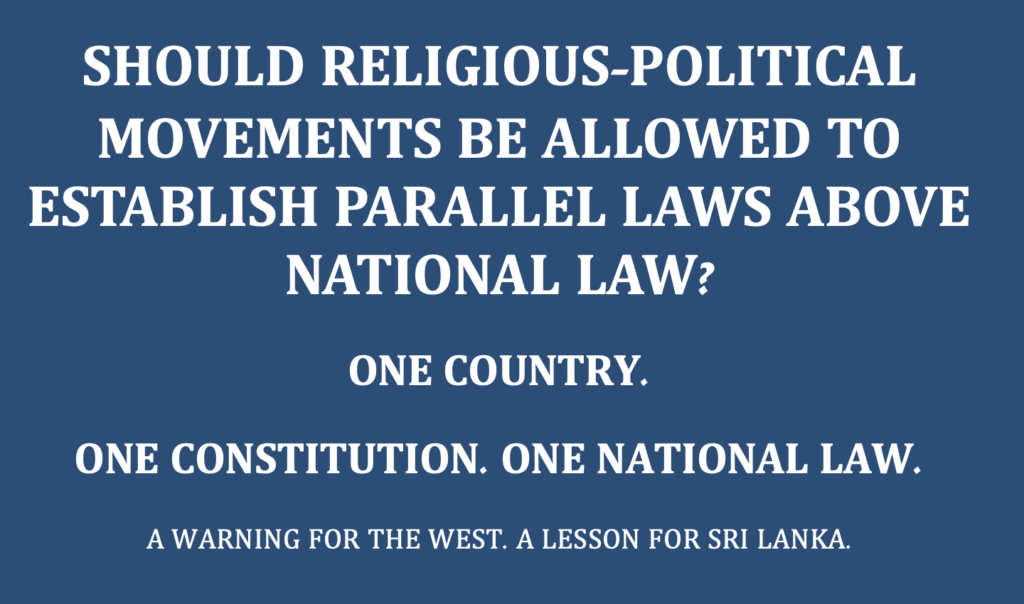
WHO HAS AUTHORITY – THE CONSTITUTION OR A RELIGIOUS-POLITICAL MOVEMENT?
The debate is not about denying Muslims or any other community the right to practise their religion. It is about ensuring that no religious or political movement can place itself above national law, intimidate those who disagree, impose its doctrines upon others or undermine the constitutional rights of fellow citizens.
Western governments are increasingly examining these challenges.
Sri Lanka has already experienced the consequences of failing to act on extremist warnings.
The lesson is clear: governments must address legitimate grievances, confront extremism, enforce one law for all and prevent institutional inaction from creating opportunities for radicalisation, division and retaliation.
Sri Lanka does not want the West to experience another Easter Sunday.
Nor should Sri Lanka wait for another tragedy before addressing the warning signs already visible within its own society in particular the manner political Islam is subtly spreading its wings.
Shenali D Waduge