
CARDINAL RANJITH: FROM WELCOMING THE SUPREME COURT DETERMINATION TO SUPPORTING THE CHANNEL 4 NARRATIVE — WHAT CHANGED?
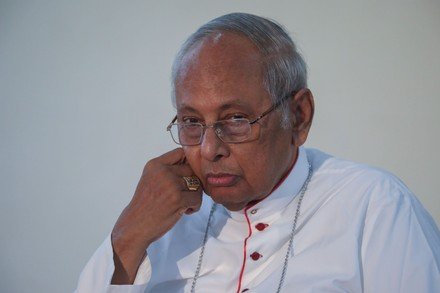
If the standard of truth changes with every new narrative, how do we ever arrive at the truth? This is the question Cardinal Ranjith must answer. The Cardinal has every right to demand justice for the victims of the Easter Sunday attacks. But Easter Sunday was not an attack on Catholics alone. Christians, Buddhists and others were among those killed and injured. The demand for justice therefore belongs to the entire nation, not to one religious community alone.
WHAT CHANGED FROM HIS STAND IN JANUARY 2023 to after SEPTEMBER 2023?
12 JANUARY 2023: THE CARDINAL WELCOMED THE SUPREME COURT DETERMINATION
On 12 January 2023, the Supreme Court delivered its landmark Fundamental Rights determination concerning the failure of senior officials to act on intelligence available before the Easter attacks. The Church was also a petitioner.
The Court found violations of the fundamental rights of the petitioners, stressed on the negligence of preventable actions and ordered compensation. This was a judicial determination concerning failure to act and constitutional responsibility. It was not a criminal finding that those officials planned or organised the Easter attacks.
The Cardinal welcomed the January 2023 determination.
If the Cardinal himself said in January 2023 that the Supreme Court determination was a beginning and a milestone on the journey toward the “entire truth,” what specifically changed after the Channel 4 documentary in September 2023?
CHANNEL 4
On 5 September 2023, four years after the attacks Channel 4 broadcast a television documentary presenting allegations of a very different narrative concerning the Easter attacks.
The following day, Cardinal Ranjith issued a statement thanking Channel 4 for focusing international attention on what he described as a “great plot” behind the Easter attacks.
He called for a new, transparent investigation into the allegations, including the removal of certain officers and the return of officers who had previously been removed.
Ironically, a Cabinet Minister stated in Parliament that these same officers had been appointed following a request from the Cardinal.
These were the same officers named as having been negligent in their duties but appeared on the Governments political stage before elections.
On 6 September 2023, within a day of the documentary’s release, the Cardinal issued a three-page congratulatory letter to Channel 4
WHAT EVIDENCE CHANGED THE DIRECTION?
The critical issue is not whether Channel 4 – a documentary made 4 years after the attacks should have been investigated.
It should have been, if its allegations were credible.
When Cardinal issues a congratulatory letter immediately after the release of the C4 documentary, we must question how Cardinal independently verified the allegations before issuing his 3-page congratulatory letter.
The Supreme Court determination had resulted from a judicial process.
Channel 4 presented allegations through an international television documentary by an asylum seeker who was evading Sri Lankan courts.
The Directors themselves when questioned in Geneva regarding the documentary stated they have no evidence apart from that which Asad Maulana alleges.
Clearly, this is not the same evidentiary category as that which the Supreme Court judgement was based on.
A documentary can raise questions.
A witness can make an allegations.
A journalist can present information.
But an allegation is not a judicial finding, and a documentary is not a court of law.
Therefore:
What specific new evidence did Channel 4 produce that changed the Cardinal’s investigative focus?
The Supreme Court’s finding of failure to act cannot automatically be converted into proof that the same individuals planned the attack.
The Cardinal has made a major mistake in his intervening petition claiming that Maj. Gen. Suresh Sallay held position of DMI during the Easter Sunday attacks. Maj. Gen. Suresh Sallay was overseas from 2016-end of 2019 and did not serve in any military or intelligence role.
The Cardinal’s intervening petition appears to reflect an incorrect understanding of the officer’s position at the time of the Easter attacks
This appears to have arisen from the new allegation presented in the Channel 4 broadcast. Likewise, a new allegation cannot automatically become established fact merely because it appears in an international documentary.
WHAT IF ANOTHER DOCUMENTARY APPEARS?
Suppose tomorrow another international broadcaster produces a documentary presenting a completely different version of Easter Sunday.
Suppose it names different individuals.
Suppose it proposes a different motive.
Suppose it contradicts Channel 4.
Will the Cardinal change his position again?
And if a third documentary appears with yet another version?
Will that become the new direction?
If not, then we ask:
WHAT IS THE OBJECTIVE EVIDENTIARY STANDARD?
Because truth cannot change every time a documentary changes.
Truth must be established by evidence. Nothing else.
THE CHANNEL 4 ALLEGATIONS & IMAM COMMITTEE REPORT
This is especially important because subsequent official scrutiny has challenged/rejected specific allegations presented in the Channel 4 documentary.
The Imam Committee’s findings, as later publicly reported, rejected key allegations in the Channel 4 narrative, including the allegations concerning Major General Suresh Sallay.
That does not mean Channel 4’s allegations should never have been investigated.
It means every allegation must survive independent verification with evidence.
Clearly there are 2 issues that need answers:
-
What motivated Zahran Hashim and his associates to radicalise, indoctrinate, recruit, collect explosives and prepare individuals for suicide attacks against civilians and non-believers?
-
What prevented the authorities—who had intelligence on Zahran and his activities for years, including information concerning his extremist network and preparations—from taking effective action to apprehend him before the attacks?
These are two separate questions.
The first concerns the origin, ideology and operational development of the terrorist network.
The second concerns the failure of the State to prevent the attack despite prior intelligence and even discovery of explosives & admission of suspects.
Neither question can automatically answer the other.
THE CARDINAL’S OPPOSITION TO THE DEATH PENALTY IS A DIFFERENT ISSUE
The Cardinal is entitled to oppose capital punishment on Catholic moral grounds.
That is a legitimate religious position.
But three things must not be confused:
Catholic doctrine
A moral and religious position.
Sri Lankan law
The legal framework enacted by the State & Constitution
A judicial sentence
A determination made by a court under that constitutional legal framework.
If the Cardinal believes capital punishment should not exist, he can campaign for the law to be changed.
He can advocate abolition.
He can seek commutation.
He can argue the issue through the legal and democratic process.
But the more difficult question is:
The legal framework governing criminal punishment is determined by Sri Lankan law and the Constitution, not by the doctrine of any individual religion
The question is therefore not whether the Cardinal may oppose the death penalty. He may. The question is whether his religious objection can determine the legal validity or appropriateness of a sentence imposed by a Sri Lankan court.
WHAT ABOUT THE PRESENT DEATH SENTENCE?
The July 2026 Trial-at-Bar judgment convicted former IGP Pujith Jayasundara and former Defence Secretary Hemasiri Fernando and imposed death sentences.
But the judgment itself was divided:
Two judges convicted.
One judge dissented.
The convicted men have a right of appeal.
That fact alone demonstrates why the judicial process must be allowed to continue.
And it also raises another important question.
Is the Cardinal opposing the death penalty as a matter of principle — or opposing this particular sentence?
If it is a principle:
Has he opposed previous death penalties regardless of the accused?
If it is this particular case:
What is the legal basis for saying the court’s assessment is wrong?
That distinction matters.
PROPORTIONALITY — THE ATTACKERS AND THE OFFICIALS FOUND RESPONSIBLE FOR FAILURE TO ACT
There is a legitimate legal question about the proportionality of the punishment.
The offences taken up before the Supreme Court via the Fundamental Rights petitions concerned alleged criminal negligence, failure to perform official duties and responsibility for failing to act on intelligence warnings.
That is not conceptually identical to:
planning the terrorist attack,
financing it,
preparing explosives & suicide cadres
carrying it out,
or
directly murdering the victims.
The distinction between criminal intention (mens rea) and dereliction/failure of duty therefore deserves serious legal examination.
The question is not whether failure to act can carry criminal responsibility.
It can.
The question is whether the ultimate punishment is proportionate to the nature of the criminal responsibility actually established.
That is a legitimate legal question — and it should be answered through law, not religious doctrine, media sensationalism or public emotion.
The Cardinal & Maj. Gen. Suresh Sallay
The Cardinal is the only intervening petitioner opposing Major General Suresh Sallay’s writ challenging the basis of his arrest under the PTA and the inhuman treatment while detained on a Presidential Detention Order.
If the Cardinal’s overriding principle is justice and accountability, what is the basis for opposing a petition that asks the Court to examine the legality of the detention and the treatment alleged by the detainee?
Does opposition to a person’s release require opposition to the Court examining whether his detention and treatment are lawful?
Cardinal would also be aware that no charges have been filed against Maj. Gen. Suresh Sallay in any Court thus far.
He is challenging his arrest and detention through a writ petition.
AND WHAT OF THE CARDINAL’S POSITION AS A PARTY SEEKING JUSTICE?
The Catholic Church and Cardinal Ranjith have been active in proceedings and advocacy concerning Easter Sunday.
But it also makes consistency even more important.
A party seeking a particular legal outcome should present its case through the legal process.
The courtroom is where evidence is tested.
The appellate process is where a disputed judgment is challenged.
The media is not a substitute for either.
Therefore:
If a judgment is wrong, appeal it.
If a law is wrong, change it.
If an allegation is credible, investigate it.
If evidence establishes guilt, prosecute.
But do not confuse a media narrative with a judicial finding.
BUT LET US NOT LOSE SIGHT OF THE BIGGER QUESTION
They cannot be answered by any named in the reports as being part of the State apparatus before and during the Easter Attacks
- WHO PLANNED EASTER SUNDAY?
- WHO FINANCED IT?
- WHO FACILITATED IT?
- WHO KNEW?
- WHO FAILED TO ACT?
- WHO ENABLED THE ATTACKERS?
- WHO OBSTRUCTED INVESTIGATIONS, IF ANYONE DID?
- AND WHO ARE THE REAL MASTERMİNDS?
These questions cannot be answered by television documentaries.
They cannot be answered by political claims.
They cannot be answered by religious authority.
They can only be answered by:
evidence + investigation + due process + judicial determination.
FIVE QUESTIONS THE CARDINAL SHOULD ANSWER
- In January 2023 you welcomed the Supreme Court determination as “a beginning” and “a milestone.” What specifically changed in your position after the Channel 4 documentary in September 2023?
Basis: Your own public statements show a clear shift in emphasis after the documentary.
- What new, independently verified evidence — beyond the Channel 4 allegations — justified the new investigative direction?
Basis: A documentary presents information and allegations; it does not itself establish criminal liability. Yet within hours of the broadcast, you sent Channel 4 a three-page congratulatory letter
- You said the “entire truth” had still to emerge. What exactly is that truth — and what evidence establishes it?
Basis: These are your own words following the Supreme Court determination.
- If another documentary tomorrow presents a completely different Easter narrative, will you change your position again? If not, what objective evidentiary standard distinguishes one documentary from another?
Basis: Truth cannot depend on which media organisation produces the latest narrative.
- If you oppose the present death sentence, are you opposing capital punishment as a matter of principle — or saying this particular court’s sentence is legally wrong?
Basis: Religious opposition to capital punishment and the legality/proportionality of a sentence are two different questions.
THE CARDINAL HAS A RIGHT TO DEMAND JUSTICE.
SO DO THE VICTIMS.
But justice cannot mean:
one standard for one narrative,
another standard for another narrative,
and a third standard when the evidence becomes inconvenient.
THE TRUTH MUST FOLLOW THE EVIDENCE
Because if the accepted “truth” changes every time a new documentary appears,
then we are not pursuing truth. We are pursuing narratives.
Shenali D Waduge


