The Legal Defects in Sri Lanka’s Land Registry: Two Registers with a Flawed Digitalisation Programme
Sri Lanka is being rapidly moved towards a digitalisation of its land records. Digital technology can undoubtedly improve efficiency, but digitalising an unreliable legal system will not create a reliable land register or any relief for land owners and even a government who has to answer long term consequences. Before investing billions in digital transformation, a Government must first correct the legal defects that have existed for decades. Why have the digital gurus tasked to roll out digitalization not seen this stark reality and commenced remedies to this issue first?
Currently, Sri Lanka operates two separate land registration systems, neither of which establishes a complete, reliable compulsory register that landowners, investors, banks or the State can confidently rely upon.
- Two Statutes – Two Registers
Sri Lanka’s land registration system is governed by:
- Registration of Documents Ordinance No. 23 of 1927
- Registration of Title Act (Bim Saviya) No. 21 of 1998
Instead of replacing one system with another, Sri Lanka now operates two parallel registers, creating legal uncertainty and administrative complexity.
- The Existing Deeds Register Does Not Prove Ownership
The Registration of Documents Ordinance No. 23 of 1927 was never designed to establish ownership.
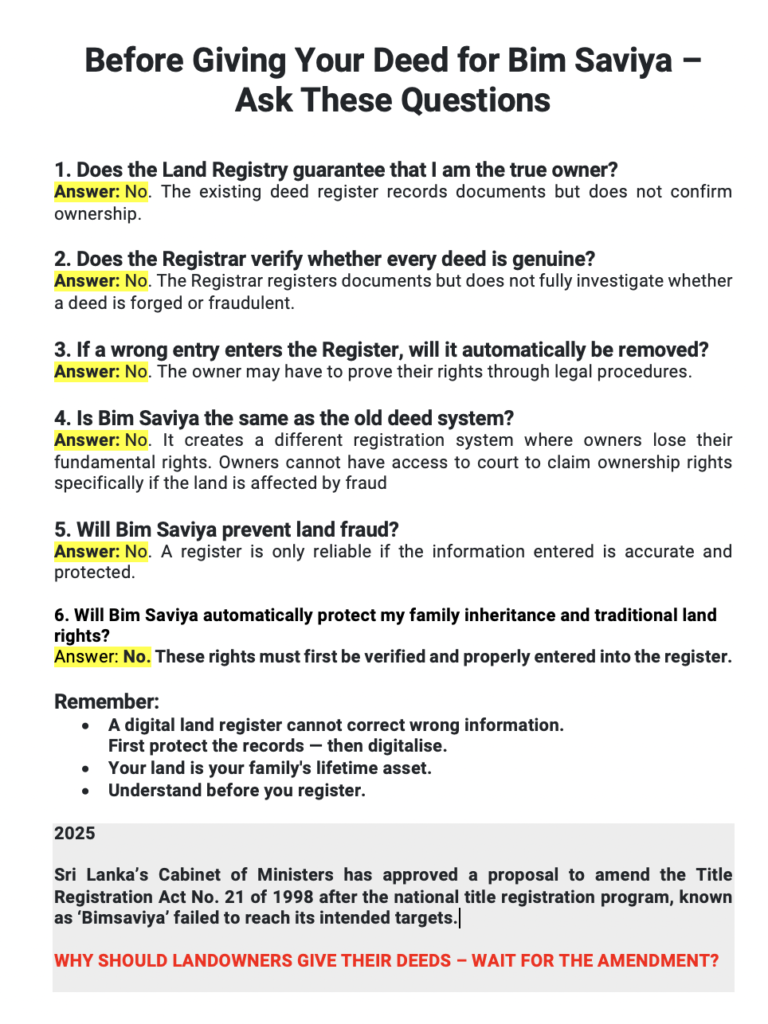
Ownership cannot be confirmed from the Register
The Registrar has no statutory authority or duty to determine whether a deed presented for registration is genuine or forged.
The Registrar records deeds presented for registration but does not certify ownership.
As a result, the Register may register both valid and invalid deeds.
Registration is Optional
A deed remains legally valid even if it is never registered.
Registration merely gives priority between competing transactions.
The Supreme Court in SC 93/2022 confirmed that the Register established under the Ordinance is only a priority register, not a register of ownership.
The Court further held that a registered Deed of Gift may lose priority to an earlier unregistered transfer for valuable consideration, demonstrating that registration alone does not conclusively establish ownership.
- Even the Registrar General Acknowledged the Defects
In 2016, the Registrar General formally informed the Prime Minister (Ref. RG/TRB/03/278) that:
ownership cannot be determined from the Register;
- the legal framework under the 1927 Ordinance is inadequate;
- the Land Registry infrastructure requires substantial reform before Sri Lanka can establish an internationally recognised land registration system.
These warnings have remained largely unaddressed.
- Landowners must maintain the Register
An extraordinary feature of the present law is that innocent landowners—not the State—carry much of the responsibility for maintaining the integrity of the Register.
Under the Land Registers (Reconstructed Folios) Ordinance No. 18 of 1945, owners must:
- discover whether folios have been damaged or lost;
- apply for reconstruction;
- bear the associated costs.
The Registrar has no general statutory duty to reconstruct damaged folios on his own initiative.
- Digitalising an Unreliable Register will not prevent Fraud
A digital database is only as reliable as the information entered into it.
If the underlying Register contains:
- forged deeds,
- incomplete records,
- damaged folios,
- inaccurate entries,
digitalisation merely transfers those defects into electronic form.
Technology cannot correct legal defects.
Without first creating an accurate base register, digitalisation risks preserving errors permanently.
- Bim Saviya created a Second Register without Reforming the First
The Registration of Title Act No. 21 of 1998 introduced the Bim Saviya title registration system without first reforming the 1927 deed registration system.
The result is two parallel systems operating under different legal principles.
The Act has generated significant legal and practical difficulties.
Among the concerns raised are that it:
- cannot adequately accommodate many ownership arrangements recognised under Kandyan, Thesawalamai and Muslim personal laws;
- has difficulty accommodating certain customary village rights, co-ownership arrangements and cultivation rights;
- limits the judicial remedies available where fraudulent registration occurs;
- repealed important aspects of earlier land legislation, including provisions affecting partition and prescription, creating practical legal complications.
- Two National Committees Reached Similar Conclusions
Because of these problems, Government appointed:
- the Presidential Committee (2013);
- the Ministry of Justice Committee (2022).
Both examined the shortcomings of the Registration of Title Act.
Significantly, the Ministry of Justice Committee recommended changing the name of the proposed legislation to the Voluntary Title Registration Act, recognising that compulsory registration was neither practical nor suitable for every category of land ownership.
Despite more than twenty-five years of implementation and substantial expenditure, Sri Lanka still lacks a complete national land register.
The Bim Saviya programme has also been the subject of observations by the Auditor General and assessments by the World Bank.
- Cabinet itself recognised the Need for Reform
Cabinet Memorandum No. 20/2100/322/007 dated 24 December 2020 recommended:
- introducing a compulsory land registration framework; and
- appointing a committee to amend the Registration of Title Act.
The Ministry of Justice subsequently appointed that committee.
This demonstrates that Government itself recognised that legislative reform was necessary before a comprehensive national register could be achieved.
https://economynext.com/sri-lanka-to-amend-title-registration-as-bimsaviya-misses-targets-279089/ (Sri Lanka to amend Bim Saviya as it has failed to achieve targets)
- Digitalisation must follow Legal Reform
At present, lawyers, registry administrators and ICT specialists largely work independently.
Technology alone cannot solve problems created by defective legislation.
Before any further digitalisation, Government should first establish an accurate legal foundation.
This includes:
- reconstructing damaged and missing folios;
- introducing owner verification before registration;
- implementing biometric identity verification;
- sending SMS/mobile alerts whenever deeds affecting land are lodged;
- using artificial intelligence to identify suspicious transactions;
- introducing tamper-evident technologies such as blockchain where appropriate;
- maintaining complete electronic audit trails of every transaction.
What Sri Lanka needs is not simply a digital land register.
Sri Lanka needs a legally reliable land registration system.
Unless the legal, administrative and technical defects in both the Registration of Documents Ordinance and the Registration of Title Act are first addressed, digitalisation will simply computerise the existing weaknesses including fraud. The situation is confounded in Bim Saviya certifications where Courts have little or no jurisdiction to intervene & resolve land issues.
A modern land registry should protect ownership—not merely record documents. Only after comprehensive legal reform can digitalisation deliver the certainty, security and public confidence that Sri Lanka’s landowners and investors deserve.
Shenali D Waduge
https://www.dailymirror.lk/print/news-features/One-law-for-all–Bim-Saviya-E-Register:-More-problems-than-solutions/131-196730
https://www.ft.lk/Columnists/Sri-Lankan-lawyers-deliberately-kept-out/4-708298
ttps://rgd.gov.lk/web/images/ActsPDF/title/2308-27_E.pdf? – Registration of Title Act Amendments – Gazette No. 2308/27 (1 December 2022)
https://www.sundaytimes.lk/140323/news/temples-losing-their-land-title-registration-act-to-be-amended-90185.html
https://www.parliament.lk/uploads/documents/paperspresented/performance-report-land-title-settlement-department-2014.pdf