CAN INDIA PROMOTE HINDUISM, THE RAMAYANA TRAIL AND BUDDHISM SIMULTANEOUSLY IN SRI LANKA WITHOUT REPLACING SRI LANKA’S CIVILISATIONAL IDENTITY?
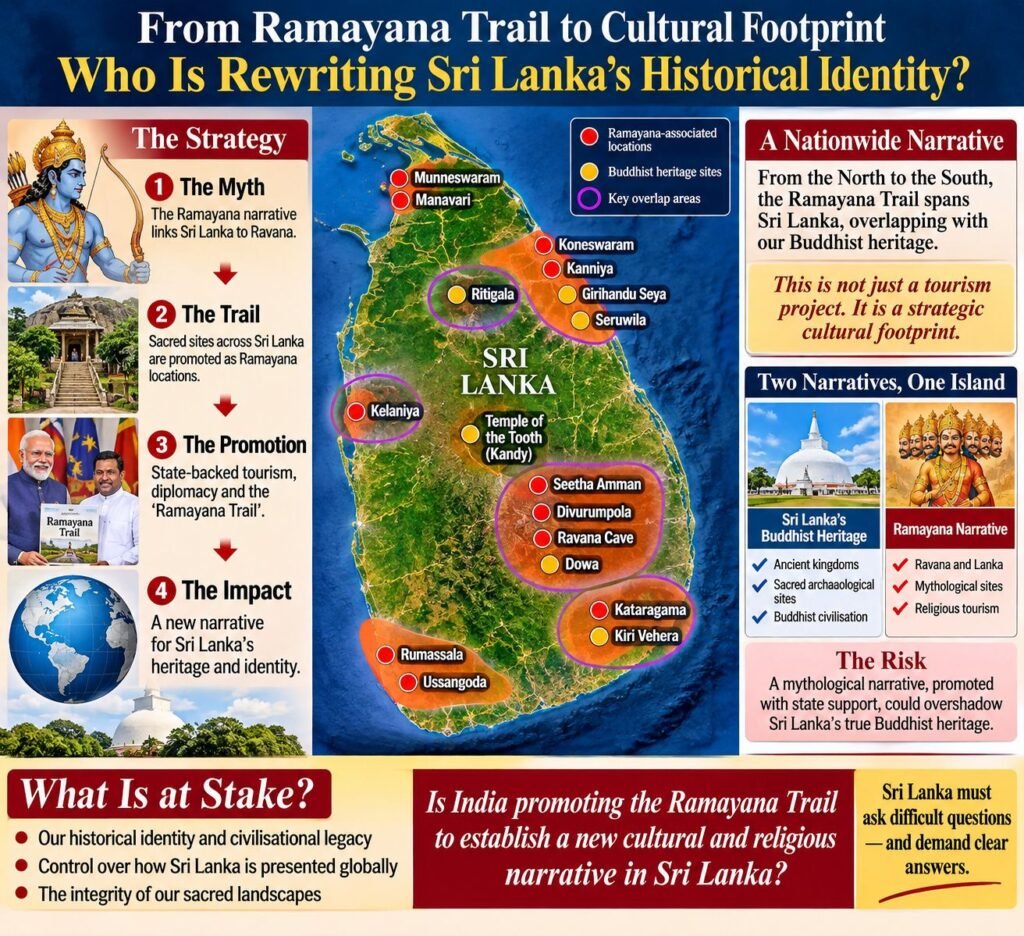
India’s promotion of the Ramayana Trail, Hindu kovils and Hindu religious tourism in Sri Lanka raises a fundamental question: Is India promoting Hinduism and Buddhism equally, or using Buddhist soft-power diplomacy alongside a much larger Hindu cultural agenda? India’s own domestic funding priorities, its religious projects in Sri Lanka and its silence over threats to Buddhist archaeological heritage must be examined together. If Hinduism takes precedence over Buddhism within India, why should Sri Lanka expect India to reverse those priorities here? More importantly, how are these dots connecting to the larger plan of establishing Arkhand Bharath? The real issue is whether Sri Lanka’s Buddhist civilizational identity is being protected or gradually overshadowed by an externally promoted religious and cultural agenda for which Sri Lanka’s own Government is knowingly or unknowingly allocating public funds disregarding the long-term irreversible consequences where the foundations are being laid for a myth to replace Buddhist archaeological heritage in the future.
If Sri Lanka’s own history, identity and civilisation are gradually presented through an India-centred Ramayana narrative, the concern is whether Sri Lanka is being culturally repositioned within a wider Indian civilisational framework.
Is the Ramayana Trail serving a wider Hindutva soft-power objective of extending India’s civilisational influence into Sri Lanka?
Sri Lanka must not confuse cultural connectivity with civilisational absorption.
Sharing religious and cultural links with India must never mean surrendering Sri Lanka’s distinct Buddhist civilisational identity, historical narrative or sovereignty.
Sri Lanka mut distinguish between cultural exchange and civilisational absorption.
It is noteworthy that immediately following the 2015 India-US brokered regime change in Sri Lanka, the Ramayana Trail promotion moved formally as a India-Sri Lanka bilateral cooperation.
February 2016
Indian External Affairs Minister Sushma Swaraj arrives in Colombo to advance the Ramayana Trail discussions.
3 June 2016
India and Sri Lanka signed an MoU specifically to promote the Ramayana Trail and facilitate Indian pilgrims visiting Sri Lanka.
July 2023 – Sri Lanka’s Cabinet confirms $15m grant signed on 28 March 2022 of which $10m was allocated for solar power facilities for Buddhist temples & pirivenas.
This is separate to the $17m Indian line of credit for rooftop solar systems at religious institutions. Since both schemes fund solar facilities, how much of India’s claimed Buddhist assistance is genuinely free aid, and how much is ultimately paid for by Sri Lanka through repayable credit?
Sri Lankan taxpayers allocation for Indian mythological Ramayana Trail promotion
Oct 2021 – Jeewana Fernando an official of the Sri Lanka Tourism Development Authority responsible for the Ramayana Trail declared that SLTDA had allocated Rs.20m annually for Ramayana Trail promotion and SLTDA had identified 52 Ramayana-related sites & SLTDA was coordinating with Hindu religious missions in India to bring Hindu devotees to Sri Lanka. 32 of these 52 sites were already being promoted. Sri Lanka had allocated public funds for promotional campaigns in India for Ramayana Tourism in 2021 & 2022.
Feb 2023 –
The question is – when Sri Lanka has enough of Sri Lanka’s own culture to promote, why is Sri Lanka allocating public funds annually to promote a Hindu epic-based tourism product. The SLTDA official even said tourists would be visiting Ramayana sites more than Buddhist sites in Sri Lanka. What is the long-term consequence of this arrangement?
Why can’t the SLTDA promote Sri Lanka’s Buddhist civilizational heritage internationally with the same vigor it is promoting a myth?
14 April 2024 – Indian High Commissioner at the launch of the Ramayana Trail-The Sacred Mission referred to the Modi-Wickremasinghe 2023 India-Sri Lanka Vision Document committing both countries to promote the Ramayana Trail and the Buddhist Circuit. Reference was also made to an Ayodhya delegation to raise awareness of the Ramayana Trail among Indians.
Was India placing Buddhism as an equal priority, or was it included to broaden the religious narrative while the immediate promotional focus remained firmly on the Ramayana Trail?
22 April 2024 – The Indian High Commissioner hosted the treasurer of the Shri Ram Janmabhoomi Teerth Kshetra Trust and his delegation to discuss how India could support development of the Ramayana Trail in Sri Lanka. This highlighted the Indian Sri Lankan missions diplomatic-religious institutional participation.
India’s allocation of funding to Hindu Kovils
April 2025 – Rs.326m Indian grant for restoration of Thirukoneswaram Kovil, Trincomalee. Yet the very site on which the present Koneswaram Kovil stands was originally a Buddhist religious establishment.This a fact established by Portuguese chronicler Fernão de Queirós and historian Bandu de Silva who argued that the temple complex destroyed by the Portuguese in 1622 was a Buddhist monastery.
By disregarding this historical fact and prioritising the Hindu kovil, this raises questions about India’s commitment to preserving Buddhist heritage.
April 2025 – Indian grant assistance to Sita Eliya, Nuwara Eliya Hindu kovils under the Ramayana Trail promotion, including exchange of scholars, artists, publications and tourism cooperation. The Indian Parliamentary Committees Sixteenth Report also recommends leveraging India’s soft-power diplomacy.
This directly highlights India’s role in Hindu kovil development and the broader Ramayana cultural-toursim program.
- India has committed US$15 million to Buddhist ties, including US$10 million for solar facilities.
- The Ramayana Trail carries a US$50 million investment, but its actual funding sources remain undisclosed.
- India has funded at least US$0.98 million for one major Hindu temple restoration, with two further temple grants announced without disclosed amounts.
- Anuradhapura’s proposed development could cost US$23–26.5 million, with Indian assistance not yet received.
The Ramayana Trail proposal is approximately 2.16 times more than the Anuradhapura project cost — more than double while a significant amount is being allocated via Sri Lankan taxpayers funds as well.
The critical issue is how much India actually spends on promoting Hindu religious tourism and Ramayana heritage in Sri Lanka compared with Buddhist heritage.
Buddhist Heritage Under Threat – North and East Sri Lanka & India’s silence
- Auditor General’s 2024 Report – Northern Province
Six archaeological locations were identified where Buddhist stupa mounds had been completely flattened or other religious structures built over archaeological stupa remains:
- Nagathambaran – Vavuniya
- Vavunikulam – Vavuniya
- Sivapuram Srimale Temple – Vavuniya
- Nedunkeni Shiva Nagar – Vavuniya
- Kulamurippu – Mullaitivu
- Koddiamalai
The Auditor General called for protection under the Antiquities Ordinance as well as Defense Ministry support where necessary.
- Vaddamana Pabbatha Viharaya – Vavuniya
- Ancient Buddhist monastery with Brahmi inscriptions dating back over 2,000 years.
- Destruction of stupa bricks and damage to cave inscriptions.
- Shiva Lingam installed at the disputed archaeological site.
- Supreme Court petition filed in 2023,
- India has not condemned the act or made attempts to restore the damage.
- Kurundi Viharaya – Mullaitivu
- Ancient Buddhist monastery and archaeological remains.
- 12 June 2022 local Tamil protestors blocked Buddhist theros conducting a Buddhist ceremony.
- India has not condemned the actions. If India presents itself as a guardian and promoter of Buddhist heritage, why is there no public Indian government or High Commission condemnation of this obstruction?
- Kanniya – Trincomalee
- Ancient Buddhist monastery, stupa and image-house remains.
- 2015 report by the Japan Consortium for International Cooperation in Cultural Heritage describes place as an ancient Buddhist temple dating to Anuradhapura period. https://www.jcic-heritage.jp/wp-content/uploads/2022/12/2014Report_SriLanka_en.pdf
- Shiva Kovil reported within the archaeological complex.
- Ovagiriya – Ampara
- Ancient Buddhist archaeological complex damaged by development activity.
- 11 ½ foot Buddha statue found headless and without hands; subsequently conserved by the Department of Archaeology in 2008. https://archaeology.gov.lk/about/sections/chemical-conservations
- Other Eastern Province locations
- Kandakudichchi Aru
- Kokkadicholai
- Ettama, Pottuvil
- Taravakulam
- Vellaveli
These have Buddhist remains associated with subsequent Hindu religious structures.
When India allocates $50m investment to promote Ramayana Trails in Sri Lanka against $15m Buddhist circuit while Buddhist archeological sites are repeatedly under threat and attack with Hindu siva lingams being placed on top of destroyed Buddhist sites, India has a moral duty to either question the Hindus involved, stop the decertation of these ancient Buddhist sites or before commencing new projects allocate funds to restore the Buddhist sites destroyed in the North and East.
India cannot promote Buddhist tourism while silently watching Hindu structures replace destroyed Buddhist sites in the North & East while also promoting Ramayana Trail and Hindu heritage in Sri Lanka which now includes a grant to promote Chola invader heritage.
India has approximately 966.3 million Hindus and 8.44 million Buddhists.
India actively promotes Hindu religious destinations through the Ramayana, Krishna and Spiritual Circuits, while maintaining a separate Central Government grant scheme for Buddhist and Tibetan cultural institutions.
In 2024–25, the Central Government released approximately US$2.39 million under its Buddhist/Tibetan cultural assistance scheme to 385 organisations across India.
In the same financial year, Tamil Nadu recorded approximately US$47.41 million in actual expenditure under its Hindu Religious and Charitable Endowments Department.
Thus, the expenditure recorded under the Hindu religious administration of one Indian state alone was approximately 19.8 times the entire national Buddhist/Tibetan institutional grant.
If Hinduism takes precedence over Buddhism in India, should Sri Lanka foolishly believe India would reverse its policy in Sri Lanka?
Is India now targeting Theravada Buddhist nations through soft-power diplomacy for the larger Arkhand Bharath objective?
Nepal example
Soft-power diplomacy replaces military intervention and operates using financial assistance, infrastructure, institutions, education, cultural exchanges, religious networks and control over how another countrys history & identity are presented.
Nepal is the birthplace of Buddha. It is a World Heritage property & under Nepalese authority and managed by the Lumbini Development Trust.
On 16 May 2022, Indian PM Modi & Nepal’s PM Bahadur Deuba laid the foundation stone for an Indian International Centre for Buddhist Culture & Heritage. It was funded by the Indian Ministry of Culture and was to be developed by the Delhi-based International Buddhist Confederation (IBC).
The Lumbini Development Trust had allocated 1.37 acres to India for the Indian Buddhist centre.
Having got a foothold in Buddha’s place of birth, the bigger question is how India proposes to use Buddhist soft-power diplomacy through Buddhist conferences, research publications, academic exchanges, religious gatherings and international networks, to influence how Buddhism and a sacred place are presented to the world.
How much influence will India eventually exercise over the interpretation and international representation of Nepal’s Buddhist heritage.
This concern is poignant given the manner India inflicted an economic embargo in 2015 when Nepal refused to amend clauses to its new constitution requested by India. That embargo resulted in a humanitarian crisis.
The Lumbini Development Trust that allocated land and permission to India faced another controversy when UNESCO reports highlighted concerns regarding its actions related to the Ramgram Stupa for involving foreign-linked private organizations. Objections by local residents ultimately led to revoking approvals given.
These developments demonstrate why sacred heritage projects require independent scrutiny, local participation and strong institutional safeguards.
INDIA’S HISTORICAL RELATIONSHIP WITH BUDDHISM
Emperor Ashoka gave Buddhism significant royal patronage and helped establish a legacy that extended beyond India. Ancient India was also home to major Buddhist institutions such as Nalanda. However, Buddhist institutions and royal patronage declined over subsequent centuries.
Sri Lanka’s history followed a different path.
Successive Sinhala Buddhist kings considered protecting the Buddha Sasana a sacred responsibility of kingship. Dutugemunu built the Ruwanweliseya; Valagamba is associated with Abhayagiri and the writing down of the Tipitaka at Aluvihare; Mahasena built Jetavanaramaya, while later kings such as Vijayabahu I and Parakramabahu I restored and reorganised Buddhist institutions.
Through royal patronage closely linked to the ideals of the Dasa Raja Dhamma, monastic discipline and scholarship, Sri Lanka became a major centre of Theravada Buddhism. Buddhaghosa’s fifth-century Visuddhimagga remains one of the most important works of the Pali commentarial tradition.
Sri Lanka’s Buddhist history was also shaped by international religious relationships. The establishment of the Siam Nikaya in 1753, following the arrival of Upali Thera from Siam, and the Amarapura Nikaya in the early nineteenth century, following ordination links with Burma, demonstrate Sri Lanka’s connections with the wider Theravada world.
Sri Lanka did not merely receive Buddhism. It preserved, practised, developed and transmitted the Theravada tradition through centuries of scholarship, monastic discipline and international religious exchanges.
India’s historical association with the birth of Buddha does not automatically confer authority over the Theravada tradition that Sri Lanka and other Theravada nations have preserved.
INDIA’S RELIC DIPLOMACY, PALI AND THE BUILDING OF INTERNATIONAL NETWORKS
Today, India is engaged in international exhibitions of Buddha relics and relics associated with Arahants Sariputta and Mahamoggallana, Buddhist circuits, academic programmes, publications, conferences and cultural exchanges.
Relics carry profound religious significance for Buddhist devotees. International exhibitions can create religious goodwill, public participation and lasting cultural and diplomatic relationships.
India even recognized Pali as a classical language in October 2024 & is offering Pali scholarships.
India also sponsored a Pali symposium in July 2024 in Colombo with Indian envoy referring to the proposed Anuradhapura Sacred City Complex.
India’s Sixteenth Report of the Parliamentary Committee on External Affairs, India–Sri Lanka Relations and the Way Ahead, presented on 25 September 2026 discloses India’s approach.
The report recommends
- Promoting Ramayana Trail for Indian visitors to Sri Lanka
- Identifying Hindu religious sites including Seetha Amman Temple and Thirukoneswaram, Yet the very site on which the present Koneswaram Kovil stands was originally a Buddhist religious establishment.
This is a fact established by Portuguese chronicler Fernão de Queirós and historian Bandu de Silva who argued that the temple complex destroyed by the Portuguese in 1622 was a Buddhist monastery. India cannot overlook the Buddhist origins of the site.
Thus, when India’s official report claims the site is Hindu this raises a legitimate question about whether Sri Lanka’s Buddhist heritage is receiving equal recognition in India’s cultural and religious engagement.
India cannot present the Ramayana Trail as Buddhist promotion while overlooking the Buddhist historical associations of sacred sites such as Thirukoneswaram.
This example is further illustrated in the manner increasing Buddhist temples in the North and East are being targeted and after destroying ancient Buddhist artefacts, Hindu sivalingam are being replaced. Vaddamana Pabbatha vihara is one such example.
- Recommending India leverage its soft-power diplomacy.
This is where India contradicts itself by its own actions.
The Ramayana Trail has nothing to do with propagating Theravada Buddhism. It promotes a mythological Ramayana-related Hindu religious heritage, pilgrimage and cultural tourism. It cannot be counted as evidence of India’s commitment to preserving or propagating the Theravada Buddha Sasana or part of Sri Lanka’s heritage and history.
The larger concern is that religious tourism, financial assistance, academic exchanges, publications, exhibitions and institutional networks can become instruments of cultural influence.
A country need not take possession of a sacred site to acquire influence over how another country’s history, religious heritage and civilisational identity are interpreted and presented.
The question Sri Lanka must ask is not simply how much assistance India offers, but whose historical narrative, religious priorities and institutional influence are being advanced through that assistance?
FROM MILITARY INTERVENTION TO CULTURAL AND RELIGIOUS BUDDHIST DIPLOMACY
Apart from the historical invasions & occupations post-independent Sri Lanka has witnessed several interventions by India.
- Late 1970s – training, funding, providing logistics support in India to Tamil youth that launched Tamil militancy in Sri Lanka lasting 3 decades.
- 4 June 1987 – Operation Poomalai – air dropping supplies over Jaffna without Sri Lanka’s permission
- Ordering Sri Lanka’s military to not capture Prabakaran in Vadamarachchi – India took Prabakaran & family to Delhi & kept him there until Accord was signed.
- 29 July 197 – signing of Indo-Lanka Accord
The Accord that claimed was in the interest of Tamils had only clauses of strategic interest to India – the use of Sri Lankan ports, facilities by foreign military and the Trinco harbor and oil tank farms.
- 30 July 1987 – arrival of Indian Peace Keeping Force
- Nov 1987 – introducing provincial council system through 13th amendment
These events demonstrate that India’s interests in Sri Lanka have extended beyond bilateral friendship.
Today, India is expanding its international Buddhist diplomacy through Buddhist circuits, relic exhibitions, support for Buddhist institutions, academic programmes and cultural exchanges.
When India’s historical & domestic civilizational identity is predominantly Hindu, why is India including Buddhism as a bilateral-policy?
ANURADHAPURA: WHY SRI LANKA MUST ASK QUESTIONS NOW
Against this background, we come to PM Modi’s visit to Sri Lanka in April 2025 where the grant for the Anuradhapura Sacred City Complex was announced. It was included into India’s Parliamentary Committee report.
Allocation of costs differ from Rs.7.7b to Rs.8.8b – so far no funding has come.
Sri Lanka’s Govt approved the Anuradhapura Sacred Area Development Plan on 8 October 2025 and published through Gazette Extraordinary 2477/44 of 27 February 2026.
How a Govt approved the plan without consulting parties concerned and the larger Buddhist populace is a matter of concern.
Are residents being relocated to erect an Lumbini type-Indian Centre?
What will happen around Ruwanweliseya, Isurumuniya, Ranmasu Uyana and Wessagiriya and why propose fencing, gates and economic zone?
Will the sacred city remain primarily a place of worship, pilgrimage and Buddhist heritage, or will it gradually be transformed into a commercial and tourism-oriented complex?
Development must serve the sacred city, its pilgrims, residents and heritage. The sacred city must not be reshaped around the priorities of external funding or tourism promotion.
THE RAMAYANA TRAIL AND THE WIDER CULTURAL NARRATIVE
Ramayana Trail has nothing to do with Sri Lanka’s Buddhist heritage.
It is a mythological narrative popularized in India. That myth revolves around India’s angst with Ravana king of Lanka resulting in the burning of Ravana effigy annually with state patronage.
Why is the Govt of Sri Lanka encouraging a trail for tourism that involves a mythological burning of the king of Lanka with Indian tourists arriving to celebrate the defeat of Ravana?
Aside from the Ravana factor associated with the Ramayana Trails, the larger unnoticed danger is the manner strategically placed mythological Ramayana sites are conflicting with Buddhist archaeological sites themselves.
Sri Lanka is witnessing physical Buddhist destruction
Sri Lanka is also witnessing narrative Buddhist destruction simultaneously.
Sri Lanka must assess these 2 developments.
A monument can remain physically standing while its historical identity is gradually changed through tourism literature, guide narratives, promotional material and institutional recognition. This is what the Ramayana Trail is proposing to do.
This is more difficult to reverse because the new narrative becomes established in the public imagination and is circulated internationally using academia.
Once a mythological association is repeatedly published in official tourism literature, international brochures, websites, maps, academic exchanges and visitor material, it will acquire the appearance of established history.
The danger is not simply that tourists visit these places.
The danger is that the official presentation of Sri Lanka’s heritage may gradually change.
A myth repeated through official institutions can eventually overshadow documented history in the minds of future generations.
When the international narrative about Sri Lanka is controlled externally and Sri Lanka’s own government, officials and academia even elements of the Sangha are complicit and facilitates the process every tourism brochure, archaeological site, international publication, educational material, historical association & even conferences will be incrementally erasing Sri Lanka’s proud past.
This cumulative consequence is an injustice to the islands civilizational past & every drop of blood shed to protect and preserve the Islands sovereignty.
THE RAMAYANA TRAIL IS NOT JUST PROMOTING HINDU PILGRIMAGE SITES – IT IS REASSIGNING THE IDENTITY OF BUDDHIST HERITAGE
Look closely at what the Ramayana Trail is claiming.
Sri Lanka Tourism identifies Kelaniya Buddhist Temple as the place where Vibhishana was crowned after Ravana’s death. It claims that a Buddhist shrine in Kalutara once stood over Ravana’s palace and tunnel. It promotes Divurumpola Raja Maha Viharaya as the place where Sita underwent her fire ordeal. It attaches Hanuman’s Sanjeevani mountain legend to Ritigala, one of Sri Lanka’s ancient Buddhist monastic complexes. It connects Kanniya’s seven hot wells to Ravana while Buddhist archaeological remains, including an ancient stupa, exist beside them.
A private Ramayana tour operator goes further, interpreting the famous Buddhist temple and sculpture at Isurumuniya through a Ravana-related story.
Let us breakdown the locations by province.
- Kelaniya Raja Maha Viharaya – Western Province
Sri Lanka Tourism identifies Kelaniya Buddhist Temple as the place from which Vibhishana ruled. It explicitly says that murals outside the Buddhist temple depict Vibhishana’s coronation and connects the location to the Ramayana’s account of Ravana’s death.
The Ramayana story is expressly attached to the Buddhist temple itself.
- Kalutara Buddhist shrine – Western Province
The official Sri Lanka Tourism Ramayana page makes a particularly extraordinary claim: it says the Buddhist shrine at Kalutara was where Ravana’s palace and a tunnel once existed. It then identifies supposed tunnel mouths across the island as part of Ravana’s transport network.
In other words, an existing Buddhist shrine is being given a Ramayana identity as the location of Ravana’s palace and tunnel. This is a direct claim in the official tourism narrative, not an archaeological conclusion.
- Divurumpola Raja Maha Viharaya – Uva Province
A Sri Lanka Tourism-hosted Ramayana tour brochure identifies Divurumpola Temple as the place where Sita underwent the Agni Pariksha, or fire ordeal. The brochure even features the Buddhist temple as the destination for this Ramayana episode.
Thus, a Buddhist temple is being promoted to Hindu pilgrims as the place where a central episode of the Ramayana supposedly occurred.
- Ritigala – North Central Province
Myth attached to Buddhist archaeological landscape
Sri Lanka Tourism identifies Ritigala as one of five places where fragments of Hanuman’s Sanjeevani mountain supposedly fell.
But Ritigala is an ancient Buddhist monastic complex, recognised in Sri Lanka’s UNESCO Tentative List as an important meditation monastery dating from the 5th to 10th centuries.
The Ramayana story is therefore being attached to an established Buddhist archaeological landscape.
- Isurumuniya Vihara – North Central Province
A Sri Lankan Ramayana tour operator identifies Isurumuniya as a temple built by Ravana in memory of his parents. It interprets the famous Man and Horse carving as Ravana’s father, Rishi Vishravasmuni.
Isurumuniya is an ancient Buddhist temple in Anuradhapura. This is a striking example of a Ramayana interpretation being placed over Buddhist history and Buddhist art.
Ramayana stories attached to Buddhist archaeological landscapes
These examples demonstrate the spread of the narrative into places containing Buddhist archaeological remains,
Kanniya, Trincomalee – Eastern Province:
Sri Lanka Tourism says Ravana created the seven hot wells with his trident while performing his mother’s last rites. A Japanese cultural heritage survey documents an Anuradhapura-period Buddhist temple beside the hot springs, including a stupa, Buddha-footprint carving and statue hall. The same locality is therefore marketed through Ravana mythology while containing documented Buddhist archaeological remains.
Gurulupotha/Sita Kotuwa, Hasalaka – Central Province:
Sri Lanka Tourism identifies Sita Kotuwa as the palace where Sita was held and Gurulupotha as Ravana’s aircraft repair centre. Both are described as archaeological sites. A recent account of a visit reports a Buddhist monastic site at Gurulupotha
Rumassala, Galle – Southern Province:
Sri Lanka Tourism says a fragment of Hanuman’s Sanjeevani mountain fell here and notes a Hanuman statue at the site. There is also a Japanese Peace Pagoda in the Rumassala landscape.
What the pattern establishes
Ramayana tourism narrative is being used to reassign historical and cultural meaning to places that already possess Buddhist identities through 3 methods
- Re-identification: Kelaniya and Divurumpola are presented through Ramayana episodes associated with Buddhist temples.
- Reinterpretation: Kalutara’s Buddhist shrine is assigned a Ravana palace and tunnel history; Isurumuniya’s Buddhist sculpture is given a Ramayana interpretation.
- Narrative overlay: Ritigala and Kanniya are promoted through Ramayana mythology despite their documented Buddhist archaeological heritage.
These are Buddhist temples, Buddhist archaeological landscapes and places carrying Sri Lanka’s Buddhist civilisational history.
What is seriously concerning is the manner a mythological narrative is being superimposed on these locations, changing the way they are presented to visitors and potentially how future generations understand their history.
When India actively promotes and supports the Ramayana Trail, Sri Lanka must ask whether it is allowing its own Buddhist heritage to be repackaged within a foreign mythological narrative. In time to come who will know to differentiate a myth from facts?
Sri Lanka must therefore ensure that its own historical scholarship, archaeological institutions, Maha Sangha and national authorities remain central to deciding how its heritage is interpreted and presented.
WHO SPEAKS FOR THE THERAVADA WORLD?
The question concerns Thailand, Myanmar, Cambodia and Laos as much as Sri Lanka.
These countries share a living Theravada tradition grounded in the Pali Tipitaka, the Vinaya, monastic lineages and centuries of scholarship. Each has its own Sangha institutions and religious history. They are custodians and practitioners of a living tradition.
Who, then, should represent Theravada Buddhism internationally?
- Who determines the scholarship and interpretation presented at international conferences?
- Who trains future Pali scholars and develops academic curricula?
- Who controls the publications and research through which the tradition is presented?
- Who represents Theravada Buddhism in international religious institutions?
- Should these responsibilities increasingly pass through institutions established or financially supported by a country that is not itself a Theravada-majority nation?
The issue is whether the countries that preserved Theravada Buddhism will retain their independent religious voice and authority.
Buddhism cannot become another arena for geopolitical competition between India and China.
The Theravada countries must preserve their religious independence and collective voice.
India cannot use its power to dictate the future of living Theravada tradition.
WHAT SRI LANKA AND THE THERAVADA COUNTRIES MUST DO
Sri Lanka cannot treat this as a matter of accepting or rejecting Indian assistance. It must establish clear safeguards before external involvement becomes embedded in institutions, education, religious activities and heritage management.
The following questions require answers:
- What exactly has India agreed to finance in the Anuradhapura project, and what funds have actually been received?
- Who will own, manage and operate every institution established under the project?
- Who will determine its educational, religious, academic and cultural programmes?
- Will Sri Lanka’s recognised Sangha institutions and the Atamasthana authorities have a decisive role in matters affecting the sacred city?
- What independent archaeological, environmental and heritage impact assessments have been completed?
- What protections will apply to existing residents, sacred sites and traditional pilgrimage routes?
- What safeguards will prevent external institutions from acquiring undue influence over Sri Lanka’s Buddhist scholarship and international representation?
Article 9 of Sri Lanka’s Constitution places a responsibility on the State to protect and foster the Buddha Sasana. This responsibility cannot be delegated to a foreign government, funding agency or international organisation.
Sri Lanka should also initiate discussions with Thailand, Myanmar, Cambodia and Laos on stronger cooperation among their Sangha institutions, universities and Pali scholars.
A joint Theravada academic and Pali studies network could strengthen research, preserve independent scholarship, support exchanges and ensure that the countries which maintained the tradition have a strong collective voice internationally.
ANURADHAPURA MUST NOT LOSE ITS VOICE
India can never be the voice of Anuradhapura or Theravada Buddhism
The preservation of Theravada Buddhism is a history in which Sri Lanka and other Theravada nations have played an extraordinary role.
Sri Lanka’s relationship with Thailand, Myanmar, Cambodia and Laos was built through centuries of religious exchanges, ordination lineages, scholarship and shared devotion. These relationships cannot be replaced by newly established international institutions or by countries seeking to become the principal champions of Buddhism.
The concern is not that India should be excluded from Buddhist affairs. The concern is that India must not use its financial, institutional and diplomatic reach to acquire an authority over the interpretation and international representation of Theravada Buddhism that it has not historically earned.
Lumbini should prompt Nepal to protect its institutional and cultural independence. It should also prompt Sri Lanka to examine what is being proposed for Anuradhapura before decisions become irreversible.
A nation can retain legal ownership of its sacred land and still gradually lose influence over the institutions, scholarship and narratives through which its civilisation is understood.
Anuradhapura is not simply another development project. It is the heart of a civilisation and a living centre of the Buddha Sasana.
India can be a partner. It cannot become the authority over the Dhamma that Sri Lanka preserved.
And the Theravada Buddhist nations must not remain silent while the future representation of their shared religious inheritance is shaped elsewhere.
India can promote its religion, culture and heritage. It can participate in Buddhist activities and maintain religious links with Sri Lanka. But none of this gives India the right to redefine Sri Lanka’s history, overshadow and replace its Buddhist archaeological heritage, influence the independent Buddha Sasana or become the authority over the Theravada civilisation that Sri Lanka helped preserve.
Shenali D Waduge