INDIA’S STRATEGIC GAME IN SRI LANKA: FROM TAMIL MILITANCY TO CONSTITUTIONAL CHANGE AND ECONOMIC INFLUENCE
How India used the Tamil ethnic conflict to advance its regional interests, intervened in Sri Lanka’s internal affairs, secured a formal role in constitutional and political arrangements, and is now expanding its economic, military, cultural-educational, digital, institutional and now religious footprint across the island.
Sri Lanka must examine its relationship with India beyond the familiar language of friendship, cultural ties and regional cooperation.
India’s involvement in Sri Lanka over the past four decades raises a much larger question: Did India use the Tamil ethnic conflict to advance its own geopolitical interests, secure political and constitutional concessions, and establish a long-term strategic presence in Sri Lanka?
The events from post-1983 to the present must be examined together.
Every country has the right to pursue its national interests.
Did India pursue those interests by intervening in the internal affairs of a neighbouring sovereign state, and whether the resulting arrangements have placed lasting constraints on Sri Lanka’s independent decision-making?
Whilst acknowledging the longstanding friendship with India, Sri Lanka must examine if its sovereignty and national interests have been subordinated to India’s strategic priorities.
-
INDIA’S STRATEGIC INTEREST IN SRI LANKA
Sri Lanka occupies a strategically important position in the Indian Ocean, close to major international shipping routes.
Trincomalee Harbour, its natural deep-water facilities and the British-built Oil Tank Farm have particular strategic significance.
Colombo Port is a major transshipment hub for Indian cargo. Approximately 70% of India’s India-bound transshipment cargo moves through Colombo. Adani Ports holds a 51% stake in Colombo West International Terminal, while India’s Government-owned Mazagon Dock Shipbuilders acquired a 51% controlling stake in Colombo Dockyard in 2026. These investments give Indian entities significant commercial interests in Sri Lanka’s maritime infrastructure. Whether these interests can translate into diplomatic or strategic leverage deserves examination.
India has historically been concerned about the presence of rival foreign powers in Sri Lanka, particularly in relation to ports, military facilities, intelligence operations and maritime security. That concern nevertheless changed after becoming a QUAD partner in the new Indo-Pacific region.
Tamil Nadu helped add another dimension. Its linguistic, cultural and political connections with Sri Lankan Tamils meant that developments in Sri Lanka could be used for India’s political gain.
India had two important avenues through which it could advance its strategic interests:
- Its regional security and strategic dominance in the Indian Ocean.
- Using Tamil Nadu vis a vis Sri Lankan Tamils to gain political leverage.
-
TRAINING AND ARMING SRI LANKAN TAMIL MILITANT GROUPS
India’s role in training Sri Lankan Tamil militant organisations is documented in material placed before the Jain Commission, appointed following the assassination of Indian Prime Minister Rajiv Gandhi in May 1991.
https://tamilnation.org/intframe/india/jaincommission/growth_of_tamil_militancy/ch1sec2
The Jaffna Library burning in 1981 and the July 1983 riots must be examined beyond their immediate consequences.
The burning of the Jaffna Library destroyed approximately 90,000 books.
Who benefited by destroying history – who later replaced that history with new narratives?
The July 1983 riots must likewise be examined beyond the communal violence itself. Were the riots simply spontaneous ethnic violence, or were political elements within the UNP Government involved in facilitating events that enabled Tamil militant organisations to emerge from hiding and gain international sympathy and legitimacy?
The timing, circumstances, political actors and beneficiaries of both events demand investigation.
- Sansoni Commission investigating 1977 riots
https://lankafreelibrary.com/2019/10/15/sansoni-commission-1980/
Paragraphs 98–105, 178–180 and 205–237, including sections on the speeches of Tamil political leaders is important when examining July 1983. It recorded how the TULF, under S. J. V. Chelvanayakam, adopted the Vaddukoddai Resolution in 1976 demanding a separate Tamil state; how TULF leaders, including A. Amirthalingam and Mavai Senathirajah, publicly associated themselves with militant Tamil youth; and how speeches at political meetings openly advocated taking up arms and waging war to establish that state. The Commission concluded that Tamil political leadership and the militant youth movement were closely connected and shared the objective of establishing a separate state. These findings establish that separatist mobilisation and the political encouragement of militancy were already part of Sri Lanka’s political landscape years before July 1983.
- Cyril Mathew Dossier to UNESCO
The appeal was submitted on 20 July 1983 giving ample evidence of the destruction of Buddhist heritage in the North and East.
https://www.lankaweb.com/news/items/2024/02/18/buddhist-viharas-and-eelam-part-14d/
-
Presidential Truth Commission on Ethnic Violence (1981–1984)
The Commission recorded:
- Violence against Tamil civilians was organized
- Govt failed to intervene – the JR Govt was faulted for failing to control situation
India subsequently used the Tamil issue, Tamil Nadu political pressure and the plight of Sri Lankan Tamils to justify its increasing intervention in Sri Lanka.
The question is whether these developments, taken together, created the very circumstances through which India advanced its strategic interests.
The subsequent developments pushed into the background India’s earlier involvement in training and supporting Tamil militant organisations, including the LTTE.
India’s Research and Analysis Wing (RAW) provided military training to Sri Lankan Tamil militant groups. Training facilities were established in India, including Tamil Nadu, and some groups received weapons and financial assistance.
The Jain Commission’s material records testimony from former Indian political leaders and officials concerning the training of militant groups.
Its material also reproduces a 1986 Tamil Nadu intelligence report detailing the presence of militant training camps, their locations, personnel and activities.
Military training, arms instruction and guerrilla warfare preparation were involved.
The question Sri Lanka must ask is:
Why was a foreign government training and arming militant organisations operating against the security forces of a neighbouring sovereign country?
India was simultaneously positioning itself as an intermediary seeking a political settlement.
How can India solve the problem India created?
That contradiction deserves examination.
-
TAMIL NADU: POLITICAL BACKING AND STRATEGIC LEVERAGE
Tamil Nadu became an important political and logistical base for Sri Lankan Tamil militant organisations.
The relationship involved:
- Refugee movements across the Palk Strait.
- Political support from sections of Tamil Nadu’s leadership.
- Militant training camps.
- Access to logistical and organisational facilities.
- Political pressure on New Delhi to intervene in Sri Lanka & vice versa.
The question is whether India’s central government used Tamil Nadu’s political pressure to justify an increasingly interventionist policy towards Sri Lanka, while also using that intervention to secure its own strategic objectives.
-
FROM MILITANT SUPPORT TO THE PROMOTION OF DEVOLUTION
Provincial devolution proposals preceded the Indo-Lanka Accord.
The 1987 Supreme Court determination on the 13th Amendment records the following sequence:
- August 1985: A Draft Framework of Accord and Understanding proposed constitutional amendments establishing Provincial Councils.
- July 1986: Further discussions between Sri Lanka and an Indian delegation led by P. Chidambaram.
- The Indian proposals envisaged a Provincial Council in every province, with legislative, executive and financial powers.
- Further negotiations continued during 1986.
- Indo-Lanka Accord was signed only in July 1987
The significance cannot be overlooked.
Under the original 1978 Constitution, Sri Lanka’s constitutional territorial framework was based on administrative districts. There were no elected Provincial Councils.
The devolution proposals introduced a different structure of government.
Why was India promoting Provincial Councils throughout Sri Lanka when the central political dispute concerned the North and East?
Who proposed this arrangement?
Why was it accepted?
If the Indo-Lanka Accord was to solve an “ethnic” issue – what did the other seven provinces have to do with the ethnic conflict?
These questions must be answered
-
OPERATION LIBERATION AND INDIA’S AIR INTERVENTION
In May 1987, Sri Lankan forces launched Operation Liberation in the Vadamarachchi area of Jaffna.
India intervened when the military operation was about to capture Prabakaran.
After Sri Lanka rejected India’s proposed sea relief mission, India conducted Operation Poomalai on 4 June 1987.
Indian Air Force transport aircraft, escorted by Mirage fighter aircraft, entered Sri Lankan airspace and dropped relief supplies over Jaffna.
Sri Lanka had not authorised this operation and protested the violation of its sovereignty and territorial integrity.
This was a direct military demonstration of India’s intervention in Sri Lanka’s internal conflict.
The sequence deserves attention:
- Sri Lanka launched a military operation against an armed organization in May1987
- India intervened militarily, despite Sri Lanka’s objection.
- Less than two months later, the two governments signed an agreement fundamentally altering Sri Lanka’s political arrangements.
-
PRABHAKARAN TAKEN TO INDIA BEFORE THE ACCORD
The events immediately preceding the Indo-Lanka Accord signing are equally significant.
On 24 July 1987, Prabhakaran and members of his delegation were airlifted from Jaffna to India by Indian military helicopters.
The Jain Commission’s account records that Rajiv Gandhi had directed that Prabhakaran be brought to Delhi for discussions.
Prabhakaran initially expressed reservations about the proposed agreement. Discussions continued in India, involving Indian officials and Tamil Nadu Chief Minister M.G. Ramachandran.
The Commission’s account records that Prabhakaran remained indecisive and wanted to return to Jaffna, but was persuaded to remain.
On 27 July, the Indian Cabinet Committee on Political Affairs decided that Rajiv Gandhi should proceed with signing the Accord regardless of the LTTE’s reservations.
On 29 July 1987, the Accord was signed in Colombo.
Prabhakaran was kept in India and returned only in early August 1987.
This raises an important question: what freedom did the LTTE leadership have to reject the proposed settlement, and what leverage did India exercise over the organisation it had previously trained and supported?
-
THE INDO-LANKA ACCORD: INDIA SECURES A FORMAL ROLE
The Accord was signed by President J.R. Jayewardene and Prime Minister Rajiv Gandhi on 29 July 1987.
WHAT DID INDIA UNDERTAKE TO DO UNDER THE INDO-LANKA ACCORD?
- Paragraph 2.11: Cooperate in rehabilitating militant youth.
- Paragraph 2.14: Underwrite and guarantee the resolutions and cooperate in implementing the proposals.
- Paragraph 2.15: Cooperate directly with Sri Lanka in implementation and resolve residual matters within six weeks.
- Paragraph 2.16: Take five specified actions if militant groups rejected the proposed settlement framework. These included preventing Indian territory from being used against Sri Lanka’s unity, integrity and security; naval cooperation; military assistance when requested; repatriation arrangements; and cooperation to protect all communities in the North and East.
- Paragraph 2.17: Cooperate in ensuring free, full and fair participation of voters from all communities in the envisaged electoral processes
It provided for:
- An interim combined administrative unit for the Northern and Eastern Provinces.
- One elected Provincial Council, in the newly merged NE Province with one Governor, one Chief Minister and one Board of Ministers.
- A future referendum in the Eastern Province.
- India’s guarantee and cooperation in implementing the resolutions.
- The Accord and annexure came into force upon signature.
- Indian troops landed in Jaffna on 30 July 1987, the day after the Accord was signed, following a formal request from the Sri Lankan Government. The IPKF withdrew in 1990 following President Premadasa’s demand for its withdrawal.
- Note: The North and East were not merged upon signing the Accord or upon certification of the 13th Amendment. The temporary amalgamation was subsequently effected by Presidential Proclamation dated 8 September 1988, under Section 37 of the Provincial Councils Act No. 42 of 1987.
The separate Exchange of Letters also addressed India’s security interests.
These letters were not included into the Accord or its Annexure.
Therefore, whatever India sought or Sri Lanka agreed to cannot be interpreted as part of the Accord.
The exchange of letters included
- Sri Lanka agreed to address India’s concerns about foreign military and intelligence personnel, Trincomalee and other ports, the Oil Tank Farm and foreign broadcasting facilities.
- India, in return, undertook to provide military training and supplies to Sri Lankan forces and to prevent Indian territory being used for activities prejudicial to Sri Lanka’s security.
- India undertook to deport Sri Lankan citizens found engaging in terrorist activities or advocating separatism or secessionism.
- India and Sri Lanka agreed to establish a joint consultative mechanism to monitor implementation of the matters contained in the Exchange of Letters.
PACTA SUNT SERVANDA – CAN INDIA CLAIM THE BENEFITS OF AN ACCORD WITHOUT FULFILLING ITS OBLIGATIONS?
The principle of pacta sunt servanda requires parties to honour their agreements in good faith.
India secured significant strategic and political concessions under the 1987 Indo-Lanka Accord. But did India fulfil every undertaking it made in return, both under the Accord and the separate Exchange of Letters?
If India failed to honour its obligations, what is the legal validity of continuing to rely upon the Accord as justification for the arrangements and constitutional changes imposed upon Sri Lanka?
Can one party demand compliance with the benefits of an agreement while disregarding its own obligations?
Sri Lanka must examine the legal consequences of such non-performance, including whether any outstanding obligations remain enforceable and whether grounds exist to invoke the applicable law of treaty breach.
-
THE 13TH AMENDMENT: A NEW SYSTEM OF GOVERNMENT
On 14 November 1987, the 13th Amendment was certified.
It introduced Chapter XVIIA into the Constitution and provided for Provincial Councils in all nine provinces.
The Provincial Councils Act No. 42 of 1987 was also certified.
The North-East arrangement was subsequently implemented through domestic legal instruments in September 1988.
The North-East Provincial Council was dissolved in 1990 following Chief Minister Varatharaja Perumal’s unilateral declaration of independence on 1 March 1990.
The North and East were thereafter administered without elected Provincial Councils for approximately 18 years.
Following the Supreme Court judgment of October 2006 separating the two provinces, elections were held in the East in May 2007 after East was liberated of the LTTE and in the North in September 2013 after the overall defeat of the LTTE in May 2009.
The Eastern Provincial Council election took place after approximately 18 years without an elected Council, while the Northern Provincial Council election followed after approximately 25 years.
The constitutional consequences of the Accord moved Sri Lanka from a district-centred constitutional framework to a system of elected provincial government.
This changed the unitary nature of the Island – making it a pseudo-federal state.
The question remains:
Was this islandwide constitutional transformation necessary to resolve the Tamil ethnic conflict, or was it part of a wider political arrangement promoted during India’s negotiations with Sri Lanka?
-
INDIA’S RELATIONSHIP WITH THE LTTE: FROM SPONSORSHIP TO CONFRONTATION
The relationship between India and the LTTE subsequently deteriorated.
The LTTE resisted disarmament and came into armed conflict with the Indian Peace Keeping Force.
India, which had previously supported and trained Tamil militant groups, was now fighting the LTTE.
With the departure of the IPKF, the presence of Western faith-based NGOs increased and Wests role in Sri Lanka’s internal affairs expanded as well.
Following Rajiv Gandhi’s assassination in 1991, India banned the LTTE under its anti-terrorism legislation.
Prabhakaran was ultimately killed by Sri Lankan forces in May 2009, not by India.
The change in India’s relationship with the LTTE demonstrates how its policy shifted from supporting militant organisations to opposing the organisation that refused to accept India’s proposed settlement.
Sri Lanka must examine the consequences of this entire period, including the lives lost, military expenditure, constitutional changes and long-term political arrangements.
In particular – had India not prevented the capture of Prabakaran in May 1987 – every life lost including that of Rajiv Gandhi would have been saved.
Had India not intervened during Operation Liberation in May 1987, the LTTE leadership would have been captured or defeated, preventing years of war, thousands of deaths and even Rajiv Gandhi’s assassination.
-
FROM MILITARY AND POLITICAL INFLUENCE TO ECONOMIC INTEGRATION
India’s present engagement with Sri Lanka operates through different instruments.
Economic assistance, infrastructure projects, energy cooperation, investment, trade and institutional partnerships have become important elements of bilateral relations.
The December 2024 India-Sri Lanka Joint Statement included cooperation on:
- Energy connectivity.
- Trincomalee as a regional energy and industrial hub.
- The Sampur solar power project.
- LNG supplies and a proposed electricity grid interconnection.
- Digital Public Infrastructure.
- Sri Lanka Unique Digital Identity.
- UPI digital payments.
- Learning from India’s Aadhaar platform and other digital systems.
In April 2025, seven MoUs were exchanged, covering energy, digitalisation, defence, healthcare, pharmaceuticals and development assistance for the Eastern Province.
The contents have been kept secret from the general public.
The important question is what they mean for Sri Lanka’s long-term independence.
-
DIGITAL, FINANCIAL AND TECHNOLOGICAL DEPENDENCE
Digital infrastructure is no longer simply an administrative convenience. It can become a foundational layer through which citizens access government services, establish identity, conduct financial transactions and interact with institutions.
Sri Lanka must therefore establish:
- Who owns and controls the national digital identity infrastructure?
- Where is citizens’ data stored?
- Who has access to that data?
- Who controls the software, platforms and technical architecture?
- What happens if the foreign technology provider withdraws?
- Can Sri Lanka independently operate and maintain these systems?
- What safeguards protect national security and personal privacy?
Increasing digital and financial interoperability creates questions about dependency, regulation, privacy and national control that must be addressed before implementation.
-
TRINCOMALEE: THE STRATEGIC QUESTION RETURNS
Trincomalee was a subject of concern in the 1987 Exchange of Letters.
Today, India, Sri Lanka and the UAE have agreed to cooperate in developing Trincomalee as an energy hub.
The proposed projects include energy infrastructure and development of the Oil Tank Farm.
Sri Lanka must ensure that development of its strategic assets does not compromise independent decision-making, national security or control over its resources.
Foreign investment and cooperation cannot supercede the terms, ownership, management, security arrangements that should be decided by Sri Lanka.
-
EDUCATION, CULTURE, INSTITUTIONAL AND RELIGIOUS INFLUENCE
India’s engagement is expanding through:
- Scholarships and educational partnerships.
- Training of Sri Lankan public officials.
- Technology and research cooperation.
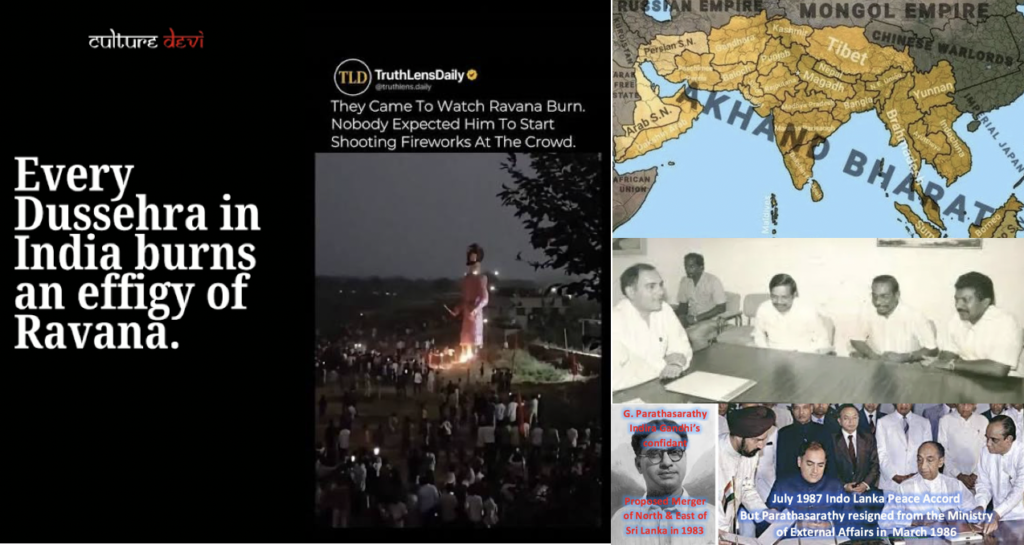
- Cultural programmes that demand promotion of Ramayana Trails as a tourist destination alongside structures to establish the presence which invariably impacts heritage history. Ravana King of Lanka as India’s historic enemy – annually effigy of Ravana is set ablaze.
- Buddhist diplomacy – current Rs.7.7b grant includes proposals to fence sacred Ruwanweliseya, likely new non-Buddhist structures in Anuradhapura and transforming a sacred city into a commercial hub.
- Claims of large numbers of siva lingams imported to be erected across the island – significantly changing the religious ethos of the island.
- Development assistance and economic dependence.
- Institutional exchanges.
- Arkhand Bharath greater India that includes Sri Lanka as part of India.
The December 2024 Joint Statement included training 1,500 Sri Lankan civil servants over five years through India’s National Centre for Good Governance.
Sri Lanka must examine the cumulative effect of external influence across education, public administration, technology, culture, religious and national institutions.
Cooperation must not become dependency.
- THE QUESTION SRI LANKA MUST NOW ANSWER
- India developed political involvement in Sri Lanka’s ethnic conflict.
- Indian agencies trained and supported Tamil militant organisations.
- Tamil Nadu became an important political and logistical base.
- India promoted devolution proposals before the Indo-Lanka Accord.
- India intervened militarily during Operation Poomalai.
- Prabhakaran was brought to India immediately before the Accord.
- India secured a formal role in implementing the settlement.
- Sri Lanka enacted the 13th Amendment and established Provincial Councils throughout the island.
- India subsequently fought the LTTE through the IPKF.
- India’s present engagement extends across energy, infrastructure, defence, digital identity, payments, education and institutional cooperation.
These events must not be examined in isolation.
The question is whether they reveal a consistent pattern of Indian strategic interests being advanced through successive political, military, constitutional and economic arrangements in the guise of friendship & cooperation?
Sri Lanka needs friendly relations with India. But friendship cannot mean surrendering the right to independently determine its constitutional structure, national security, economic priorities, digital systems, education policy and control over strategic assets.
India must be able to pursue its national interests.
Sri Lanka must equally be able to protect its own.
The relationship must be one of sovereign equals, not one in which geographical proximity, economic dependence or historical intervention determines Sri Lanka’s future.
The question is no longer simply what India did in 1987.
It is whether Sri Lanka has understood the consequences of what happened — and whether it is adequately protecting its sovereignty in the agreements being entered into today or are political parties for their own survival ready to barter Sri Lanka?
Shenali D Waduge